
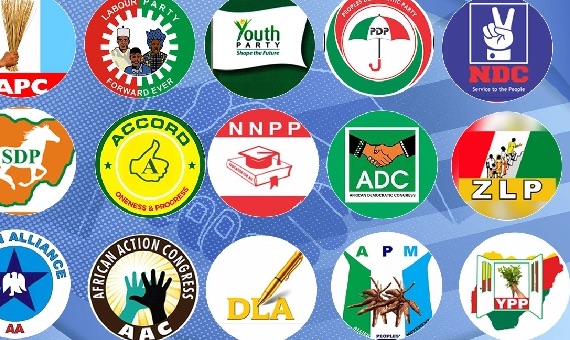
As the 18 political parties cleared to field candidates begin campaigns for the 2027 general elections, questions are mounting over how they will pay for it, with most declining to say where the money will come from.
The concern sits against sharply higher legal ceilings. Under the Electoral Act 2026, which President Bola Tinubu signed in February, the National Assembly doubled the presidential campaign spending limit to N10 billion and raised the governorship ceiling from N1 billion to N3 billion. Senate candidates may now spend up to N500 million and House of Representatives candidates N250 million, while State Assembly contestants are capped at N100 million. The revisions are contained in Section 92 of the Act.
The Independent National Electoral Commission has translated those figures into a collective ceiling. INEC put the combined presidential and governorship spending cap at N571 billion in August, comprising N190 billion across 19 presidential candidates and N381 billion across 127 governorship candidates in 28 states. That is the maximum permitted, not a projection of actual spending.
Attention has centred on the ruling All Progressives Congress, which unveiled Tinubu’s Presidential Campaign Council in August. Opposition figures have alleged that public funds could be channelled into the effort, pointing to serving public officials on the list, among them the Executive Chairman of the Nigeria Revenue Service, Zacch Adedeji, the Director-General of the Budget Office, Tanimu Yakubu, and the Bank of Industry Managing Director, Supo Olusi.
The APC has rejected the claim. Its National Secretary, Senator Ajibola Basiru, who sits on the council, told the Nigerian Tribune that the party would fund its presidential campaign mainly from the monthly statutory dues of its members, which he put at 12.6 million. The party’s Deputy National Publicity Secretary, Duro Meseko, added that it also raised substantial sums from the sale of Expression of Interest and Nomination Forms ahead of its primaries. He described the funding allegations as mischievous and said Tinubu, whom he called a scrupulous leader promoting fiscal discipline, would not approve of dipping into public money.
The Peoples Democratic Party said it would keep within the legal limits but would not disclose its sources. Its National Publicity Secretary, Jungudo Haruna Mohammed, told the same newspaper that the law sets spending ceilings but does not compel parties to reveal how they raise money, describing that as a matter of strategy. He said the party would spend responsibly and within the prescribed limits.
The Labour Party struck a similar note on discretion while promising restraint. Its National Publicity Secretary, Ken Asogwa, said the party’s approach would be cost-effective and conservative but, in his words, lethal.
Civil society groups say the silence is the problem. The Executive Director of the Civil Society Legislative Advocacy Centre, Auwal Musa Rafsanjani, warned that campaign finance is becoming a test of electoral integrity, and that the danger lies not only in excessive spending but in illicit and unexplained money entering politics. He said INEC must monitor finances throughout the campaign rather than collect returns after the vote, and noted that the Commission’s 2026 regulations set a N500 million threshold for contributions by an individual, group or entity to a party or aspirant.
The legal architecture for that oversight rests on Section 91 of the Act, which gives INEC power to cap contributions and demand information on the amount and source of funds. Section 91(2) prescribes a fine of not more than N10 million and forfeiture of the sum donated for a party that exceeds the limit, and a fine of five times the excess for an individual. Analysts have noted that the Act raised the individual donation cap from N50 million under the 2022 law to N500 million.
Enforcement remains the open question. The Director of the Centre for Democracy and Development, West Africa, Dauda Garuba, said campaign finance ceilings had historically been observed more in breach than in compliance, and doubted they would work in 2027 given the difficulty of tracking sources and amounts. The Convener of the Good Governance Team, Tunde Salman, called the N10 billion presidential limit arbitrary, saying it is not tied to measurable indices such as voter numbers, logistics or advertising, and that spending by individual support groups is not captured in candidates’ declared expenses.
The transparency dispute has already reached court. The Socio-Economic Rights and Accountability Project sued INEC at the Federal High Court in Abuja, in suit FHC/ABJ/CS/2114/2026, seeking an order compelling the Commission to disclose whether it has prescribed contribution limits under Section 91 and to publish party financial records for 2023 to 2025.
INEC says it is prepared to act. Its Deputy Director of Publicity, Wilfred Osilama Ifogah, told the Nigerian Tribune that the Commission’s Election and Political Party Monitoring department, guided by the Act and its regulations, is responsible for tracking party finances and campaigns. Whether that machinery can match the scale of a doubled spending regime will not be clear until returns are filed after the 2027 polls.