
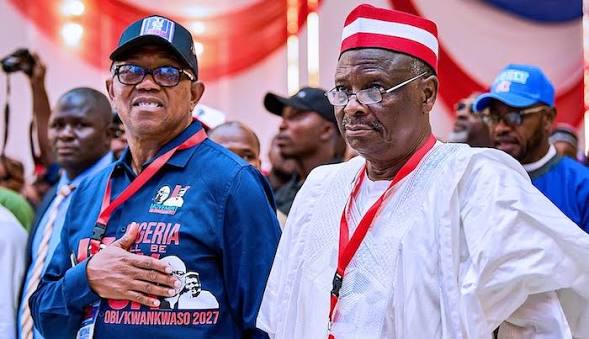
The Obi-Kwankwaso Movement, widely known as the OK Movement, has lost its National Head of Operations, Francis Nnoli, who resigned on Sunday over what he described as a growing disconnect between the group and the Nigeria Democratic Congress ahead of the 2027 general elections.
According to a statement issued by Nnoli, his exit was driven by the need for political discipline, structural clarity and coordination between support groups, candidates and the party. He framed the disagreement as one about how a campaign structure should relate to the platform it works for, rather than a break with the candidates themselves.
“Every support structure established around a political ticket must operate with a clear understanding of its relationship with the political party, its candidates and the broader political mandate it seeks to advance,” Nnoli said in the statement.
At the centre of the dispute is a straightforward question with no agreed answer inside the coalition: whether the OK Movement should run as an independent body or fold formally into the NDC, the party on which Peter Obi and Rabiu Kwankwaso are pursuing a joint presidential bid. Nnoli said the ambiguity had reached a point where he could no longer serve the structure with full confidence.
His resignation did not come out of nowhere. It followed a position attributed to the movement’s Director-General, John Ugulu, that the OK Movement is an independent organisation with no formal relationship with the NDC and does not require the party’s endorsement or directives. That stance set the group on a collision course with the party leadership.
The immediate trigger was a 59-member Presidential Campaign Council unveiled under Ugulu’s name. The NDC leadership dissociated itself from the council, and its National Chairman, Senator Moses Cleopas, said only the appropriate party organs have the authority to constitute and announce such a body.
The movement pushed back hard. In a statement on Saturday, it demanded an apology from Cleopas over remarks it considered defamatory, and insisted it would not be intimidated or surrender its independence. Nnoli’s departure a day later turned an external quarrel into an internal one.
Nnoli was careful to draw a line. He said his resignation was not a rejection of the Obi-Kwankwaso project, reaffirmed his commitment to its broader objective, and urged supporters to avoid parallel structures and statements capable of causing confusion. In his words, the 2027 contest would require “coordination, credibility, discipline, strategic thinking and a clear understanding of how political movements and political parties must work together.”
The friction matters because the NDC has become the main vehicle for one of the more consequential opposition realignments since the last election. Obi and Kwankwaso, who ran separately in 2023 on the Labour Party and New Nigeria Peoples Party respectively, moved to the African Democratic Congress in 2025 before quitting for the NDC in May 2026, with Obi ratified as presidential candidate and Kwankwaso as his running mate on 29 May.
The party has also spent much of the year fighting for its own survival in court. INEC initially declined to register the NDC, but a Federal High Court in December 2025 directed the commission to do so, and the certificate was issued in February 2026. That recognition was thrown into doubt on 26 June, when the same court in Lokoja set aside its earlier judgment.
The uncertainty was only lifted last week. On Friday, 18 September, the Court of Appeal in Abuja, in a majority decision, overturned the Lokoja ruling and restored the party’s registration, holding that the lower court had erred in revisiting its own final judgment. One member of the panel, Justice Okon Abang, dissented. The decision removed a significant obstacle to the party’s participation in 2027, though further appeals cannot be ruled out.
Against that backdrop, an open dispute over campaign authority carries real cost. Support groups such as the OK Movement and the older Obidient network have been central to the mobilisation around Obi, but their energy depends on a clear chain of command once formal campaigning begins. The current standoff exposes what one analysis of the row described as an organisational fault line between grassroots enthusiasm and party control.
For now, both sides say they remain behind the Obi-Kwankwaso ticket even as they disagree publicly over who speaks and acts in its name. The movement has indicated it will hold its structure and continue its activities despite the party’s warning, while Ugulu faces a disciplinary referral from the NDC.
What happens next is unsettled. Whether the party and the movement reach a working arrangement, or the rift hardens into competing camps, will shape how effectively the coalition converts its 2023 momentum into a national campaign. With the election drawing closer and the legal cloud only just cleared, the pressure to resolve the question of structure is unlikely to ease.