
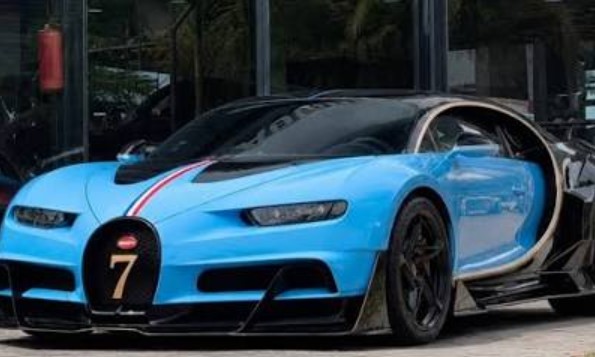
Grammy-winning musician Damini Ogulu, known globally as Burna Boy, took formal delivery of a bespoke Bugatti Chiron VXX hypercar in Lagos on Saturday, 19 September 2026. Dubai-based vehicle customiser Venuum and dealership Abuja Car valued the one-of-a-kind vehicle at roughly nine billion naira. A handover ceremony, broadcast through promotional video clips on social media, showed presenters removing a black silk cover to reveal the machine to the musician. The acquisition caps months of anticipation that began when the singer first commissioned the vehicle for his thirty-fifth birthday in July. Ostentatious wealth remains the ultimate trophy for Nigeria’s global pop elite.
The car itself represents an aggressive exercise in personal branding and mechanical excess. Venuum built the vehicle on the mechanical platform of a Bugatti Chiron Pur Sport, adding an ultra-wide carbon-fibre body kit and bespoke paint scheme. The exterior features a French Racing Blue front fascia, the marque’s signature horseshoe grille bearing a bright yellow number seven, and a tri-colour centre stripe. Custom blue sports seats with gold-threaded geometric embroidery and yellow contrast stitching dominate the cabin. The coachbuilder also emblazoned the singer’s stage moniker across a massive carbon rear wing. Subtle taste clearly took a back seat to unmistakable recognition.
Underneath the custom body panels sits one of the most formidable internal combustion engines ever built. An 8.0-litre quad-turbocharged W16 powerplant churns out 1,500 horsepower through an all-wheel-drive transmission. The vehicle accelerates from zero to 100 kilometres per hour in under two and a half seconds, reaching an electronically restricted top speed of 420 kilometres per hour. Ten radiators cool the massive engine block, and four turbochargers feed it air. Such performance numbers border on the theoretical. Finding open asphalt in Lagos to run through seven gears remains completely impossible.
The transaction highlights the eye-watering sums circulating through the upper ranks of the African music industry. Burna Boy has spent five years headlining sold-out stadiums across London, Paris, and New York, earning foreign exchange receipts that easily dwarf domestic corporate payrolls. Those dollar revenues insulate elite musicians from the harsh currency devaluations that plague the wider Nigerian economy. A factory-standard Bugatti Chiron starts at three million dollars before freight charges, local import duties, and luxury taxes enter the calculation. Custom body conversions in Dubai quickly push the final invoice into eight-figure dollar sums. Global streaming royalty streams make such eye-popping indulgences commercially viable.
The hypercar enters an already crowded private fleet inside the singer’s compound. His personal garage already houses a Rolls-Royce Spectre, a McLaren Senna, a Lamborghini Revuelto, and a Ferrari Purosangue alongside several bespoke SUVs. In West African pop culture, exotic cars do not serve as mere urban transport. They operate as walking billboards of peerless commercial dominance. Musicians treat every vehicle handover as a strategic promotional event, feeding clips to millions of fans on digital video platforms. Raw horsepower functions as the primary visual proof of artistic relevance.
Yet the arrival of a nine-billion-naira track car exposes the surreal contrast of life in commercial Lagos. The metropolis struggles with crumbling municipal drainage, severe road gridlock, and uneven asphalt that can destroy low-slung carbon splitters within metres of leaving a driveway. Keeping an exotic vehicle alive in Nigeria presents a logistical nightmare. Annual routine servicing for a Chiron often exceeds one hundred and fifty million naira, requiring foreign factory technicians to fly into the country with dedicated diagnostic tools. The machine will spend most of its working life idling in traffic or parked behind security gates. Status symbols exist to be seen, not necessarily driven.
The purchase also drew sharp public debate across social channels within hours of the weekend unveiling. Critics questioned the civic morality of displaying a nine-billion-naira foreign vehicle in a country grappling with double-digit food inflation and widespread youth unemployment. Fans countered that the singer earned his wealth legitimately on the international stage without touching public state treasuries. Burna Boy himself has long dismissed criticism of his spending, arguing in recent concert performances that personal success requires no public apology. The luxury machine reflects an unapologetic appetite for individual triumph.
The Bugatti handover marks a symbolic high point in the financial coming-of-age of Afrobeats. A generation ago, Nigerian musical legends struggled with local record piracy, unpaid royalties, and exploitative domestic distribution contracts. Today’s crossover icons negotiate multi-million-dollar global festival runs, sign worldwide distribution pacts, and purchase the rarest automobiles that European luxury houses can manufacture. Damini Ogulu wanted a machine that no other collector on earth could copy. By parking the Chiron VXX in his Lagos garage, he bought himself an unrepeatable seat at the table of global consumer extravagance.