
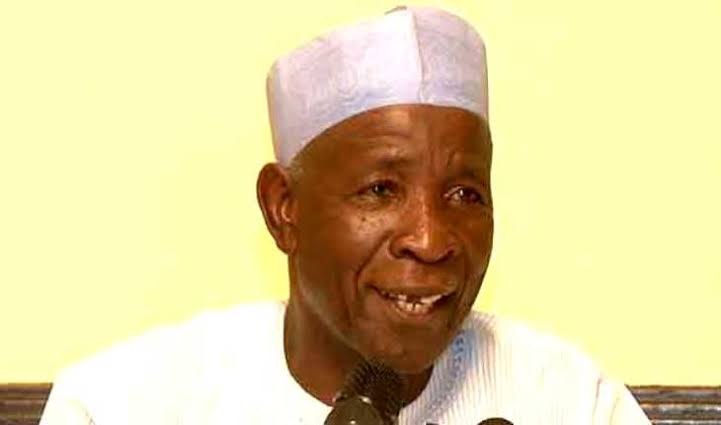
A chieftain of the Nigeria Democratic Congress, Buba Galadima, has accused the All Progressives Congress and the Federal Government of frustrating opposition politicians ahead of the 2027 general elections, alleging that candidates face obstacles and attacks when they try to campaign in parts of the country.
Galadima made the allegations on Tuesday during an appearance on Arise Television’s Prime Time, speaking with roughly 100 days left before the polls. He claimed opposition figures were being stoned in some areas and that the ruling party did not want any opponent to campaign freely anywhere in Nigeria.
“There are blocks put in the path of the opposition. This APC and its government does not want any opposition person to campaign in any part of the country, as they are stoned wherever they go,” he said, adding that the aim was to make life difficult for rivals.
He framed the complaint as a question about the character of the system itself, arguing that a setting in which opponents cannot move and speak freely does not meet the test of democracy. “So, why should we call it democracy? We can just as well call it fascism, or dictatorship, or monarchy,” he said, pointing to free choice, free speech and free movement as rights guaranteed in the constitution.
Galadima also turned part of the blame on the public, saying the restrictions persisted because citizens had allowed them to. The remark sat somewhat at odds with the rest of his argument, which placed responsibility on the authorities, but he did not expand on how the two sat together.
The allegations are serious and, as presented, remain unverified. Galadima named no specific candidate, date or location for the attacks he described, and offered no documentary evidence during the interview. The APC had not responded to the claims at the time of writing, and the account rests on his word as an interested party, given that the NDC is fielding the Peter Obi and Rabiu Kwankwaso ticket for 2027.
A second strand of his argument touched on campaign finance, where the figures are easier to test. Galadima said the Electoral Act caps campaign spending at N10 billion, yet a single billboard in some states could cost as much as N1 billion. “Do you know how much they are asking for one billboard in Abuja? In Imo, it is N1 billion. One billboard, not the whole state,” he said, arguing that billboards across 37 locations could push a campaign past the legal ceiling.
The N10 billion figure is accurate but applies differently from the way he framed it. Section 92 of the Electoral Act 2026, which President Bola Tinubu signed into law in February, sets N10 billion as the maximum a presidential candidate may spend, not a limit on a political party as a whole. The law doubled the presidential ceiling from the N5 billion allowed under the 2022 Act, citing inflation and rising campaign costs. It also raised the governorship limit to N3 billion, Senate to N500 million, and House of Representatives to N250 million.
His billboard arithmetic should also be read as an illustration rather than a settled cost. The N1 billion per board figure is his own claim, not an independently confirmed market rate, and advertising prices vary widely by state, location and the length of a booking. The broader point he was making, that compliance with the spending cap is difficult to monitor, is one that electoral observers have raised separately.
Enforcement has long been the weak link in Nigeria’s campaign finance rules. The Independent National Electoral Commission has powers under the Act to limit donations and demand records of amounts and sources, with penalties including fines and forfeiture of excess sums. In practice, analysts have repeatedly noted that the commission has struggled to track actual spending, and the ceilings tend to be revised upward each cycle without a matching improvement in oversight.
The timing gives the comments weight. Campaigning for the presidential and National Assembly elections opened in August, and parties have only a few months to reach voters before the 2027 polls. Complaints about an uneven field, access to venues and the cost of reaching the electorate are likely to grow louder as that window narrows.