
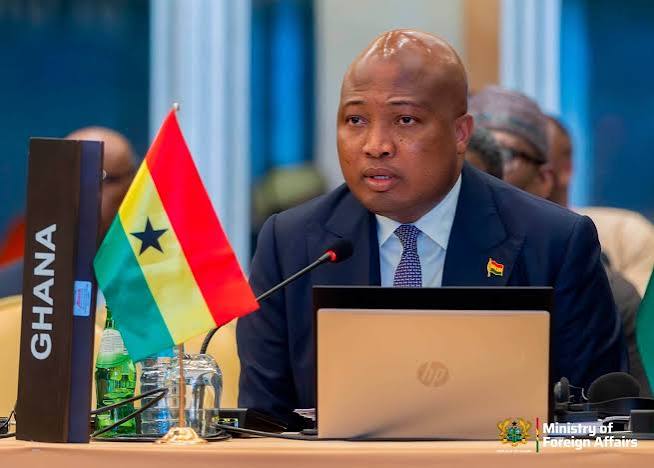
Ghana’s cabinet has approved a decision to formally apply to join BRICS, the country’s Foreign Affairs Minister, Samuel Okudzeto Ablakwa, announced on Tuesday, 6 October 2026, placing a second West African state firmly within reach of the bloc that already counts Nigeria among its partners.
Ablakwa disclosed the decision at a joint press briefing in Accra with India’s visiting External Affairs Minister, Subrahmanyam Jaishankar. In his words, the cabinet of President John Dramani Mahama “has decided that Ghana should put in a formal application to join BRICS.” He said Accra had already sought India’s backing for the bid.
The minister framed the move as an effort to broaden Ghana’s economic and diplomatic options rather than a break with existing allies. He argued that BRICS offered the country room to pursue its development agenda on wider terms, while stressing that Ghana would not walk away from its traditional partners. He also noted that Ghana maintained good relations with all the bloc’s founding members and several of its newer entrants.
Economics sat at the centre of his case. Ablakwa said trade between Ghana and India had more than doubled, from around three billion dollars in 2024 to about seven billion dollars currently, while China remained a major economic player in the country. He added that the two governments were working to deepen cooperation in areas including railways, pharmaceuticals, information and communications technology, and defence.
For his part, Jaishankar said India welcomed Ghana’s aspirations and had consistently supported the country’s development goals. He was careful, however, to note that admission was not India’s to grant alone, saying membership would require consideration by the wider BRICS grouping. India currently holds the bloc’s rotating chair for 2026 and hosted its 18th summit in New Delhi in September.
That caveat matters, because entry into BRICS is decided by consensus among its full members, and the announcement from Accra is a statement of intent rather than a settled accession. Ablakwa did not give a date for when the formal application would be submitted, nor did he specify whether Ghana was seeking full membership or the lower tier of partner status. The September summit in New Delhi closed without announcing any new expansion, and the bloc has set no public timetable for admitting further countries.
Understanding where Ghana would fit requires a look at how the group has grown. BRICS began as an association of Brazil, Russia, India and China, with South Africa joining in 2011. A larger expansion took effect from January 2024, when Egypt, Ethiopia, Iran, Saudi Arabia and the United Arab Emirates became members, and Indonesia followed as a full member in January 2025, bringing the count of full members to eleven.
Alongside that core, the bloc created a separate partner country category at its 2024 summit in Kazan, designed to admit interested states without immediate full accession. Ten partner countries now hold that status, namely Belarus, Bolivia, Cuba, Kazakhstan, Malaysia, Nigeria, Thailand, Uganda, Uzbekistan and Vietnam. The tier functions as a structured on ramp, allowing countries to join working groups and ministerial meetings without taking on the full political obligations of membership.
The Nigerian angle is direct. Nigeria accepted an invitation to become a BRICS partner country in January 2025, making it one of the African states already inside the framework that Ghana now wants to enter. New Delhi has described Nigeria as a strategic partner and a leading candidate for fuller African representation within the bloc, which gives Abuja a stake in how the group’s next phase of expansion unfolds and in the terms on which fellow West African economies are admitted.
The appeal for emerging economies lies partly in what the bloc now represents in scale. Taken together, its members and partners account for a substantial share of global output and trade, and the group has positioned itself as a platform for countries seeking alternatives to Western dominated financial and diplomatic institutions. For a country such as Ghana, which leaned on external support during its recent fiscal difficulties, the prospect of additional development financing and new trade channels carries clear attraction.
There are also wider considerations that any applicant weighs. Closer alignment with BRICS can introduce friction with established partners in the West, and the bloc’s consensus based decision making means an applicant’s progress can be slowed by the competing interests of existing members. These are among the factors that will shape how quickly, and on what footing, Ghana’s request advances once it is formally lodged.