
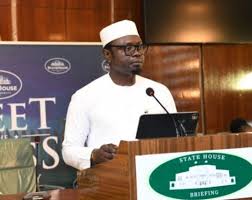
The Federal Government has fixed October for a National Youth Confab and pledged that its outcomes will translate into policy rather than gather dust, the Minister of Youth Development, Ayodele Olawande, said in Abuja.
Olawande unveiled the plan on Thursday at the Presidential Villa, describing the gathering as an attempt to move young Nigerians from passive commentary to a direct role in shaping decisions. Themed “Next-Gen Nigerian: Crafting Solutions, Owning the Future,” it is open to citizens aged 18 to 35.
“This is not just another youth conference. It is not just to come and deliver speeches,” Olawande said, according to the account of his briefing. He added that the intention was to move “from conversation to real action,” and stated plainly, “enough of talking. We want to see the action.”
By his account, the process will run in two stages. About two weeks of virtual consultations will come first, followed by a physical conference in Abuja drawing delegates from the country’s 360 federal constituencies, Nigerians in the diaspora and other stakeholders.
The minister said a dedicated portal, to be managed by the National Information Technology Development Agency, would handle online participation, receive policy proposals and collate contributions ahead of the physical meeting. Organisers, he added, would reach out to young entrepreneurs, farmers, students, artisans and technology innovators, including those who feel shut out of national conversations.
On selection, Olawande said the process would prioritise transparency, merit and grassroots representation, alongside gender balance, religious inclusion and participation by young people with disabilities and other marginalised groups.
He listed six priority areas for the deliberations: governance, leadership and political participation; economic transformation, entrepreneurship and job creation; education and skills; technology, innovation and digital transformation; climate change and energy transition; and social harmony and security.
Speaking for the Presidency, the Senior Special Assistant to the President on Digital and New Media, O’tega Ogra, said the administration had reviewed earlier youth conferences and was determined to avoid their shortcomings. He said President Bola Tinubu had deliberately created more space for young Nigerians in governance.
The Special Assistant to the President on Social Media, Segun Dada, echoed that position, saying the government did not want the conference to end as another documentation exercise. The Permanent Secretary in the Ministry of Youth Development, Dr Maryam Ismaila Keshinro, said the youths would lead the process while the ministry provided institutional coordination.
The pledge to implement resolutions speaks to a recurring frustration in Nigerian public life, where the reports of major national gatherings have often been shelved. The 2014 National Conference convened under former President Goodluck Jonathan produced a detailed report whose recommendations were never formally adopted, and calls to revisit it have surfaced repeatedly. That history is part of why organisers of the current confab have stressed action over paperwork.
The October event is not an entirely new idea. Tinubu first signalled a National Youth Confab in his Independence Day address on 1 October 2024, and inaugurated a planning committee at the State House in March 2025, when he told members, “You are the hope of this country, everything hangs on your future.” The government also opened a registration portal for a 2025 edition of the confab in June last year, built around a similar structure of diaspora engagements, constituency consultations and a final conference in Abuja.
The demographic case for the exercise is substantial. The government has previously put the share of Nigeria’s population under the age of 35 at more than 70 per cent, a figure the ministry has used to argue that youth participation is central to the country’s economic and political future. That scale gives the conference its weight, though the test will be whether ideas raised through the portal survive into concrete measures.
A note of caution has come from within the planning process itself. Samson Itodo, a member of the earlier planning committee and Executive Director of Yiaga Africa, urged in 2025 that the confab be kept fully insulated from partisan politics to serve its purpose. That concern remains relevant as the 2027 general election approaches and youth mobilisation becomes a contested space.
Separately, the Social Democratic Party presidential candidate, Adewole Adebayo, used a visit by the Young Progressive Professionals to the party’s national secretariat in Abuja to press young Nigerians to build institutions rather than merely inherit them. He said the younger generation could not remain on the sidelines while decisions affecting their future were taken, and urged the group to carry conversations about governance into communities across the country.
For now, the confirmed elements are the October timing, the two-stage structure and the six thematic areas. Whether the gathering delivers the policy outcomes the government has promised, and avoids the fate of past national conferences, will only become clear after the Abuja sessions conclude and any resolutions are placed before decision-makers.
.