
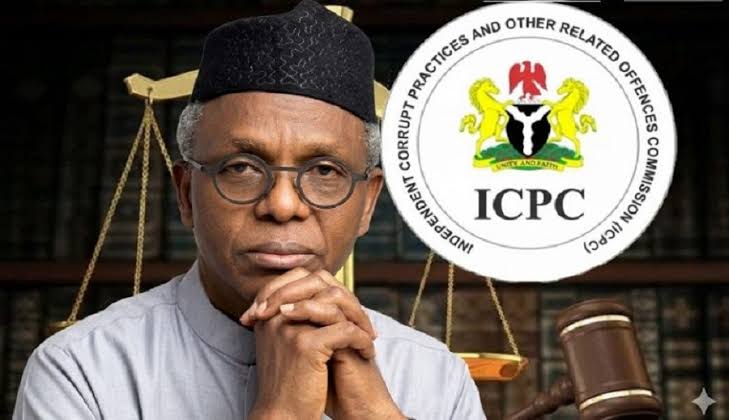
The Federal High Court in Abuja has dismissed a suit filed by former Kaduna State Governor Nasir El-Rufai seeking to restrain the Independent Corrupt Practices and Other Related Offences Commission and other federal agencies from freezing his bank accounts or seizing his assets, in a ruling that further complicates the legal position of the detained former governor.
Justice Joyce Abdulmalik, in a judgment delivered on Thursday, held that the suit, marked FHC/ABJ/CS/368/2026, not only lacked merit but was speculative, as the applicant failed to disclose any reasonable cause of action against the agencies he listed as defendants. Consequently, the Economic and Financial Crimes Commission, the Department of State Services and the Attorney General of the Federation were struck out from the case. The court agreed with the respondents that the suit constituted an abuse of the court’s process, since El-Rufai had filed a similar suit before the High Court of the Federal Capital Territory. The judge further held that no citizen could use a court of law to prevent law enforcement agencies from carrying out their statutory responsibilities.
El-Rufai, in the suit he filed on February 24, had sought an interim injunction directing the respondents to maintain the status quo ante regarding his assets. He argued that the order was necessary to prevent him from being placed in a state of helplessness. He insisted that the severance pay he received upon completing his tenure as governor of Kaduna State between 2015 and 2023 could not reasonably be suspected to be proceeds of any unlawful activity, and urged the court to declare that properties purchased from that severance pay were lawfully acquired.
The banks he sought to protect included Zenith Bank Plc, Naira Account Number 1007158671; Zenith Bank Plc, Domiciliary Account Number 5071511327; Guaranty Trust Bank Plc, Account Number 0023824978; Access Bank, Dollar Account Number 1396386493; and Access Bank, Naira Account Number 1396382103.
El-Rufai had also sought a declaration that any attempt by the respondents to apply for, obtain or execute any interim or final forfeiture or freezing order, without first establishing a reasonable suspicion supported by credible evidence as required by relevant law, would amount to a breach of his rights. He relied on Section 17(1) of the Advance Fee Fraud and Other Related Offences Act, 2006, and the Supreme Court decision in Melrose General Services Ltd v. EFCC (2024), to argue that as a Nigerian citizen he is entitled to the presumption of innocence and the protection of his fundamental rights. He contended that any action by the respondents seeking to circumvent those rights through ex parte applications that conceal material facts would amount to a breach of Section 36(5) of the Constitution and a violation of the principles of fair hearing.
The ruling is the latest development in a protracted legal battle that began in February 2026, when El-Rufai was taken into the custody of the ICPC. He has now spent more than seven months in detention. The ICPC has arraigned him before the Federal High Court in Kaduna on a 10-count charge bordering on abuse of office, money laundering and fraud. According to the charge sheet marked FHC/KD/73/2026, the commission alleges that El-Rufai, in September 2020 and January 2023, received the sum of N289,826,998.12 on each occasion as severance allowance, far exceeding the legally entitled sum of N20,013,245.00, which represents 300 per cent of his annual basic salary. The total severance pay received was N579.7 million, against the approximately N40 million to which he was entitled.
The charge further alleges that between 2016 and 2023, the former governor took control of various sums in United States dollars through his domiciliary account with Guaranty Trust Bank, including $320,800 allegedly paid in tranches by a co-defendant, Joel Adoga, as well as other deposits amounting to $155,800, $305,300, and several smaller sums from different individuals, all reasonably suspected to be proceeds of unlawful activities. Adoga was also accused of conspiring with the former governor in July 2019 to disguise the origin of $10,000 deposited into the account. Both defendants pleaded not guilty to all counts.
The ICPC subsequently revised its prosecution strategy, filing an amended nine-count charge on April 10, 2026, before the Kaduna State High Court, dropping the earlier money laundering allegations and introducing a fresh set of corruption, fraud, procurement and abuse of office offences. The amended charge, marked KDH/KAD/ICPC/01/2026, now alleges that El-Rufai induced the Kaduna State Government to confer a benefit of N11 billion on Indokaduna MRTS JV Nigeria Limited for the construction of a light rail project that was never executed, an offence charged under the Advance Fee Fraud and Other Fraud Related Offences Act, 2006. It also alleges that he used his position as governor to confer a corrupt advantage upon himself by knowingly approving and receiving the sum of N289,826,998.12 as severance allowance over and above his legitimate entitlement of N20,013,245.00.
The legal framework underpinning the case has drawn significant judicial attention in recent years. Section 17(1) of the Advance Fee Fraud and Other Related Offences Act empowers the EFCC and the ICPC to approach any High Court through an ex parte application to secure an interim forfeiture order against any unclaimed property or property reasonably suspected to be derived from unlawful activities. The provision has been criticised by some judges for being invoked too readily. In the Melrose General Services case, the Supreme Court, by a majority of three to two, allowed an appeal and dismissed an application by the EFCC, ruling that the commission had failed to prove that the funds in question were proceeds of fraud. The court ordered the release of the full amounts to the rightful owners.
In a separate development, El-Rufai is pursuing a N1 billion fundamental rights suit at the Federal High Court in Abuja over an alleged unlawful invasion of his house by ICPC operatives in February. He has also filed another N1 billion rights enforcement suit against the ICPC, its chairman and the Attorney General of the Federation over the denial of access to his family members while in custody in July. The ICPC has urged the court to dismiss that suit, arguing that it is empowered to establish protocols within its facilities to prevent security breaches. The commission said it adopted a temporary access control measure after it received reports that a medical visit had turned into a political meeting, breaching its security protocol.
The broader context of the case is the ongoing scrutiny of former governors in Nigeria. The EFCC has announced the successful prosecution of several former governors and ministers over the past year, with recoveries running into hundreds of billions of naira. The ICPC has also secured convictions in high-profile cases, including the forfeiture of properties belonging to the Yar’Adua Foundation. The El-Rufai case, however, is unusual in its duration and profile. The former governor served two terms from May 2015 to May 2023 and was a prominent figure in the ruling All Progressives Congress before falling out with the party’s leadership.
The court’s ruling on Thursday does not determine El-Rufai’s guilt or innocence on the corruption charges. It merely holds that his attempt to preemptively restrain the anti-graft agencies from freezing his assets was premature and speculative. The criminal trial in Kaduna and the various fundamental rights suits will proceed separately. What the ruling does establish is that the courts will not readily bar law enforcement agencies from exercising their statutory powers of investigation and asset preservation, even when the subject of those powers is a high-profile former public official. For El-Rufai, who remains in ICPC custody, the legal path ahead remains contested and uncertain.