
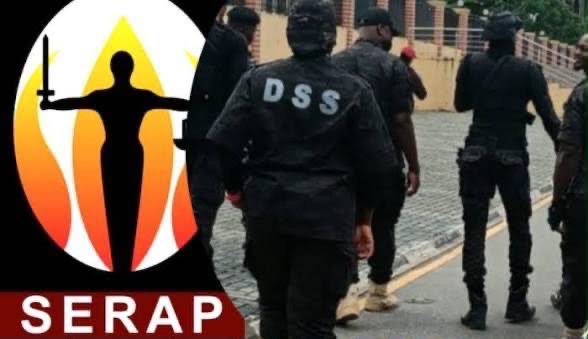
The Court of Appeal in Abuja on Tuesday reserved judgment in the appeal by the Socio-Economic Rights and Accountability Project against a ₦100m defamation award won by two officials of the Department of State Services. The decision will settle, at least at the appellate level, one of the most closely watched legal contests between a civil society group and the country’s secret police. A three-member panel led by Justice Danlami Senchi said the date for judgment would be communicated to the parties.
The case grew out of a visit by DSS operatives to SERAP’s office in Wuse Zone 1, Abuja, on September 9, 2024. That same day, SERAP said on X that DSS officers were unlawfully occupying its office and demanding to see its directors. The incident came shortly after the group urged President Bola Tinubu to direct the NNPC to reverse a petrol price increase and to investigate alleged corruption in the company.
The DSS did not deny the visit. In a statement on September 10, 2024, it said two unarmed operatives had been sent on a routine investigation, and rejected claims of harassment and intimidation. SERAP has since accused the agency of giving conflicting accounts, arguing that the DSS later told the court the visit was a familiarisation call on the organisation’s new leadership.
The two officers, Sarah John and Gabriel Ogundele, then sued SERAP and its Deputy Director, Kolawole Oluwadare, in suit CV/4547/2024 at the FCT High Court. They sought damages running into more than ₦5bn, as well as a public apology. On May 5, 2026, Justice Yusuf Halilu found SERAP and Oluwadare liable for defamation.
The judge awarded ₦100m in general damages and ₦1m in costs, bringing the total to ₦101m. He ordered 10 per cent annual interest on the judgment sum until it is paid, which on the face of the order adds ₦10m for every year the debt remains outstanding. SERAP was also directed to publish an apology on its website and X account, in two national newspapers and on two television stations.
“Having been unable to establish invasion and harassment, the defence of justification fails,” Justice Halilu held. He said the publication had affected the claimants mentally and psychologically, and urged SERAP to exercise greater care before releasing information to the public. The award amounts to less than two per cent of the sum originally claimed, but it remains one of the largest defamation judgments against a Nigerian rights group in recent years.
SERAP rejected the judgment the day it was delivered. One of its lawyers, Ebun-Olu Adegboruwa, SAN, described it as “very dangerous for our democracy as it can be used to silence NGOs.” He argued that the officers did not establish their ranks or earnings before the court, which he said should guide any award of damages, and that there was no basis for the 10 per cent interest.
The group filed its appeal, marked CA/ABJ/CV/1114/2026, on May 8 through Tayo Oyetibo, SAN. Oluwadare filed a separate appeal. The panel had earlier reserved judgment on SERAP’s appeal, but on October 9 it vacated those proceedings and fixed October 13 for both appeals to be heard together, after counsel to Oluwadare said his brief had only just been served on the respondents.
At Tuesday’s hearing, Oyetibo argued that the trial court lacked jurisdiction to award damages to Sarah John over a publication said to refer to a “Sarah David”. He questioned how the court verified the description of a “tall, large, dark-skinned” woman without a photograph. SERAP’s central argument is that its publication named neither officer and contained nothing capable of identifying them personally.
The group has also pointed to a letter written on September 17, 2024 by the DSS counsel, Dr Alex Izinyon, SAN. According to SERAP’s court filings, that letter stated that the publication was made about the DSS as an institution, not the two officials. SERAP contends this undermines the officers’ claim that the statement was about them.
Counsel to the respondents, O.S. Kehinde, urged the court to dismiss the appeal. He argued that SERAP failed to prove that Sarah John and Sarah David were different persons. He also told the court that a person can be identified from a publication through a description, even where the name is not stated.
The panel struck out applications by Columbia University, the United Nations Special Rapporteur on the rights to freedom of peaceful assembly and the Southern Africa Litigation Centre, which sought to join the appeal as friends of the court. The applicants withdrew after the panel said it saw “no need” for their intervention. Whichever way the court rules, the losing side retains the option of a further appeal to the Supreme Court.