
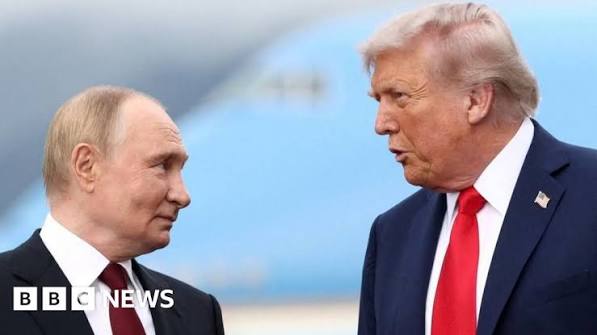
Ukrainian President Volodymyr Zelensky on Saturday accused US President Donald Trump of rewarding Vladimir Putin, a day after Trump signed an executive order waiving a sweeping package of sanctions aimed at Russia’s energy earnings. Zelensky said the waiver came on the same day Russia struck 15 critical power generation facilities across Ukraine, in what he described as one of the largest attacks yet on the country’s energy grid. Easing pressure on the aggressor, he warned, “only encourages him to keep attacking.”
“Russia is trying to leave millions of our people without electricity and heating,” Zelensky said in a post on social media. He said the sanctions law “could have helped enormously” in forcing an end to the war, and urged allies to keep up pressure on Moscow. Last winter, hundreds of thousands of Ukrainians were repeatedly left without heat and power in freezing temperatures.
The law at the centre of the row is the Lindsey O. Graham Sanctioning Russia and Iran Act of 2026, named after the late South Carolina senator who championed it. Congressional records show it passed the Senate by 86 votes to 11 on August 7 and the House by 262 votes to 159 on September 16, before Trump signed it on September 18. The act targeted Russia’s energy and defence sectors, Putin himself and the “shadow fleet” of tankers Moscow uses to dodge Western sanctions. It also directed the president to impose tariffs of up to 100 per cent on the five biggest importers of Russian oil or gas, and extended the Iran Sanctions Act to 2031.
Trump’s order, signed on Friday, invoked the law’s national interest waiver just two days before its October 18 implementation deadline. “I am hereby waiving the application of such sanctions, restrictions, and duties provided for in the Graham Act,” the order states. Sanctions imposed under earlier executive orders remain in force, including those Trump placed on Russian oil giants Rosneft and Lukoil in October 2025. However, the waiver frees the administration from the new penalties the law required, a move condemned by Senator Richard Blumenthal, the Connecticut Democrat who helped draft it.
The waiver followed a fuel deal with Moscow. On October 9, Trump announced that Putin had agreed to immediately supply more than 300,000 tonnes of diesel, roughly 2.25 million barrels, to the United States. The Treasury Department then issued a licence easing sanctions on Russian diesel until April 2027, the first such relief to run beyond the usual 30-day window since the war began. Trump has presented the arrangement as a way to bring down fuel prices before the November 3 midterm elections, although a series of 30-day waivers on Russian oil earlier this year did little to halt rising prices.
Kyiv has rejected both moves. Zelensky described the diesel deal as “an obvious weakness” and has refused Trump’s demand that Ukraine stop striking Russian refineries unless Moscow agrees to do the same. He also said in an interview this week that he felt betrayed by the president’s decision.
Moscow welcomed the waiver. “The Trump administration’s suspension of the Graham Act is an important and truly historic moment,” said Kirill Dmitriev, Putin’s special envoy, adding that the law would have seriously damaged the US economy and global markets. The Kremlin had not formally reacted by Saturday. On Friday, Putin, dressed in military uniform, told army commanders that “one of the main objectives remains the liberation of the Donetsk People’s Republic,” using the Kremlin’s name for Ukraine’s eastern Donetsk region.
The fighting has not paused. Ukrainian officials said a Russian strike on the southern city of Kherson on Saturday killed one person and wounded 22 others, including two children, while another person was killed in the northeastern city of Sumy. The war, now in its fifth year since Russia’s full-scale invasion in February 2022, has killed hundreds of thousands of people and displaced millions, and US-led peace talks have yet to produce a breakthrough.
European leaders closed ranks around Zelensky at a European Union summit in Brussels on Friday, where he urged them to keep financing Ukraine’s defence. “This is no time to withdraw the support to Ukraine. This is no time to relieve Russia’s sanctions,” said European Council President Antonio Costa. “Now it is time to increase our support, to increase our pressure.”
What happens next may rest partly with Congress. A 2017 law signed by Trump during his first term requires congressional review of significant changes to Russia sanctions, though no move to challenge the waiver had been announced by Saturday. For Ukraine, the more immediate test is whether its battered grid can hold through the coming winter.