
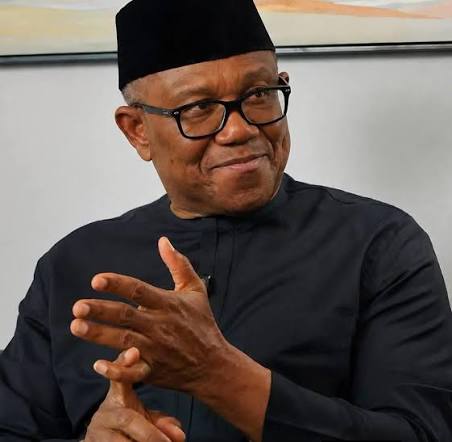
Peter Obi, presidential candidate of the Nigeria Democratic Congress (NDC), has vowed that anyone who rigs elections, including officials of the Independent National Electoral Commission (INEC), will go to jail if he becomes president. The former Anambra State governor made the pledge on Wednesday at an NDC town hall meeting in Nasarawa State. His comments came exactly 80 days before Nigerians vote in the January 16, 2027 presidential and National Assembly elections.
Obi was responding to a question from the audience on what the party would do about election rigging. “You didn’t ask about what we are going to do if people rig election next year. Let me assure you, number one, this coming election, we will rig those who rig it,” he said. He did not explain further what he meant by the phrase. “And let me assure you number two, if I’m elected the President of Nigeria, nobody will rig election in this country again because the first thing we need to do is to strengthen our parties, strengthen the process,” he added.
The NDC candidate also proposed stricter eligibility rules for anyone seeking elective office. “Our laws will be strict. For you to contest election, you must have attended a primary school, you must have attended a secondary school and it will be visible, it will be clear,” he said. He warned that anyone who forged a certificate would face prison, and extended the threat to election officials. “Any INEC official, anybody who is involved with elections under my watch that rigs elections will go to jail,” Obi declared.
He said his approach would rest on the rule of law, with no one exempt from accountability. “Nobody must be above the law; nobody will behave rascally,” he said. Obi described his campaign as part of an effort to change the country, adding that “a new Nigeria is possible.”
Electoral integrity has been central to Obi’s politics since 2023. In that year’s presidential election, INEC declared Bola Tinubu of the All Progressives Congress winner with 8,794,726 votes, ahead of Atiku Abubakar of the Peoples Democratic Party with 6,984,520 votes. Obi, then of the Labour Party, came third with 6,101,533 votes, about 25.4 per cent of valid votes cast. Turnout was 26.7 per cent of the 93.4 million registered voters, one of the lowest since 1999.
Obi challenged the outcome in court, arguing among other things that INEC failed to upload polling unit results to its Result Viewing Portal (IReV) as promised. The Supreme Court dismissed his appeal on October 26, 2023, holding that the electoral law at the time did not make electronic transmission mandatory. That gap became one of the main arguments for reform over the next two years.
The rules have since changed. President Tinubu signed the Electoral Act 2026 into law on February 18, 2026, repealing the 2022 Act. Section 60(3) of the new law now requires presiding officers to transmit polling unit results electronically to IReV, although the manually completed Form EC8A becomes the primary source for collation where transmission fails because of communication problems. Legal analysts have noted that the provision sets no time limit for the upload.
The new Act also raises penalties. Under Section 60(6), a presiding officer who wilfully frustrates electronic transmission faces six months in prison, a fine of ₦500,000, or both. According to Senate Leader Opeyemi Bamidele, offences such as impersonation and result manipulation now attract up to two years’ imprisonment. Anyone convicted of vote buying also faces a 10-year ban from contesting elections.
Obi’s certificate proposal would go beyond the current constitutional requirement. Sections 131 and 318 of the 1999 Constitution require a presidential candidate to be educated up to at least School Certificate level or its equivalent, a standard that has been tested repeatedly in pre-election and post-election litigation. Obi wants proof of both primary and secondary school attendance to be clear and verifiable.
Whether stiffer laws will translate into convictions remains an open question. Prosecuting electoral offenders currently falls largely on INEC, which has for years called for a separate Electoral Offences Commission, arguing that it lacks the capacity to handle prosecutions on its own. Any president seeking to jail offenders would depend on investigators, prosecutors and the courts, not on executive power alone.
Obi is running on the NDC ticket with former Kano State governor Rabiu Kwankwaso as his running mate. Eighteen candidates are on the ballot for the presidential election, and campaigns, which began on August 19, must end 24 hours before polling day. Governorship and State Houses of Assembly elections will follow on February 6, 2027.