
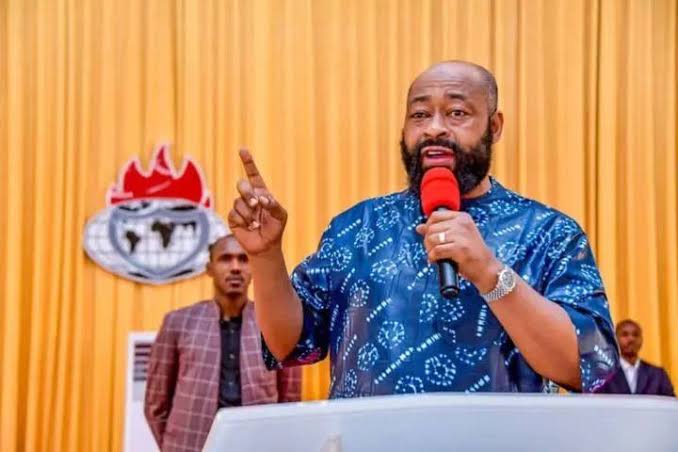
Niger State Governor Mohammed Bago, a Muslim, joined worshippers on stage at a Christian gospel concert in Minna and sang praise songs with the congregation, a gesture he presented as a show of unity at a time when Nigeria’s religious divisions are under unusually close international scrutiny.
Bago performed three numbers, among them the worship song “I’m a New Creation,” during the eighth edition of SHOUT, an annual gospel concert organised by House on the Rock Minna at the Trade Fair Complex. A video of his appearance circulated widely online, showing him leading the crowd through the song’s refrain about being born again. Convened by Pastor Peterock Sadiq, the event also featured the preacher Apostle Joshua Selman. The governor told the gathering it was “a season we must rejoice.”
His presence was not a first. House on the Rock Minna said in a Facebook post that Bago had supported the Christian community and attended SHOUT for four years, missing only the seventh edition, and described his latest appearance as a continuation of that relationship rather than a campaign stop. At earlier editions he has used the platform to preach coexistence, urging residents to live in unity regardless of faith and calling on Christian and Muslim clerics to promote peace rather than division.
Bago, born in Minna in 1974 into a devout Muslim family linked to the Masaba royal house of Bida, is a former member of the House of Representatives for Chanchaga. He was elected governor on the All Progressives Congress platform in March 2023 and took office that May. Widely known as the “Farmer Governor” for his focus on agriculture, he has spoken before about attending a missionary school without it altering his Islamic faith, and has argued that religion should never be forced on anyone. At a Living Faith Church service in Minna he once described himself as “born again,” a remark that drew mixed reactions and prompted some clerics to note that a verbal declaration does not amount to religious conversion.
The setting gives the moment its weight. Niger State is predominantly Muslim with a sizeable Christian minority, and sits along the belt where Nigeria’s Muslim north meets its Christian south. Nationally the population is split almost evenly between the two faiths. Pew Research Center estimates put Muslims at about 51 per cent and Christians at roughly 47 per cent, with both communities among the largest of their kind in the world. Between 2010 and 2020, by the same estimates, Nigeria’s Muslim population grew to about 120 million and its Christian population to about 93 million.
That delicate balance has become a diplomatic flashpoint. In late October 2025 the United States redesignated Nigeria a Country of Particular Concern over what it called severe violations of religious freedom and the persecution of Christians, a status whose first anniversary fell this month. American lawmakers have since pressed to tie portions of US assistance to demonstrable steps to protect Christian communities. The Federal Government has rejected the framing, maintaining that terrorism, banditry and communal violence in the country claim Christian and Muslim lives alike rather than amounting to targeted religious persecution.
Against that backdrop, the image of a northern Muslim governor singing gospel songs and preaching unity carries a political charge it might not have held a few years ago. Niger has largely been spared the mass attacks seen in some neighbouring states, and Bago has repeatedly leaned on interfaith gatherings to project a message of tolerance.
His record on religion is not uniformly liberal, however. In 2025 his administration moved to require preachers in the state to submit sermons for approval, a security driven measure that unsettled some religious leaders who saw it as overreach. Supporters cast his concert appearances not as conversion but as solidarity, an elected Muslim leader signalling that the state belongs equally to Christians.
For House on the Rock and its thousands of worshippers, the governor’s return to the stage was both celebration and statement. For a country whose unity is being questioned far beyond its borders, a Muslim governor singing of a new creation offered a small, pointed counter image to the narrative of a nation divided by faith.