
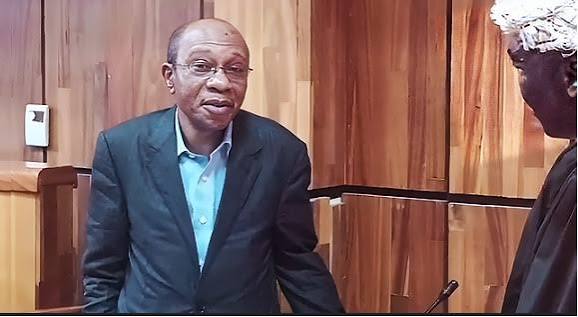
A former Governor of the Central Bank of Nigeria, Godwin Emefiele, allegedly used associates, including a lawyer, to acquire multi-billion-naira properties through proxies while in office, an investigator with the Economic and Financial Crimes Commission has told the Ikeja Special Offences Court in Lagos.
The witness, Alvan Gurumnaan, who led the EFCC special operations team that investigated the matter, testified before Justice Rahman Oshodi as the trial of Emefiele and his co-defendant, Henry Omoile, resumed this week. He said assets traced to the former apex bank chief had been recovered in Lagos, Delta, Ogun and Abuja, and that more than $2m in cash was found in the office of a lawyer, Ifeanyi Omeke, who allegedly admitted acting as a front and receiving money on Emefiele’s behalf.
Led in evidence by the Director of Public Prosecutions of the Federation, Rotimi Oyedepo (SAN), Gurumnaan alleged that Emefiele used his position to create a system that made it difficult for ordinary Nigerians and businesses to access foreign exchange for legitimate needs. According to him, some businessmen were pushed into special arrangements before they could obtain forex. He cited one company that allegedly paid millions of dollars through an Emefiele aide, Monday Osazuwa, who he said admitted receiving about $17m and passing it on.
The investigator listed properties he said were acquired through associates, among them twin duplexes in Lekki Phase 1, two mansions on Queen’s Drive in Ikoyi, a block of eight flats on Adekunle Lawal Street in Ikoyi, a factory under construction in Agbor, Delta State, a warehouse in Ogun State, an 11-storey building of about 94 luxury flats in Ikoyi, an industrial park in Amuwo Odofin, and an estate of roughly 750 housing units in the Lokogoma district of Abuja. He told the court their value far exceeded Emefiele’s legitimate earnings as governor.
Emefiele is standing trial on a 19-count charge bordering on gratification, corrupt demands and abuse of office involving sums put at $4.5bn and N2.8bn. Omoile faces a three-count charge of unlawful acceptance of gifts. Both men pleaded not guilty when the matter first came before the court, and they deny any wrongdoing.
Lawyers for the two defendants, Ojo Olalekan (SAN) for Emefiele and Kazeem Gbadamosi for Omoile, objected to the testimony, arguing that the prosecution was introducing facts outside the proof of evidence served on the defence. They relied on provisions of the Administration of Criminal Justice Law and submitted that the properties mentioned had no established link to the charges. Oyedepo countered that the evidence was relevant because the prosecution’s case is that Emefiele acquired assets with proceeds of gratification, and that the defence would be free to test the claims under cross-examination.
Justice Oshodi overruled the objection, relying on the Supreme Court decision in Ugwuma v. The State, which held that an investigating officer may give evidence of what he personally discovered during an investigation. The judge allowed the witness to continue, with the defence retaining the right to cross-examine, and deferred a decision on a disputed certified copy of a Supreme Court judgment until the next sitting.
The case is one strand of a wider legal pursuit of the former governor, who led the CBN from 2014 until his suspension in 2023 and his arrest by the Department of State Services. He was first arraigned in Lagos in 2024 and has faced separate proceedings in Abuja over other allegations.
The courts have already stripped him of substantial assets. In July 2026, the Supreme Court restored a final forfeiture of seven landed properties, $2.045m in cash and share certificates linked to him, overturning an appeal court ruling that had briefly granted a reprieve. A separate Federal High Court order in February 2025 forfeited about $4.7m, N830m and further properties, while another judgment confirmed the forfeiture of Abuja assets valued in billions of naira. Taken together, the recoveries run into hundreds of billions of naira.
What the current trial will test is whether the prosecution can convert its forfeiture victories into a criminal conviction. The outcome rests on evidence still being weighed, and on whether the court accepts that the cash and properties were tied to corrupt earnings rather than legitimate income. For now, the allegations remain unproven, and the former governor maintains his innocence.