
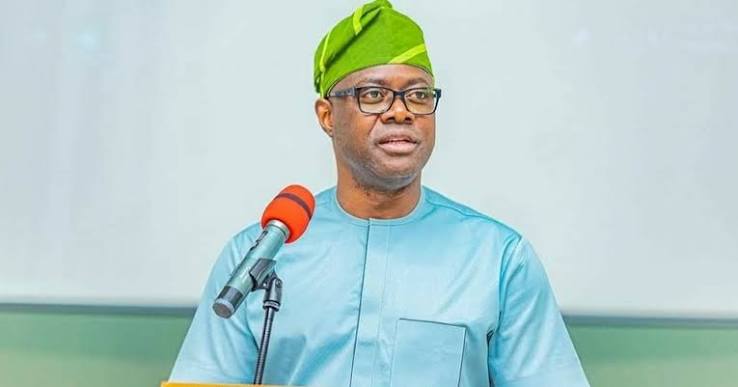
Oyo State Governor Seyi Makinde has confirmed that opposition leaders are in active discussions to form an alliance capable of unseating the ruling All Progressives Congress in the 2027 presidential election, saying he is ready to work with either former Vice President Atiku Abubakar or former Labour Party candidate Peter Obi if the evidence points that way.
Speaking in an interview with ARISE News anchor Ojy Okpe, Makinde rejected the suggestion that he was merely open to a coalition. He said consultations were already under way, adding, “Not only that I’m open, we’re actively discussing this.” He declined, however, to name a preferred candidate, insisting that any decision must rest on data rather than sentiment.
The governor said the opposition would weigh candidates’ manifestos, past performance and public opinion before settling on a flag bearer. “To arrive at a decision, you need data,” he said, cautioning against emotional choices. He argued that the first task was to agree on the best course of action, and only then to seek an alliance around it.
Drawing on his background in the oil and gas industry, Makinde likened the talks to dealings between firms in the same sector, which may compete, collaborate or trade with one another depending on a project’s demands. Applied to 2027, he said opposition figures could end up as rivals, collaborators or partners, depending on where the consultations led. Pressed on whether he would work with Atiku should the data establish the former vice president as the strongest contender, he answered simply, “Yes,” adding that he was willing to work with any Nigerian.
Makinde framed the exercise as a national rather than personal project, stressing that negotiations should not be driven by individual ambition. “That negotiation will be the deal for Nigeria, by Nigeria,” he said. He pointed to the 1999 contest, when Olu Falae carried the South West but could not convert regional strength into national victory, as a caution against a poorly coordinated opposition.
His comments land at a delicate moment for an opposition that remains split across several platforms barely two months before the presidential vote scheduled for 16 January 2027. Atiku is now the presidential candidate of the African Democratic Congress, having left the Peoples Democratic Party, while Obi is running on the platform of the Nigeria Democratic Congress after exiting the ADC. Makinde himself emerged as the presidential candidate of the Allied Peoples Movement through an alliance with a faction of the PDP, even as he remains the PDP governor of Oyo. Rabiu Kwankwaso’s New Nigeria Peoples Party adds a fourth centre of gravity.
That fragmentation is the heart of the opposition’s problem. In 2023, Tinubu won with 8,794,726 votes, about 37 per cent of the total, as Atiku, Obi and Kwankwaso divided the ballot against him three ways. Opposition strategists argue that a single candidate inheriting those blocs could reverse the outcome, a calculation that has driven repeated unity efforts, including an April 2026 summit in Ibadan where leaders pledged to field one candidate.
The politics are complicated by history and ego. Makinde was a member of the G-5 bloc of PDP governors who worked against Atiku’s candidacy in 2023 and backed Tinubu, a decision he has since said he regrets and will not repeat. The ADC, assembled in 2025 as the coalition’s vehicle, has been weakened by internal disputes, including the exit of founding figure Salihu Lukman, who blamed former Kaduna governor Nasir El-Rufai, and by litigation over its leadership. Whether Makinde, Atiku and Obi can set aside competing ambitions, and agree who steps aside for whom, will decide whether these talks yield a united ticket or simply another divided field.