
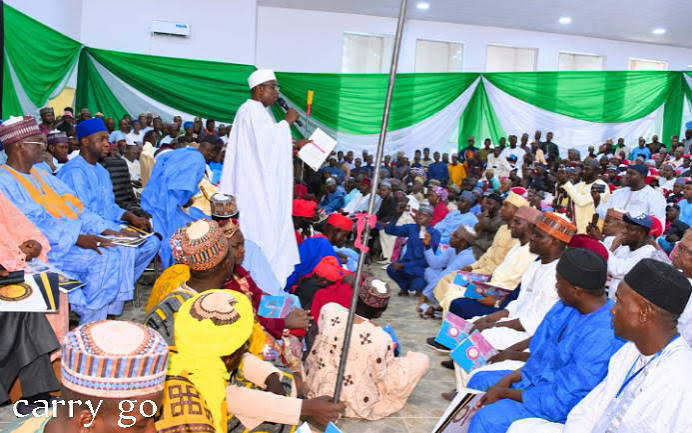
Gwoza, the Borno State town that Boko Haram once declared the capital of its self-styled caliphate, has hosted its first youth summit, a gathering its organisers hope will anchor the community’s long recovery from insurgency.
The Emir of Gwoza, Alhaji Mohammed Idrissa Timta, opened the summit at the Federal College of Education, Gwoza, over the weekend. He urged that the forum become a permanent platform for engagement rather than a one-off event, calling it the beginning of a sustained process to secure lasting peace and development. To give it structure, he inaugurated Mohammed Adamu Bams as caretaker chairman alongside two executive members, pending the election of substantive leaders, and directed that a communiqué be drafted to guide its work.
The event drew young people, traditional rulers, politicians and professionals from Gwoza’s 13 ethnic communities, along with participants from other parts of Nigeria and neighbouring countries. It was convened by a team led by Dr Buba Musa Tunga.
The symbolism is hard to miss. Boko Haram fighters seized Gwoza, which sits in the Mandara Mountains along the Nigeria-Cameroon border about 135 kilometres from Maiduguri, on 6 August 2014. Weeks later, the group’s then leader, Abubakar Shekau, proclaimed the town the headquarters of an Islamic caliphate he renamed Darul Hikima. At the time Gwoza had a population estimated at about 275,000, and the occupation uprooted almost all of them.
The violence had already struck at the heart of the emirate. In May 2014, the reigning Emir, Shehu Mustapha Idrissa Timta, was ambushed and killed by the insurgents near Biu while travelling to a funeral, and his son, the present monarch, succeeded him weeks later. In early June 2014, gunmen massacred hundreds of residents in villages around Gwoza, and places of worship were among the many buildings burnt during the occupation. Nigerian troops recaptured the town in late March 2015, but many residents remained displaced for years afterwards.
Rebuilding has been slow and uneven. The Borno State Government, under Governor Babagana Zulum, has made the closure of displacement camps and the return of residents to their ancestral homes a central policy, saying it has resettled more than one million people and built about 20,000 homes for returnees across the state. Independent assessments have at times questioned the precise figures, and United Nations agencies recorded roughly 1.8 million displaced people in Borno and close to 900,000 returnees in the years after the fighting peaked. At the summit, Senator Mohammed Ali Ndume, who represents Borno South, credited the Federal Government, the state and security agencies for improved conditions, pointing to newly built homes allocated to thousands of returnees.
That optimism sits beside a sober security reality. The military has maintained that there is no ceasefire with the insurgents, and attacks by factions of the group have continued across parts of Borno through 2025 and 2026, keeping questions about the safety of returns very much alive. It was against that backdrop that speakers pressed the summit’s unifying message. Ndume said its purpose was to bring all of Gwoza’s people together regardless of ethnic, religious, political or geographical differences, while Ahmed Usman Jaha, who represents the Damboa, Chibok and Gwoza federal constituency, told the young audience that leadership demanded discipline, learning and effort in the present rather than a wait for better days.
Whether the forum becomes the lasting institution its backers envisage will depend on what follows the speeches. For a town whose name became shorthand for the darkest stretch of the insurgency, convening its young people in one hall, under its own emir, is itself a measure of how far Gwoza has come, and of how much rebuilding remains.