
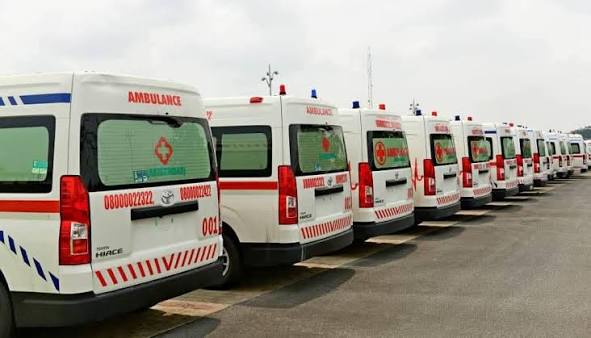
The Akwa Ibom State Government has banned the use of ambulances to convey corpses for burial, and says any vehicle used that way, whether government, private or mission-owned, can be impounded.
State Commissioner for Health Dr Ekem John announced the measure on Thursday at the monthly media briefing of the Ministry of Information. He was joined by the Commissioner for Information, Aniekan Umana, and the Chief Press Secretary to the Governor, Ekerete Udoh.
John said Governor Umo Eno had turned the state’s emergency ambulance programme from a policy into a statutory agency, the Akwa Ibom State Emergency Medical Service Ambulance System, also known as AKISEMSAS. “Through this law, the state government has now criminalised and outlawed the use of ambulances to carry corpses,” he said.
He argued that ambulances are for the living and that using them as hearses creates a public health risk. “You will not find any government ambulance at any burial site. The law is very clear, whether it is a privately owned ambulance, mission ambulance or government ambulance, you cannot carry corpses. Corpses are carried by hearses and when you now use our ambulance to carry corpses, you are creating a public health threat to the rest of the public.”
Officials are empowered to intercept hired ambulances on the road. Families who still book an ambulance for a funeral, he warned, risk losing the vehicle.
The practice is widespread in Nigeria. Many communities treat the ambulance as a funeral car, in part because hearses are scarce or expensive and because emergency medical culture is weak. Health workers have long complained that stretchers and interiors used for bodies are then used for accident and obstetric patients. The Federal Capital Territory administration condemned the same habit in 2025 and moved to stop medical ambulances carrying corpses in Abuja, calling it unethical. Similar debates have surfaced in Lagos and other states. Akwa Ibom’s step is among the more explicit: a statewide ban with a threat of impoundment, covering private and church fleets as well as government ones.
AKISEMSAS was built under the Eno administration’s health reforms. The state has previously advertised a dedicated fleet, including basic life-support ambulances, for pre-hospital care and emergency transport. John said operations had, over about 18 months, been returned to a model in which government ambulances are not seen at burial grounds. Independent verification of response times and coverage across all local government areas was not presented at the briefing.
The commissioner also said about nine health-related bills had been sent to the State House of Assembly. They cover hospital governance, public health security, HIV prevention, protection and anti-discrimination, and minimum standards for facilities. Once a standards law is in force, he said, hospitals would have to meet set obligations before they could operate.
Whether the corpse ban works will depend on enforcement, the supply of hearses, and whether private operators comply. Impounding a hired ambulance may deter some families. It will not, by itself, create a functioning emergency service if vehicles, trained crews and a dispatch system are not available when a living patient needs them. The public health argument is straightforward: keep the ambulance for emergencies, and use a hearse for the dead. The test is whether Akwa Ibom can make that distinction hold on the road, not only in the law.