
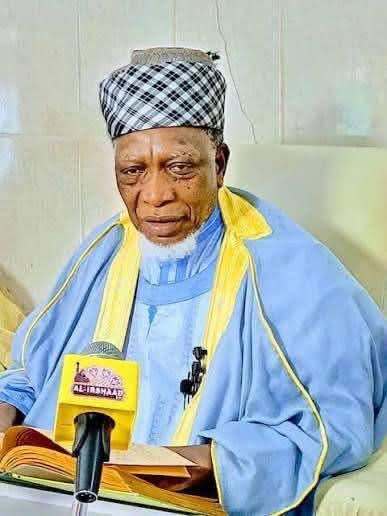
The National Human Rights Commission has asked the Inspector-General of Police and the Director-General of the Department of State Services to arrest and prosecute Islamic cleric Sheikh Sani Yahaya Jingir, in one of the strongest institutional responses yet to a viral video in which he described Christians as infidels and urged Muslims to use their numerical strength to outvote them ahead of the 2027 general elections.
The demand, contained in a statement issued on Tuesday by the commission’s Executive Secretary, Chief Tony Ojukwu, SAN, was joined within a day by the Christian Association of Nigeria, CAN, the Pentecostal Fellowship of Nigeria, PFN, the vice presidential candidate of the Nigeria Democratic Congress, NDC, Rabiu Kwankwaso, and Nigeria’s High Commissioner to South Africa and former Minister of Aviation, Femi Fani-Kayode. Together, their interventions have turned a weekend sermon in Kano into a national controversy testing how far Nigeria’s institutions are prepared to go in policing religious rhetoric ahead of an already tense election cycle.
As at the time of filing this report, neither the police, led by Acting Inspector-General Olatunji Disu, nor the DSS had publicly confirmed any action against the cleric.
Jingir made the remarks at a mass wedding organised by the Kano State Government, through its Hisbah Board, to support widows, divorcees and other residents unable to afford the cost of marriage. Video of the event, which circulated widely online from Sunday, showed the cleric, speaking in Hausa, praising President Bola Tinubu for the same-faith presidential ticket he ran with Vice President Kashim Shettima in 2023, under the All Progressives Congress, APC, and affirming his readiness to back a repeat of the arrangement in 2027.
He went further, telling the gathering that Nigeria is a Muslim-majority country and urging Muslims to obtain their Permanent Voter Cards to “show the infidels their limit.” He also referenced the 2014 bombing of a mosque in Kano, attributing it to Christians operating under the guise of the Maitatsine sect.
That particular claim does not hold up against the documented historical record. The attack on Kano’s Central Mosque in November 2014, which killed more than a hundred people, was attributed at the time to Boko Haram, an Islamist militant group, not to Christians. The Maitatsine movement itself, which emerged in Kano in the 1970s and triggered a deadly uprising in December 1980, was led by Muhammadu Marwa, a Cameroonian preacher who broke away from mainstream Sunni teaching. Historical accounts consistently describe it as a radical Islamic sect rather than a Christian one.
Footage from the event also appeared to show Kano State Governor Abba Kabir Yusuf and Jigawa State Governor Umar Namadi applauding at points during the address, though the video alone does not establish that either governor endorsed every specific statement Jingir made. Neither governor had publicly clarified his reaction as at the time of this report.
Ojukwu said the commission reviewed the video with grave concern and considered Jingir’s language, particularly his reference to “infidels” and his call for supporters to “show their limit,” a direct attack on the equality and non-discrimination guarantees in the 1999 Constitution and on Nigeria’s international human rights obligations. The commission described what it heard as “hate speech and incitement to religious hatred and potential violence,” and said prosecution ought to proceed regardless of Jingir’s standing or political ties. It added that it would work with security agencies, the Independent National Electoral Commission and civil society groups to keep the 2027 elections free of religious hatred and violence.
Nigeria’s legal architecture complicates that ambition. The country has no single, comprehensive hate speech law. A National Commission for the Prohibition of Hate Speech Bill, which sought to establish an agency empowered to prosecute offenders, generated years of controversy in the National Assembly, partly over an earlier version’s provision for capital punishment where hate speech led to loss of life, and partly over fears that its broad wording could be used against ordinary political criticism. It has not been enacted. Prosecutors instead rely on scattered provisions in the Criminal Code, the Cybercrime Act and public order legislation, an arrangement legal researchers have long described as weakly enforced, with hate speech prosecutions in Nigeria remaining rare even though the term is invoked often in public debate.
CAN, in a statement from its media office, was careful to separate the row over Jingir’s language from ordinary political choice. “CAN has no quarrel with anyone’s political choice, preferred candidate or political persuasion,” the association said, adding that every Nigerian has the right to support whichever candidate they choose within the law, and that no one should be made to feel like a stranger in the country because of their faith. It urged religious leaders to use their platforms for peace and tolerance rather than division.
PFN was named alongside CAN and the NHRC in condemning the cleric, though it did not appear to issue a separately reported statement of its own as at the time of this report.
Kwankwaso, a former Kano State governor, said he was troubled that such language should come from a cleric of Jingir’s standing, insisting that “the good people of Kano do not endorse or support these divisive remarks.” He linked the episode to the 2027 elections, arguing Nigerians would have the chance to judge the current administration at the ballot box.
Fani-Kayode called for the DSS to caution the cleric before matters escalated, saying “Jingir should be invited by the DSS and formally cautioned before he sets this country on fire.” In a separate reaction, he said the episode had, in his assessment, done more political damage to the ticket Jingir claims to support than good, suggesting the cleric may be inadvertently working against Tinubu and Shettima’s 2027 prospects.
Beyond the named institutions, the Northern Christian Association, whose chairman, Rev. Joseph Hayab, argued that Tinubu and Shettima were not elected by Muslim votes alone in 2023, and the youth wing of the TEKAN/ECWA Fellowship also condemned the remarks. The Indigenous People of Biafra, a proscribed separatist group, cited the episode in support of its own long-standing claims about religious marginalisation.
The controversy has not produced a united Muslim front. Kaduna-based cleric Ahmad Gumi publicly urged Jingir to keep religion out of partisan politics. A former Chief Imam of the Apo Legislative Quarters Central Mosque in Abuja, Sheikh Musa Khalid, called for Jingir to be reprimanded and prosecuted. Activist Mahdi Shehu described the “infidels” remark as un-Islamic and unrepresentative of the wider Muslim community, citing Quranic references to Christians as people of the Book.
A statement purportedly issued by the Plateau State chapter of the Jama’atu Nasril Islam, JNI, an umbrella Muslim body headed by the Sultan of Sokoto, declaring full support for Jingir, was subsequently disowned by the organisation as fake. Its publicity secretary, Gambo Hamza, said JNI Plateau had neither authorised nor endorsed the statement and that Jingir’s views, while his to hold as an individual scholar, did not represent the organisation’s position.
Jingir himself has not retracted his comments. Responding to critics, he said, “I know this statement pains the unbelievers,” and defended the Muslim-Muslim arrangement as necessary to sustain what he described as Muslim political dominance. He is a long-serving figure in northern Nigeria’s Izala reform movement, formally the Jama’atu Izalatil Bid’ah Wa Iqamatus Sunnah, JIBWIS, based in Jos, where he has chaired the Plateau Ulama’u Council since 2015 and delivers an annual Ramadan tafsir. He has previously argued, contrary to Boko Haram’s justification for violence, that the group’s interpretation of jihad has no basis in Islamic law.
The row revives a debate that has run since July 2022, when Tinubu, then the APC’s presidential candidate, picked Shettima, also a Muslim, as his running mate, departing from Nigeria’s long-standing informal convention of religious balance on national tickets. CAN and PFN both criticised the pairing at the time, warning it could deepen religious division, and resistance within the APC itself was significant enough that some party members publicly opposed it. Tinubu went on to win the 2023 election, including in several Christian-majority states, a point Hayab and other critics have cited in recent days to argue the ticket was never purely a function of religious bloc voting.
Reports in recent weeks suggest the same-faith arrangement is being quietly revisited as the APC positions itself for 2027, which is part of why Jingir’s endorsement of it, delivered in explicitly sectarian terms, has landed with such force.
No arrest has been confirmed, and it is not yet clear whether prosecutors would find a sustainable charge given the gaps in Nigeria’s hate speech laws. What is established is that a widening circle of religious and political figures, cutting across both faiths, has publicly condemned the language Jingir used, even where they disagree on what ought to happen to him next. Whether the Federal Government responds to the NHRC’s demand, or allows the controversy to fade as earlier ones have, is likely to shape how religious leaders on both sides calibrate their rhetoric as campaigning for 2027 intensifies.