
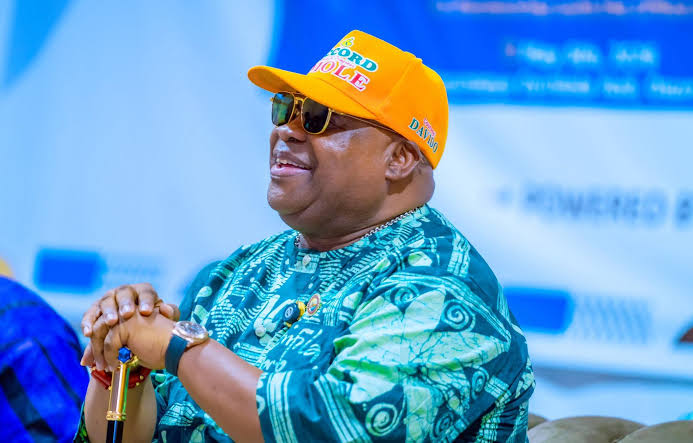
The Independent National Electoral Commission has declared Governor Ademola Adeleke of the Accord Party the winner of the 2026 Osun State governorship election, securing the incumbent a second four-year term after a keenly contested poll across the state’s 30 local government areas.
Announcing the final results on Sunday at the INEC state headquarters in Osogbo, the Returning Officer, Professor Joshua Olalekan Ogunwole, Vice-Chancellor of the Federal University, Oye-Ekiti, said Adeleke polled 511,067 votes to defeat his closest challenger, Bola Oyebamiji of the All Progressives Congress, who secured 444,815 votes. The African Democratic Congress candidate, Najeem Salaam, came a distant third with 17,180 votes.
Professor Ogunwole declared that Adeleke had satisfied the constitutional requirements, having scored the highest number of votes and obtained a two-thirds majority in two-thirds of the 30 local government areas. The winning margin stood at 66,252 votes.
According to the official figures announced by the electoral commission, the total number of registered voters for the election was 2,339,544, with 1,010,684 voters accredited on polling day. The total number of valid votes was 985,097, while 20,721 votes were rejected. The total number of ballots cast was 1,005,800.
A breakdown of the results showed that Adeleke won 19 of the state’s 30 local government areas, while Oyebamiji carried the remaining 11 councils. The governor recorded commanding victories in major voting centres, including his political base in Ede, where he secured overwhelming victories in both Ede North and Ede South. His strongest individual local government performance came in Osogbo, the state capital, where he polled 36,480 votes against Oyebamiji’s 30,474. In Ede North, he recorded 35,427 votes against Oyebamiji’s 10,283.
Other local government areas won by Adeleke included Boluwaduro, Ife North, Ilesa West, Ifedayo, Ife Central, Orolu, Oriade, Odo-Otin, Ife East, Ifelodun, Iwo, Ede South, Egbedore, Ayedire, Ila, and Ayedaade, among others.
Oyebamiji, however, retained control of several traditional APC strongholds, including Ilesa East, Boripe, Irepodun, Obokun, Atakumosa East, Atakumosa West, Irewole, Ife South, Isokan and Olaoluwa. His strongest performance came in Irewole, where he scored 29,972 votes against Adeleke’s 10,934. He also won Olorunda with 24,671 votes to Adeleke’s 23,514 and Ilesa East with 16,208 votes against Adeleke’s 12,280.
Several local government areas recorded closely fought contests. In Boluwaduro, Adeleke led with 7,118 votes against 7,050 for Oyebamiji, a margin of just 68 votes. In Isokan, Oyebamiji edged Adeleke 14,063 to 13,765 votes.
The election, which featured 15 political parties, was conducted across 3,763 polling units spread over 332 registration areas. It attracted national attention following months of vigorous campaigns, political realignments and legal disputes among the major political parties.
Technical challenges with the Bimodal Voter Accreditation System were reported across several local government areas during the poll. The Centre for Democracy and Development, which monitored the election across the state, reported operational issues with BVAS, including slow processing and difficulties with biometric verification. Problems were recorded in Irepodun, Ejigbo, Obokun, Osogbo, Olorunda, Ola Oluwa, Ede North, and Ede South local government areas.
The centre noted that INEC’s deployment was mostly successful, with 89.1 per cent of observed polling units recording officials arriving before 8:30 a.m. However, some delays were noted in locations such as Ife Central and Ayedire local government areas.
The Centre for Journalism Innovation and Development also confirmed BVAS failures at polling units in Egbedore, Ife Central, Ilesa West, Ifedayo, Ifelodun, Oriade and Ilesa East local government areas, based on earlier reports from the election day.
The electoral process was marred by isolated incidents of violence and widespread allegations of vote-buying. The Centre for Democracy and Development expressed concern over violent episodes reported in Ejigbo and Modakeke. Suspected thugs disrupted voting at Ejigbo Ward 4, Polling Unit 13, where the ADC governorship candidate, Najeem Salaam, cast his vote. The centre also reported allegations of voters being tear-gassed in Modakeke and Obokun.
The centre raised concerns about vote-buying, with observers noting solicitation of votes around polling stations in Ilesa East and Ola Oluwa. Media reports also alleged vote-buying involving agents of the APC and Accord at a polling station in Irewole Local Government Area.
The Socio-Economic Rights and Accountability Project called on INEC, the Economic and Financial Crimes Commission and the Independent Corrupt Practices and Other Related Offences Commission to investigate alleged vote-buying, financial inducement, violence and other electoral offences linked to the election.
The European Union Support to Democratic Governance in Nigeria Election Observation Hub, in its assessment, documented 323 cases of electoral offences, including 103 cases of vote trading, 85 cases of exposure of ballot papers, 31 cases of obstruction of voters, and 28 cases of inducement of polling and security officials.
Despite these challenges, the Centre for Democracy and Development stated that the election was mostly peaceful, with voting remaining calm in many areas.
Following the declaration, jubilation erupted in Osogbo as supporters of the governor trooped onto the streets singing victory songs. Adeleke’s victory hands him a fresh four-year mandate and reinforces the Accord Party’s political dominance in Osun following months of intense campaigning.
The APC had yet to issue an official statement on the outcome at the time of this report. However, the party had earlier raised concerns over the conduct of the election in some areas, accusing Accord Party thugs of snatching a ballot box in Osogbo.
The ADC had rejected the election during the collation process, describing it as a sham and calling on INEC to suspend further collation and cancel results from affected areas. The party alleged that voters were attacked, chased away, and their phones seized to prevent documentation of crimes.
The declaration brings to a close one of Nigeria’s most closely watched off-cycle governorship elections. With the final figures now collated and officially announced, Adeleke is set to continue as Governor of Osun State for another four-year term.