
Two days after the Independent Corrupt Practices and Other Related Offences Commission handed President Bola Tinubu an interim report on the disputed Presidential Foreign Intervention Promotion Council, the African Democratic Congress and a chieftain of the All Progressives Grand Alliance, Chekwas Okorie, have rejected the findings and demanded an independent investigation into how a body the government now calls fictitious operated inside the machinery of state.
The ADC, in a statement issued on Saturday, August 8, 2026 by its National Publicity Secretary, Mallam Bolaji Abdullahi, described the report as “predictable and inadequate” and accused the Federal Government of being more interested in containing political damage than establishing the full facts. The party recalled that it had opposed the President’s decision to refer the matter to the ICPC in the first place, insisting instead on an independent investigative panel.
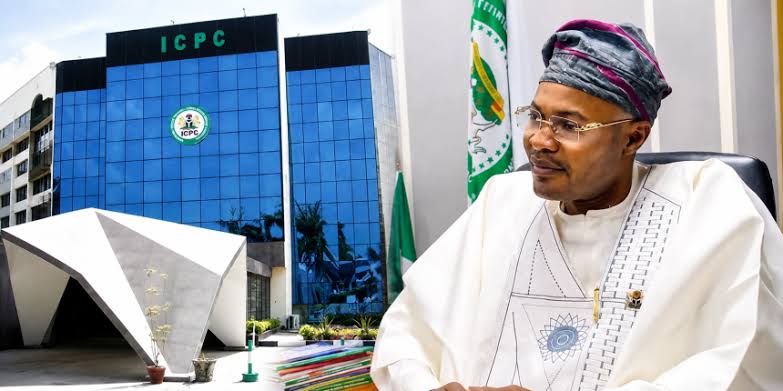
The rejection followed the presentation of the interim report on Thursday, August 6, by the ICPC Chairman, Dr Musa Adamu Aliyu (SAN), exactly 30 days after Tinubu, on July 7, 2026, gave the commission a one month deadline to investigate the council. Aliyu told State House correspondents that investigators established that Adeniyi Adeyemi Matthew was never appointed by the Federal Government or any authorised institution, and that the council was never created by any law, executive order or other valid instrument of government.
“The appointment letter presented by Mr Adeniyi Adeyemi Matthew was completely forged, alongside similar documents used to perpetrate the illegal activities of the fake agency,” the commission stated, adding that a forged gazette and other fabricated legal instruments were used to project the body as legitimate.
The commission cleared the Chief of Staff to the President, Femi Gbajabiamila, of wrongdoing, reporting that the forged appointment letter did not originate from the Presidency. It also said it found no weaknesses in the systems of the State House or the Central Bank of Nigeria, and that “no funds of the federal government were approved or disbursed to the fake PFIPC or PEAC.” Aliyu attributed the breach to “weaknesses in verification, inter agency oversight and government processes” which, he said, “were exploited by Adeniyi Adeyemi Matthew with some level of negligence and connivance.”
Investigators further disclosed that Adeyemi allegedly floated two additional fictitious bodies, the FCT Investment Promotion Agency and the Foreign Investment Promotion Agency and Public Private Partnership, using forged legislative instruments to open bank accounts. The commission recommended his prosecution, administrative sanctions against public officials whose actions or negligence enabled the operation, and institutional reforms across ministries, departments and agencies.
It is that recommendation the ADC has taken exception to. The party argued that identifying one principal suspect while merely suggesting the existence of other accomplices does not answer the central question. “What Nigerians expected was an investigation into how a ‘fictitious agency’ managed to obtain all authorisations and institutional support required to operate as a legitimate government agency,” it said.
The numbers sit at the heart of the dispute. Records of the 2026 budget show that the council’s proposal appeared on pages 50 and 51 of the estimates presented by President Tinubu, under code 0111062001, with a total expenditure of N1,302,978,784. That comprised N1,002,978,784 in recurrent spending, made up of N802,978,783 for personnel costs and N200,000,001 for overheads, alongside N300,000,000 for capital expenditure. The same amount was approved by the National Assembly on pages 33 to 35 of the Appropriation Act under code 0111001001, sitting within the State House headquarters budget.
Placed against the N68.32tn aggregate expenditure that Tinubu signed into law in April 2026, of which N15.4tn is recurrent, N32.2tn capital, N15.8tn debt service and N4.799tn statutory transfers, the disputed provision amounts to less than two thousandths of one per cent of the national budget. The ADC’s position is that the size of the sum is beside the point.
“Budgetary provisions do not materialise by accident. They leave records, submissions, approvals and an audit trail,” the party said, demanding that investigators name who proposed, processed and verified the allocation. It also asked who confirmed the council’s existence before civil servants were deployed to it, who authorised its accommodation, and, having accepted that the appointment letter was forged, “How did a forged document survive the verification procedures of government?”
Okorie, quoted by Sunday PUNCH, said the outcome was unsurprising. “No reasonable Nigerian will be surprised at the outcome of the so called ICPC investigation of the Adeyemi fake agency saga,” he said, describing the commission as operating under the same executive arm at the centre of the controversy, a situation in which “the accuser and the judge” appear to be the same party. He called for “a reputable, independent and open probe” of the establishment, funding and operation of the body, while expressing doubt about the National Assembly’s capacity to provide a credible alternative.
Testimony already on record before the House of Representatives ad hoc committee, chaired by Hon. Yusuf Gagdi and constituted after a resolution of July 8, 2026, has laid out how the entity moved through the bureaucracy. On July 27, the Accountant General of the Federation, Shamseldeen Ogunjimi, told the panel that a letter intended for the Permanent Secretary, State House, which could have exposed the forged documents, was instead handed to Adeyemi. Two days later, the Head of the Civil Service of the Federation, Mrs Didi Esther Walson-Jack, conceded lapses in her office. “We now concede that we ought to have carried out more due diligence in issuing an authorised establishment and recruitment waiver to the PEAC/PFIPC,” she said, explaining that representatives of the body attended the 2025 Annual Manpower Budget Defence with what appeared to be an Establishment Act and a letter appointing a Director General. A recruitment waiver for about 300 staff was granted on that basis.
The Central Bank of Nigeria’s Director of Banking Services, Hamisu Abdullahi, told the same panel that two domiciliary accounts, in dollars and pounds sterling, were opened for the body on the mandate of the Office of the Accountant General of the Federation. The Director General of the Budget Office, Tanimu Yakubu, has also appeared, while the committee has said it uncovered a network of forged appointment letters, fabricated legislative documents and fictitious offices, counting 29 forged state documents.
The criminal case predates the political storm. The Nigeria Police Force filed an eight count charge, marked FHC/ABJ/CR/562/2025, on November 27, 2025, following a petition by Gbajabiamila’s office to the Inspector General of Police over forged letters bearing false signatures, seals, reference numbers and the Coat of Arms. Adeyemi, alongside two co defendants listed only as Femi and Anu, both at large, faces counts of conspiracy, forgery and false impersonation under Section 1(2)(c) of the Miscellaneous Offences Act and Section 179 of the Penal Code. Justice Mohammed Umar issued a bench warrant on July 14, 2026 after repeated failures to appear, and Adeyemi was picked up the same day in Osun State by the police Intelligence Response Team. Arraignment stands adjourned to September 30, 2026.
Adeyemi had alleged that Gbajabiamila received N400m through a proxy, demanded a further N200m and sought 48 per cent of a N27.4bn take off grant, claims the Chief of Staff denied and which formed the basis of a N15bn defamation suit. Police say records show the money was spent on vehicles, relatives and luxury items, with no evidence of conversion to dollars or payment to the Chief of Staff, and noted a contradiction between his claim of appointment in March 2024 and payment in 2025. Before the Reps panel, a businessman, Gbenga Collins, managing director of Divine Dopacy Nigeria Limited, said he gave Adeyemi N400m to facilitate a renovation contract, believing the council genuine because it operated from the Federal Secretariat with government plated vehicles and security personnel.
Budget insertions have long been contested territory in Abuja, from the 2016 padding row that convulsed the House of Representatives to recurring civil society findings on duplicated and unverifiable line items. What distinguishes the present matter is that the disputed entry attached not to a project but to an institution the Presidency insists never existed.
Attention now turns to the ICPC’s final report, the Gagdi committee’s findings, and the September arraignment. The ADC has demanded immediate publication of the full interim report and accountability for every official whose action or negligence enabled the arrangement, asking, “how has this administration operated that made such systemic criminality possible?” The commission, for its part, has said its work is continuing.