
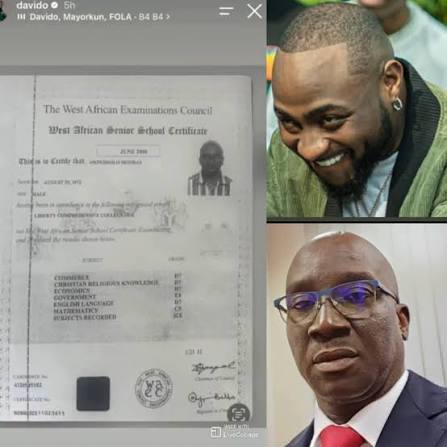
Eight days before voters in Osun State choose a governor, a wordless Instagram Stories post by Afrobeats star David Adeleke, popularly known as Davido, has dragged one of Nigerian politics’ oldest and most combustible arguments back into the middle of an already tense campaign: who is qualified, on paper, to govern.
Davido, nephew to Osun State Governor Ademola Adeleke, shared on Friday what appeared to be the West African Senior School Certificate Examination result of Edo State Governor Monday Okpebholo. He attached no caption. None was needed. Hours earlier, Okpebholo had stood before a crowd at an All Progressives Congress campaign rally in Osun and ridiculed the Osun governor’s well documented fondness for dancing.
“Before somebody signs paper, he will dance. Are you not tired? For four years, this man has been dancing. Before he takes breakfast, before he drinks tea, he will dance,” the Edo governor told supporters at the rally, which was held for the APC governorship candidate, Asiwaju Munirudeen Bola Oyebamiji, popularly called AMBO, and attended by Kogi State Governor Ahmed Usman Ododo. Okpebholo also urged the crowd to collect money from political opponents but cast their ballots for the APC on August 15. In separate remarks reported from the same rally, he linked Adeleke to former Edo governor Godwin Obaseki, saying, “That man is Obaseki’s friend. You know we kicked Obaseki out of Edo. So, we have to kick his friend out of this place too.”
The document Davido circulated is not new, and its authenticity remains unresolved. The purported WASSCE result, said to have been sat in May and June 2008 at Liberty Comprehensive College, Jos, Plateau State, shows several low grades, including D7, E8 and F9. It first surfaced during the September 21, 2024 Edo governorship campaign and resurfaced in July 2025 following controversy over remarks Okpebholo made about former presidential candidate Peter Obi.
Readers should note that the document has never been independently authenticated. A fact check published by the Centre for Democracy and Development ahead of the 2024 Edo poll applied open source forensic analysis to the widely shared image and concluded that it may have been digitally doctored. The CDD review also flagged a timeline problem: Okpebholo’s political career is reported to have begun in 2003, five years before the sitting date shown on the circulating result. Okpebholo’s campaign team, in a statement signed by his legislative aide at the time, denied the document outright. No verification from the West African Examinations Council itself has been placed in the public domain, and the governor has not been shown by any court to have submitted a false qualification.
Separately, SaharaReporters reported in July 2024 that Okpebholo’s Independent National Electoral Commission nomination papers carried three different dates of birth: August 29, 1970 on an age declaration document, August 29, 1972 on the WAEC result attached, and August 1, 1977 on his voter card. The Peoples Democratic Party called for a police investigation. Okpebholo went on to win the election with 291,667 votes, defeating the PDP’s Asue Ighodalo, who polled 247,274, and the Labour Party’s Olumide Akpata, who got 22,763. The PDP’s petition was heard by the Edo Governorship Election Petition Tribunal chaired by Justice Wilfred Kpochi, which admitted 148 Bimodal Voter Accreditation System machines in evidence before delivering judgment in 2025. Okpebholo remains in office.
There is a particular sharpness to certificate politics landing on the Osun ballot, because the man Davido is defending survived exactly this fight.
Two APC chieftains, Wahab Raheem and Adam Habeeb, sued Ademola Adeleke in 2018, arguing he lacked the qualification prescribed by Section 177 of the 1999 Constitution as amended, which requires a governorship candidate to be educated up to at least School Certificate level or its equivalent. On April 2, 2019, Justice Othman Musa of the Federal Capital Territory High Court in Bwari nullified Adeleke’s nomination. The Court of Appeal in Abuja overturned that ruling on May 30, 2019, in a unanimous judgment read by Justice Emmanuel Agim, who described the lower court’s decision as perverse. The appellate court held that the suit was statute barred, having been filed outside the 14 day window, that the Abuja court lacked territorial jurisdiction, and that WAEC’s own ledger for the May and June 1981 examination listed Adeleke as candidate number 149 at centre number 19645. WAEC had earlier deposed an affidavit confirming he sat the examination.
Adeleke has consistently maintained his position. “I did not forge the certificate,” he told the Court of Appeal through counsel, insisting the document attached to his nomination Form CF 001 was lawfully issued. INEC’s published candidate list for 2026 records Adeleke, 65, as holding SSC and BSc qualifications. Oyebamiji, 60, is listed with FSLC, WAEC and a Higher National Diploma.
The exchange lands in an unusually charged contest. INEC’s final candidate list, attached to a letter signed by the commission’s Secretary, Dr Rose Oriaran-Anthony, on March 4, 2026, cleared 14 political parties. Notably, both the PDP and Labour Party fielded no candidate. The commission had originally fixed the poll for August 8 before rescheduling to August 15. Campaigning opened on March 11.
According to a document titled “Analysis of Register of Voters”, signed by Osun INEC Director of Voter Registry, Olatunde Olalere, and released to political parties on July 9, 2026, some 2,339,233 voters are eligible to vote. Adeleke, who won in 2022 with 402,979 votes to Gboyega Oyetola’s 375,077, taking 17 of the state’s 30 local government areas, is seeking re election on the platform of the Accord Party after leaving the PDP. That defection reframes the entire contest, testing whether the 2022 mandate belonged to the party or to the man.
Tension has been rising for weeks. On July 29, Adeleke, Oyebamiji and 12 other candidates signed a peace accord convened by the National Peace Committee under Bishop Matthew Hassan Kukah. INEC Chairman, Professor Ojo Amupitan, said the commission was working with the Economic and Financial Crimes Commission, the Independent Corrupt Practices and Other Related Offences Commission and the Office of the Attorney General of the Federation. “We are attacking vote-buying head-on,” he said, adding that “anyone attempting to buy or sell votes, whether through physical cash or digital transfers, will be arrested and prosecuted under the Electoral Act 2026.”
Then came the account freeze. On August 5, the EFCC moved against an Osun State Government statutory allocation account at First Bank, citing an investigation opened in March into the alleged mishandling of roughly N11bn in Ecology Funds, Intervention Funds and Federation Account Allocation Committee allocations. President Bola Tinubu intervened the following day in a personally signed statement. “I feel deeply embarrassed not by the EFCC’s exercise of its mandate backed by a court order, but by the timing of the agency’s action,” he said, directing the commission to return to court. The Osun State Government has gone to court seeking N2bn in damages. The African Democratic Congress, through National Publicity Secretary Bolaji Abdullahi, welcomed the reversal but queried the President’s repeated reference to a court order the EFCC never publicly confirmed. Calls for the resignation of EFCC Chairman Ola Olukoyede have followed.
Davido’s post is the third public clash he has entered in a week. He traded barbs on X with former presidential aide Bashir Ahmad, who had bookmarked the singer’s celebration of a Tinubu phone call to Adeleke and predicted he would “come back here to lament if the August 15 results don’t go your way.” Davido replied by mocking Ahmad’s 16 votes in an APC primary in the Gaya, Ajingi and Albasu federal constituency of Kano State. Imo State Governor Hope Uzodimma, responding through his Senior Special Assistant on Electronic and Creative Media, Ambrose Nwaogwugwu, advised the singer to “begin making preparations to officially sign his uncle as a dancer in his musical band.”
Whether any of it moves a single vote in a state of 2.3 million registered voters is untested. What is clear is that eight days out, the Osun campaign is being fought less on budgets and manifestos than on dance steps, primary results and a school certificate whose authenticity nobody has yet proved.