
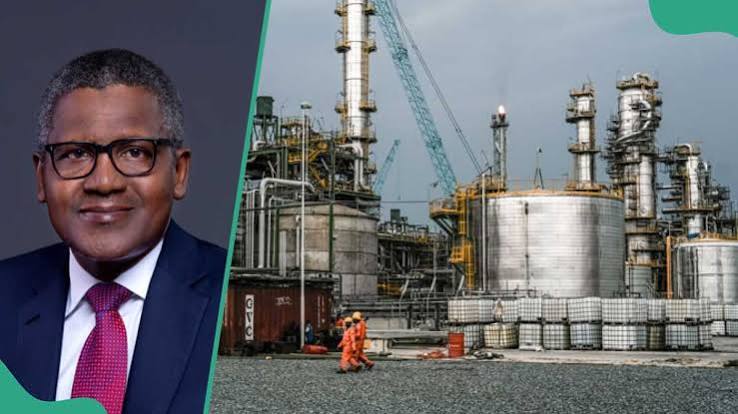
Nigeria’s biggest ever share sale has opened to a surge of demand, with the Dangote Petroleum Refinery and Petrochemicals initial public offering attracting about N1.5 trillion in commitments within the first six hours of trading, according to figures cited by market operators. The pace of subscription has already pushed Aliko Dangote, president of Dangote Industries Limited, to signal that he may widen the offer beyond the shares currently on the table.
The offer opened on the Nigerian Exchange on Monday, 14 September 2026, when Dangote sounded the ceremonial gong at the NGX trading floor in Lagos. It comprises 4.1 billion new ordinary shares priced at N525 each, with a minimum subscription of 10 shares valued at N5,250. At full take up the sale raises about N2.15 trillion, roughly 1.6 billion dollars, making it the largest public share offer in Nigerian corporate history and, by the company’s account, the biggest ever on the continent. The offer is scheduled to close on 13 October, with listing on the exchange expected in November.
Speaking on Arise News, Dangote said the strong response could encourage him to release an additional 30 to 35 per cent of the company to the public rather than cap participation at the shares presently offered. He tied that possibility firmly to demand and to the applicable regulatory and offer terms, and stressed that any oversubscription would be settled in favour of small holders. In his words, “If the offer is oversubscribed, retail and small investors will receive priority consideration. We are determined to ensure that ordinary Nigerians are not crowded out by large subscriptions.”
The framing matters because the company has positioned the sale as a “People’s IPO”, with a stated target of drawing at least 10 million investors from Nigeria and across Africa. To lower the barrier to entry, subscription has been built around BVN enabled digital channels, and the low floor of N5,250 is designed to admit first time and low income investors. The appetite has been visible beyond the headline figure. Several digital investment platforms reported unusually heavy traffic as the offer opened, with some experiencing downtime as users moved to subscribe.
The timing places the offer at a point of unusually strong earnings for the refinery. The company posted a net profit of about 1.82 billion dollars in the first half of 2026 on revenue exceeding 13 billion dollars, a sharp reversal from a loss of about 476 million dollars in the corresponding period of 2025. That turnaround has been linked in large part to disruptions in global fuel supply through 2026, which lifted refining margins and demand for alternative suppliers, with the plant emerging as a significant exporter of jet fuel and middle distillates to markets in Africa and Europe.
Investors are being asked to value the asset at a considerable premium. The offer implies a valuation of roughly 47 to 50 billion dollars for a facility built at a cost of about 20 billion dollars, which processes crude at a capacity of about 700,000 barrels a day. Proceeds are earmarked for a 14.3 billion dollar expansion intended to roughly double capacity to 1.4 million barrels a day, a scale the company says would rank it among the largest refineries in the world. That gap between construction cost and market valuation is where caution enters. Some analysts have questioned whether the price already captures much of the expansion upside, leaving limited room for error should the project face delays or cost overruns.
There are early signs that parts of the market are pricing in that risk. The exchange recorded a sharp fall in equity value in the days around the launch, a movement several operators have attributed to portfolio repositioning as institutional investors freed up cash for the offer. Paul Uzum, executive director of Halo Capital Management Limited, said some high net worth investors were likely to wait two to three weeks before committing, using the time to gauge how demand builds before deciding. That measured approach among larger buyers sits alongside the visible rush from retail subscribers, and the interplay between the two groups will shape how the book finally closes.
The offer follows a private placement completed in July, which market accounts put at about 2 to 2.5 billion dollars in value and reported as several times oversubscribed. The scale of that earlier round, combined with the speed of the current retail response, has fed expectations that the public offer could close well above its base size, which is the scenario Dangote’s remarks on additional shares appear to anticipate.
For the wider market, the listing carries weight beyond a single company. It is the first time a refinery has been offered to the public on the exchange in its 66 year history, and it introduces a large scale energy infrastructure asset to a market long dominated by banks, telecommunications firms and consumer goods companies. If the shares list at or near the offer’s implied valuation, the refinery would rank among the most valuable companies quoted in Lagos, materially changing the composition of the exchange and its total capitalisation.
What remains uncertain is how far the final subscription will run, whether the additional tranche Dangote raised will in fact be released, and how the shares will perform once a public price is established at listing. The company has forecast long term appreciation in the share value, but such projections are expectations rather than confirmed outcomes and depend on execution of the expansion, sustained refining margins and the operational stability of a plant still ramping towards full steady output. The Securities and Exchange Commission is expected to review returns after the offer closes and clear allotment before trading begins. Until then, the size and shape of the deal will not be settled.