
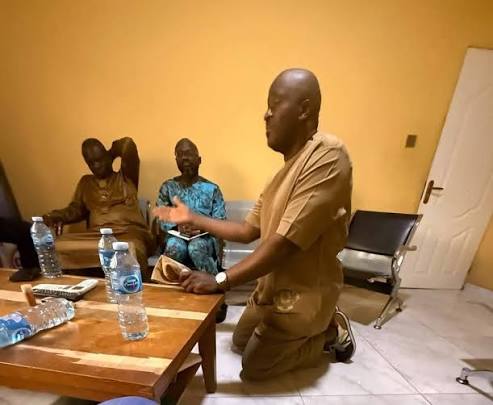
A viral video of Lagos lawmaker and Nollywood actor Desmond Elliot kneeling and prostrating before the Chief of Staff to President Bola Tinubu, Femi Gbajabiamila, has drawn fresh attention to a rift that has quietly shaped politics within the ruling All Progressives Congress in Lagos for more than a year and a half.
In the clip, which spread across social media on Sunday, 13 September 2026, Elliot, who represents Surulere Constituency I in the Lagos State House of Assembly, is seen pleading for forgiveness during a meeting with Gbajabiamila and other party figures, and asking to be brought back into the fold of the party leadership. “I’m sorry. I have no excuse; I have nothing other than to say I’m deeply sorry. I’m deeply sorry, sir. And in our culture, we prostrate. Don’t be angry, Daddy,” he said in the recording, using the Yoruba plea “e ma binu” before Gbajabiamila asked him to rise.
The gesture was Elliot’s second public apology in four months. In May, appearing on a television programme, he told the former Speaker of the House of Representatives that “to err is human, to forgive is divine,” and said any offence had been unintentional. That earlier apology followed disclosures by Gbajabiamila himself, at an APC stakeholders’ meeting in Surulere on 14 May 2026, that the crisis in the Lagos Assembly had nearly cost him his position in the Presidency.
By Gbajabiamila’s own account, President Tinubu summoned him to his study in Abuja at the height of that crisis and raised intelligence reports linking Elliot to moves against the Assembly’s then Speaker, Mudashiru Obasa. “I hear this Desmond is your boy,” Gbajabiamila recalled the President saying, adding that he initially defended the lawmaker before advising him to distance himself from the dispute. Gbajabiamila said Elliot did not publicly deny involvement as requested. Elliot, for his part, has expressed surprise at the allegations, pointing to a long mentor and protégé relationship and describing Gbajabiamila as his “egbon,” the Yoruba term for elder brother.
Understanding why a single video matters requires the fuller record of the Lagos Assembly crisis, one of the most consequential intra party disputes in the state in recent years. On 13 January 2025, 36 of the Assembly’s members removed Obasa, who had held the speakership since 2015 and had been a lawmaker since 2007, on allegations of gross misconduct and abuse of office while he was abroad and the House was on recess. His deputy, Mojisola Meranda, was elected in his place, becoming the first female Speaker in the Assembly’s history. The removal split both the House and the Lagos APC, the political home of President Tinubu, and drew in party elders including former governors Bisi Akande and Olusegun Osoba.
Meranda’s tenure lasted 49 days. She stepped down on 3 March 2025 and returned to the deputy speaker’s role, while Obasa was reinstated after what several accounts described as intervention by President Tinubu. The dispute was later settled in court. On 16 April 2025, Justice Yetunde Pinheiro of the Lagos State High Court in Ikeja declared the 13 January proceedings that ousted Obasa illegal, unconstitutional, null and void, awarded him N500,000 in damages and expunged Meranda’s name from the record of former speakers. The court held that the sitting had not been properly convened. Obasa remains Speaker.
Elliot’s role in those events has been the subject of competing accounts. He has at various points acknowledged supporting the move against Obasa while denying that he was a central actor in it, and he has said he accepted the eventual outcome. What is not in dispute is that the fallout strained his standing with Gbajabiamila, one of the most powerful figures in the Lagos APC and in the current Presidency, at a critical moment in Elliot’s political career.
That timing is the reason the reconciliation carries weight now. On 20 May 2026, Elliot lost the APC primary for the Surulere Constituency I seat, polling 270 votes against 11,385 for Barakat Odunuga Bakare, who was widely regarded as enjoying the backing of the party leadership in the state. Odunuga Bakare, a former Special Adviser on Housing to the Lagos State governor, had contested for the same ticket before the 2023 elections. Elliot withdrew from the May exercise citing alleged intimidation of his supporters, rejected the result and indicated he would pursue the party’s appeal mechanism. His public gesture of submission months later suggests a shift from challenging the outcome toward seeking accommodation within the party structure.
Elliot’s trajectory illustrates a familiar pattern in Nigerian politics, where entertainers convert popular recognition into elected office and then must navigate the internal machinery of party gatekeepers to survive. First elected to the Assembly in 2015, he secured his party’s nomination unopposed in his early terms and reached a third term partly through intra party negotiation before the 2023 elections. The 2026 primary loss, coming without the protection of a firm relationship with the state leadership, marked a clear reversal.
The reconciliation also unfolds against a broader political calendar. The Independent National Electoral Commission’s publication of candidate lists is already shaping contests ahead of the 2027 general elections, and party discipline is at a premium as the APC works to present a united front in Lagos, a state central to the President’s political base. Public displays of loyalty from previously aggrieved members serve that objective, though they also underline how much authority now rests with a small circle of party leaders.
What the episode confirms is limited but real. Elliot has publicly sought to mend his relationship with Gbajabiamila and to return to the good graces of the Lagos APC. What it does not settle is whether that will translate into a political future for him, including any fresh path to elective office. Neither Elliot nor the party leadership has publicly outlined what, if anything, follows the apology. Whether the gesture reopens a route back into contention, or simply closes a chapter, will depend on decisions that have not yet been made public.