
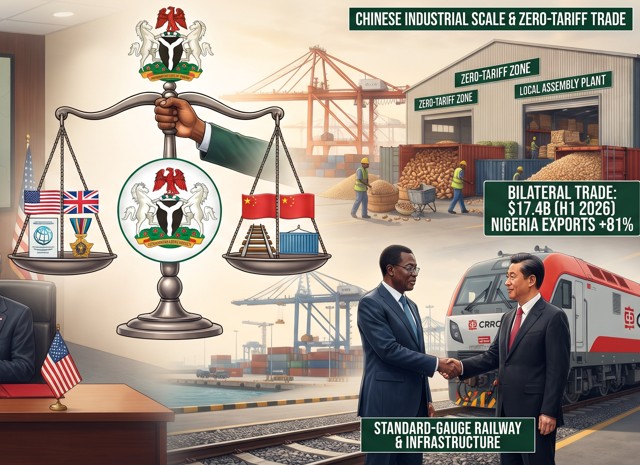
Nigeria navigates fierce global rivalry by balancing Western security and financial ties, Chinese infrastructure and zero-tariff trade, and Russian defence hardware without surrendering its diplomatic independence.
Since gaining independence in 1960, Nigeria has consistently resisted pressure to lock its foreign policy into any single ideological camp. Today, as fierce competition divides Washington, Beijing, and Moscow, Africa’s most populous nation pursues a disciplined multi – vector diplomacy, treating competing superpowers as specialised partners rather than exclusive patrons.
Rather than choosing between Western financial institutions, Chinese industrial scale, and Russian defence networks, Abuja extracts concrete economic, military, and developmental value from each bloc without surrendering national sovereignty. As major powers convene summits and scramble for influence across the Global South, Nigeria’s approach reveals how a regional heavyweight converts external rivalry into domestic leverage.
Western Capital and Security Architecture
Nigeria’s deepest institutional and financial ties remain anchored in the West, particularly with the United States, the United Kingdom, and the European Union. Western capital markets continue to serve as primary channels for foreign direct investment, Eurobond issuances, and multilateral development financing that underpin fiscal stability.
In the security arena, cooperation with Western allies remains indispensable to counterterrorism and maritime stability. During the fourth United Kingdom-Nigeria Security and Defence Partnership Dialogue held in Abuja in June 2026, National Security Adviser Nuhu Ribadu and his British counterpart Jonathan Powell reaffirmed joint commitments to countering unmanned aerial threats, improvised explosive devices, and cyber vulnerabilities. Alongside intelligence sharing and maritime domain awareness patrols in the Gulf of Guinea, European partners continue to channel millions of euros into regional peace facilities.
Yet, Abuja no longer accepts Western alignment without conditions. Nigerian policymakers routinely push back against external pressure regarding domestic governance and energy transition timelines, insisting on the sovereign right to exploit natural gas reserves to power local industrialisation while gradually integrating renewable energy.
Chinese Industrial Scale and Zero-Tariff Trade
While Western nations dominate financial services and intelligence frameworks, China has established itself as Nigeria’s premier partner for physical infrastructure and commercial volume. Over the past two decades, Chinese engineering firms and credit facilities have transformed Nigeria’s transport and energy landscape, delivering standard-gauge railways, modern airport terminals, hydroelectric dams, and deep-sea maritime hubs.
Commerce between both nations continues to expand rapidly. Figures released by the Chinese Embassy in Nigeria show that bilateral trade surged 35 percent to 17.4 billion dollars in the first half of 2026 alone. Following Beijing’s implementation of a zero-tariff policy for fifty-three African nations in May 2026. Nigerian exports of agricultural produce, raw materials, and specialised goods to China jumped by 81 percent to 2.25 billion dollars over the same six-month period.
Despite this export surge, Nigerian shipments still represent roughly thirteen percent of total bilateral trade, highlighting an ongoing structural imbalance. To reduce foreign exchange pressures and deepen economic integration, Abuja continues to utilise local currency swap arrangements between the Central Bank of Nigeria and the People’s Bank of China while urging Chinese manufacturers to establish local assembly plants rather than relying solely on finished imports.
Russian Defence Hardware and Agricultural Inputs
Nigeria’s engagement with Russia operates on a smaller commercial scale than its trade with China or the West, yet Moscow holds decisive strategic value in targeted sectors. Historically, the Soviet Union provided vital military backing to the Nigerian federal government during the civil war and constructed the foundational infrastructure of the Ajaokuta Steel Complex, cementing an enduring industrial legacy.
In contemporary diplomacy, Abuja approaches Moscow with hard-nosed pragmatism. At the Russia-Africa Summit in Moscow in late October 2026, Nigerian delegates called for shifting bilateral relations away from broad political declarations toward measurable economic outcomes, pushing specifically for technology transfer, industrial investment, and local currency trade settlement mechanisms.
Defence procurement remains a cornerstone of this relationship. When Western suppliers previously delayed critical weapons sales over human rights concerns, Nigeria turned to Russian manufacturers for Mi-35 attack helicopters and ammunition to sustain counterinsurgency operations in the northeast. Furthermore, Russian wheat and mineral fertiliser shipments play a quiet but crucial role in stabilising domestic food production and tempering agricultural inflation.
Navigating Regional Ruptures Without Taking Sides
Maintaining simultaneous partnerships with rival powers demands constant diplomatic calibration, especially when global crises spill onto West African soil. When military juntas in neighbouring Mali, Burkina Faso, and Niger severed ties with Western allies and invited Russian Africa Corps personnel into the Sahel, Abuja faced an acute regional security dilemma.
As chair of regional integration efforts and a frontline state sharing vast borders with Niger, Nigeria resisted calls to transform West Africa into an ideological battleground. Instead, Abuja maintained diplomatic communication with Moscow while deepening border intelligence cooperation with Western partners, seeking to contain insurgent spillovers and preserve regional stability.
A similar pragmatism guides Nigeria’s posture at the United Nations. While voting to uphold international law and condemn territorial aggression in principle, Nigerian diplomats have consistently avoided unilateral sanctions regimes that could disrupt global fertiliser supply chains or harm domestic economic recovery.
The Future of Sovereign Agency
As global powers navigate an increasingly multipolar era marked by trade friction and shifting alliances, Nigeria’s diplomatic playbook offers a clear lesson in strategic self-interest. By refusing to grant exclusive loyalty to any foreign capital, Abuja forces Washington, Beijing, and Moscow to compete for relevance through tangible offerings.
Whether negotiating maritime security protocols with London, expanding zero-tariff agricultural exports to Beijing, or seeking technology transfers in Moscow, Nigeria’s foreign policy rests on a single enduring calculation: permanent interests always outweigh permanent patrons. How effectively Abuja converts these competing external courtships into domestic industrial capacity and lasting security will define its standing on the world stage for decades to come.