
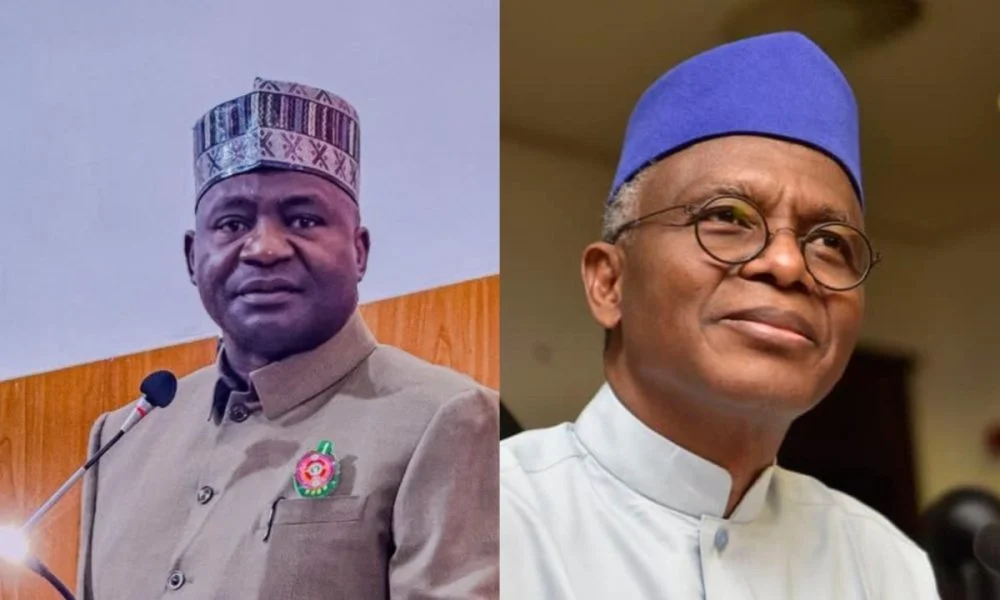
Former Kaduna State Governor Nasir El-Rufai has opened a legal challenge against Defence Minister, Gen. Christopher Musa (retd.), demanding a public apology and N10 billion compensation over comments he alleges damaged his reputation.
The demand, contained in a letter before action issued by El-Rufai’s lawyers, has added a new dimension to the continuing public debate over insecurity in Kaduna State, political accountability and the limits of public statements by government officials.
The dispute followed Musa’s appearance on Channels Television’s Politics Today programme on September 3, where discussions centred on insecurity in Kaduna State and the wider challenges surrounding banditry and violence in the region.
According to the letter from Chambers of Ubong Akpan, El-Rufai’s legal representatives argued that statements attributed to the minister during the programme presented their client in a negative and damaging manner. They described the remarks as defamatory and demanded corrective action.
The lawyers specifically took issue with comments they said suggested that the former governor had responsibility for killings, had paid bandits and had carried out demolitions against individuals unlawfully.
El-Rufai’s legal team maintained that the allegations were false and had not been established by any court of competent jurisdiction.
In the letter, the lawyers demanded N10 billion as compensation, explaining that the amount represented a claim for alleged damage to reputation, distress and inconvenience suffered by their client. They also requested a public retraction and apology from Musa.
The legal representatives clarified that the amount being demanded was not a court-awarded judgment but a request for settlement before possible legal proceedings.
They asked that any apology be issued publicly on the same television platform where the disputed comments were made and also published in two national newspapers — one with strong circulation in Northern Nigeria and another in Southern Nigeria.
The lawyers argued that comments made by a serving Defence Minister and retired military officer carried significant public influence because of his official position and professional background.
They requested that Musa preserve relevant materials connected to the television appearance, including recordings, transcripts, notes and documents that may have informed his statements. They also demanded disclosure of the sources and materials relied upon for the allegations.
The former governor’s lawyers rejected claims that he had ever participated in planning killings or supported bandit activities. They said El-Rufai had consistently maintained that he did not negotiate with or pay bandits.
On the issue of demolitions carried out during his administration as Kaduna governor, the lawyers said such actions were conducted according to the law and for public purposes. They also disputed suggestions that his administration promoted divisions along ethnic or religious lines.
The letter gave the Defence Minister seven calendar days from the date of effective receipt to respond to the demands. The lawyers warned that failure to do so could result in legal action seeking various remedies, including damages, injunctions and other court orders.
The controversy has attracted reactions from community and religious leaders in Southern Kaduna, who have appealed for restraint and dialogue.
At a joint peace meeting in Kafanchan involving representatives linked to the Jama’atu Nasril Islam (JNI) and the Christian Association of Nigeria (CAN), Chairman of the Council of Imams, Southern Kaduna, Imam Muhammed Kabir Kasim, urged Nigerians to approach the matter carefully and avoid escalating tensions, particularly through social media discussions.
Kasim described Musa as a respected military figure and appealed for calm while acknowledging the sensitivity surrounding issues of insecurity and communal relations in the region.
The dispute comes against the backdrop of longstanding public concerns about insecurity in Kaduna State, where issues involving banditry, communal violence and government responses have remained subjects of public debate.
For El-Rufai, who governed Kaduna State from 2015 to 2023, the legal move represents an attempt to challenge what his lawyers describe as damaging claims. For Musa, who became Defence Minister after serving as Chief of Defence Staff, the controversy raises questions about public communication by officials addressing sensitive national security issues.
The matter is now positioned between two competing issues: the right of public officials to discuss matters of national concern and the responsibility to ensure that public allegations about individuals are supported by evidence.
Until addressed through a response, settlement or court process, the claims and counterclaims remain allegations from both sides rather than findings established by a judicial authority.