
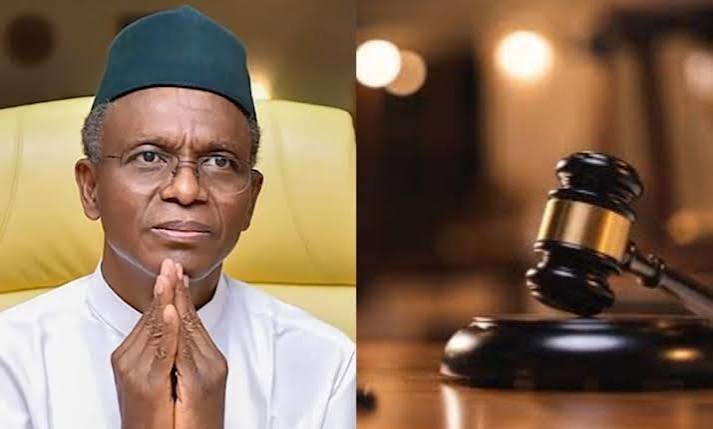
Former Kaduna State Governor, Nasir El-Rufai, on Wednesday told the Federal High Court in Abuja that he neither intercepted the telephone conversations of the National Security Adviser, Nuhu Ribadu, nor authorised anyone to carry out such an operation on his behalf.
Testifying in his ongoing trial over alleged unlawful interception of telephone communications, El-Rufai maintained that his remarks during a television interview in February 2026 were political rhetoric rather than an admission of involvement in surveillance activities.
Led in evidence by his counsel, Paul Erokoro, SAN, the former governor said he had never possessed equipment capable of intercepting telephone conversations and lacked the technical expertise required to undertake such operations. He also denied having access to Ribadu’s communication devices or networks.
El-Rufai explained that his use of the collective pronoun during the interview referred to opposition politicians, maintaining that his comments were exaggerated for political effect.
His testimony comes more than nine months after the television appearance that gave rise to the criminal proceedings, following an encounter with security operatives at the Nnamdi Azikiwe International Airport, Abuja.
The case stems from El-Rufai’s appearance on Arise Television’s Prime Time programme on February 13, 2026, a day after security operatives attempted to arrest him upon his return from Cairo, Egypt. Although the operatives confiscated his international passport, the former governor was not taken into custody at the airport.
During the interview, El-Rufai alleged that Ribadu directed security personnel to arrest him. He claimed that information about the directive came from a telephone conversation involving the NSA, while acknowledging that unauthorised interception of telephone communications was illegal.
On February 16, the Federal Government, through the Department of State Services (DSS), instituted criminal proceedings against him in a suit marked FHC/ABJ/CR/99/2026. The original three counts were subsequently expanded to five, covering alleged unlawful interception, unauthorised access to classified information, interference with critical national information infrastructure and failure to disclose the identity of an individual allegedly involved in the interception.
The prosecution alleged that the actions of El-Rufai and other individuals still at large compromised public safety and national security. The charges were brought under the Cybercrimes Amendment Act, 2024, the Nigerian Communications Act, 2003, and the Designation and Protection of Critical National Information Infrastructure Order, 2024.
El-Rufai pleaded not guilty to all five counts. The prosecution called two witnesses before closing its case in June 2026.
Among the witnesses was lawyer and public commentator Deji Adeyanju, who testified that he was at the television station when El-Rufai granted the interview. During cross-examination, however, Adeyanju acknowledged that the former governor did not expressly state that he personally intercepted Ribadu’s telephone conversations.
Following the conclusion of the prosecution’s evidence, El-Rufai filed an application seeking to terminate the trial, arguing that the evidence against him was insufficient to warrant a defence.
Justice Joyce Abdulmalik dismissed the application on October 26, holding that the prosecution had presented sufficient evidence requiring an explanation from the defendant. The ruling did not establish El-Rufai’s guilt but provided the legal basis for the continuation of the trial.
The proceedings also touch on the constitutional protection of private communications under Section 37 of the 1999 Constitution, alongside statutory provisions governing unauthorised interception and the protection of national information infrastructure.
El-Rufai, who served as Minister of the Federal Capital Territory between 2003 and 2007 and Kaduna State Governor between 2015 and 2023, has maintained that his televised comments were not a confession to criminal conduct.
With the former governor now presenting his defence, the court must determine whether the prosecution’s evidence establishes the alleged offences beyond reasonable doubt or whether his explanation raises sufficient doubt about the charges.
No judgment has been delivered, and El-Rufai remains presumed innocent under Section 36(5) of the Nigerian Constitution
.