
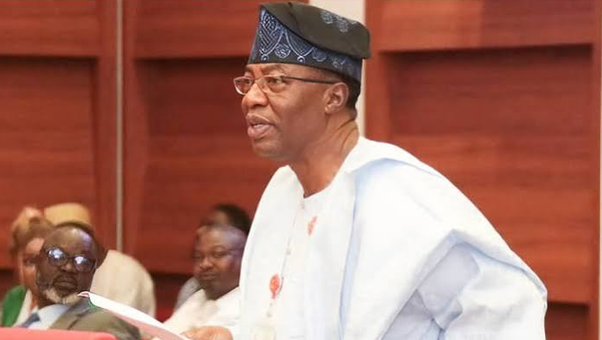
Former Ogun State Governor and Senator representing Ogun East, Gbenga Daniel, has warned that Nigeria’s efforts to strengthen its economy will remain limited unless the country addresses insecurity and creates safer conditions for businesses, farmers and investors.
Daniel said economic growth and national security were mutually dependent, arguing that insecurity raises production costs, disrupts commercial activities and weakens investor confidence. At the same time, an economy that fails to create jobs and improve livelihoods could deepen frustration and threaten social stability.
He spoke on Thursday as the Special Guest of Honour at the seventh Freedom Online Annual Lecture held at the Sheraton Hotel in Ikeja, Lagos. The event had the theme, “Economy and Security: The Future of Nigeria.”
The senator said Nigeria had recorded some positive economic indicators, including a reported 4.43 per cent growth in the second quarter of 2026. He noted that agriculture and services were among the sectors contributing to the improvement.
He, however, cautioned that headline growth figures alone could not adequately reflect the state of the economy. According to him, economic progress should also be measured by its effect on employment, household income, food production and the survival of businesses.
Daniel said the relevant questions were whether young Nigerians could secure decent employment, farmers could reach their farms without fear, manufacturers could compete effectively and small businesses could cope with the rising costs of electricity, transportation and finance.
He described security as part of the infrastructure required for economic development, rather than an issue separate from the country’s financial and productive systems.
Insecurity, he said, reduces agricultural output when farmers are unable to work safely, increases the cost of moving goods and makes Nigerian businesses less competitive. It also discourages local and foreign investors who require stability before committing capital.
“The reported abduction of more than 7,800 people between July 2025 and June 2026 is therefore not only a security statistic. It is also an economic warning,” Daniel said.
Despite the scale of the challenges, the former governor said Nigeria possessed significant advantages that could support long-term development. He identified the country’s young population, entrepreneurial culture, technology industry, financial institutions and creative economy as important sources of economic strength.
He said government policy should focus on establishing the conditions that would allow Nigerians to use their skills and enterprise more productively. These conditions, he added, included reliable infrastructure, greater economic opportunities and improved security.
‘Nigeria Cannot Rely on Oil Alone’
Daniel also called for further diversification of the Nigerian economy, warning that the country’s future could not continue to depend predominantly on oil revenue.
He said the non-oil sector accounted for approximately 95.8 per cent of Nigeria’s real Gross Domestic Product in the second quarter of 2026. According to him, the figure demonstrated the increasing contribution of agriculture, manufacturing, construction, technology, tourism, financial services, entertainment and the digital economy.
The senator said the challenge was no longer simply to record growth in those sectors but to ensure that the expansion produced more jobs, higher earnings and better living conditions for Nigerians.
He placed particular emphasis on the country’s young population, saying young people needed marketable skills, access to finance, employment and technology to participate fully in national development.
“If we give our young people opportunity, they will build Nigeria. If we deny them opportunity, frustration will grow and social stability will suffer,” he said.
Daniel’s remarks linked youth unemployment and limited economic opportunities to the wider security debate. He argued that expanding access to productive work could reduce social tension while strengthening the economy.
Daniel Points to Lagos, Ogun
The former Ogun governor cited Lagos and Ogun states as examples of the economic activity that could emerge when infrastructure, population and enterprise were supported by opportunity.
Although both states continued to face difficulties, he said their experience showed that Nigerians could be highly productive when they operated in an enabling environment.
Daniel called for economic opportunities to be expanded beyond Lagos and Ogun to other parts of the country. He said entrepreneurs in Aba, Kano, Ibadan, Jos, Port Harcourt and Maiduguri should be able to conduct business with the same level of confidence as those operating in Lagos.
According to him, securing farming communities would support food production, while protecting major roads would improve the movement of goods and commercial activity. Safer communities, he added, would attract investment, while employment and youth development would contribute to social stability.
“If we secure our farms, we strengthen food security. If we secure our roads, we strengthen commerce. If we secure our communities, we attract investment. If we create jobs and invest in our young people, we strengthen social stability and the future of the nation,” he said.
Daniel expressed optimism about Nigeria’s prospects, saying the country had sufficient human and material resources to overcome its present difficulties if they were properly managed.
“We have the people, the resources, the market and the entrepreneurial spirit. What we need is the security, leadership, infrastructure and discipline to convert potential into prosperity,” he said.
At the end of his remarks, Daniel handed over to Lagos State Governor Babajide Sanwo-Olu, who was scheduled to deliver the main lecture.