
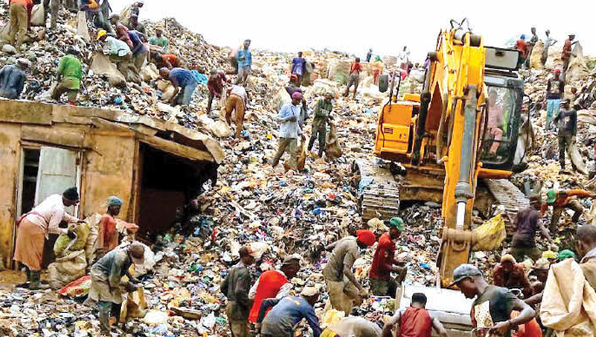
Lagos has a waste problem that is becoming increasingly difficult to hide. Across parts of the state, refuse has continued to accumulate even as authorities intensify efforts to improve collection and disposal. The problem is no longer simply about overflowing bins or untidy streets. It points to a larger challenge: how a rapidly expanding megacity can keep pace with the amount of waste generated by its residents, businesses and markets. The scale is considerable. The Managing Director of the Lagos Waste Management Authority (LAWMA), Muyiwa Gbadegesin, said in August 2026 that Lagos generates between 13,000 and 15,000 tonnes of waste every day. That figure helps explain why waste management in Lagos is less a matter of occasional clean-up and more a continuous race against the clock.
A City Producing More Waste Every Day
Lagos has experienced rapid population growth, urbanisation, industrial activity and commercial expansion. LAWMA itself acknowledges that these changes have driven a steady increase in the volume of solid waste produced across households, businesses, markets and other establishments. The consequence is straightforward: more people and more economic activity mean more waste to collect, transport, process and dispose of.
But collecting waste is only one part of the chain. The system also depends on trucks, transfer stations, disposal facilities, access roads, landfill capacity and private-sector operators working effectively together. A weakness at any point can slow down the entire process. That became particularly visible in 2026 when refuse began piling up in different parts of Lagos. LAWMA officials have acknowledged infrastructure and operational challenges affecting waste evacuation. The authority’s management has also pointed to the need for greater investment across the waste-management chain, from household containers to transportation and final disposal.
When The Dumpsite Becomes Part Of The Problem
One of the clearest examples came from Olusosun, one of Lagos’ major waste-disposal facilities in Ojota. In July 2026, the Lagos State Government commissioned a rehabilitated internal road and new disposal platforms at the Olusosun facility. The intervention was intended to improve movement within the site and reduce operational bottlenecks affecting waste evacuation. The rehabilitation followed reports about deteriorating infrastructure at the landfill and its impact on the movement of waste trucks. According to a report, the poor condition of an access road at Olusosun had contributed to difficulties moving compactor trucks into the facility, with the disruption linked to refuse accumulating in roads, markets and residential areas. That episode illustrates an important point about Lagos’ waste crisis. Sometimes the garbage seen on the street is not necessarily the beginning of the problem. It may be the final visible consequence of a breakdown somewhere else in the system.
The Private-Sector Question
Lagos’ waste-management system also relies heavily on private operators. LAWMA’s current structure places the authority in a regulatory role, while several waste-management operations, including domestic waste collection and landfill operations, involve private-sector participation. This arrangement is intended to make waste collection more efficient by combining public oversight with private-sector operations.
But it also means that questions about service delivery cannot be separated from the performance of the wider network of operators. In August 2026, LAWMA and operators under the Private Sector Participation scheme began discussions aimed at reforming the system. The process was designed to examine existing problems and develop a roadmap for a more sustainable and accountable waste-management structure. The timing is significant. The authorities are not merely dealing with individual piles of refuse. They are attempting to rethink how a system designed to serve a growing city can remain functional as the volume of waste continues to rise.
The Problem Is Bigger Than Collection
There is another layer to the crisis: what happens after waste leaves the street. LAWMA describes landfill disposal as the ultimate endpoint of the solid-waste system. Its own published material acknowledges environmental problems associated with poorly managed landfill operations, including bad odour, insects, rodents, litter and broader environmental degradation. That means a city cannot solve its waste problem simply by moving rubbish from one location to another. The longer-term question is how much waste Lagos should continue sending to disposal sites and how much can instead be reduced, reused, recycled or converted into other forms of value. The authority has indicated that waste-to-energy is part of its longer-term direction, while current interventions continue to focus on improving collection, transportation and disposal infrastructure.
Residents Still Have A Role
Government infrastructure, however, is only one side of the equation. Waste management also depends on how residents and businesses dispose of their refuse. Where waste is dumped indiscriminately, drainage channels and roads can become collection points for rubbish. That places additional pressure on an already stretched system. LAWMA’s own description of its operations includes public education and awareness as part of its responsibilities, reflecting the importance of changing disposal practices alongside improving infrastructure. For Lagos, therefore, the challenge is not simply to collect today’s waste. It is to build a system capable of handling tomorrow’s.
Can Lagos Stay Ahead?
The authorities have taken steps to address immediate bottlenecks. Roads and disposal platforms have been rehabilitated, discussions with private operators have begun, and longer-term solutions such as waste-to-energy are being pursued. But the arithmetic remains demanding. If Lagos is producing as much as 15,000 tonnes of waste each day, every increase in population, consumption and commercial activity adds pressure to the system.
That leaves the city with a question that cannot be answered by sanitation campaigns alone: can its waste infrastructure expand quickly enough to match the city itself? For now, the piles of refuse appearing on Lagos streets remain a visible reminder that the answer is still being worked out.