
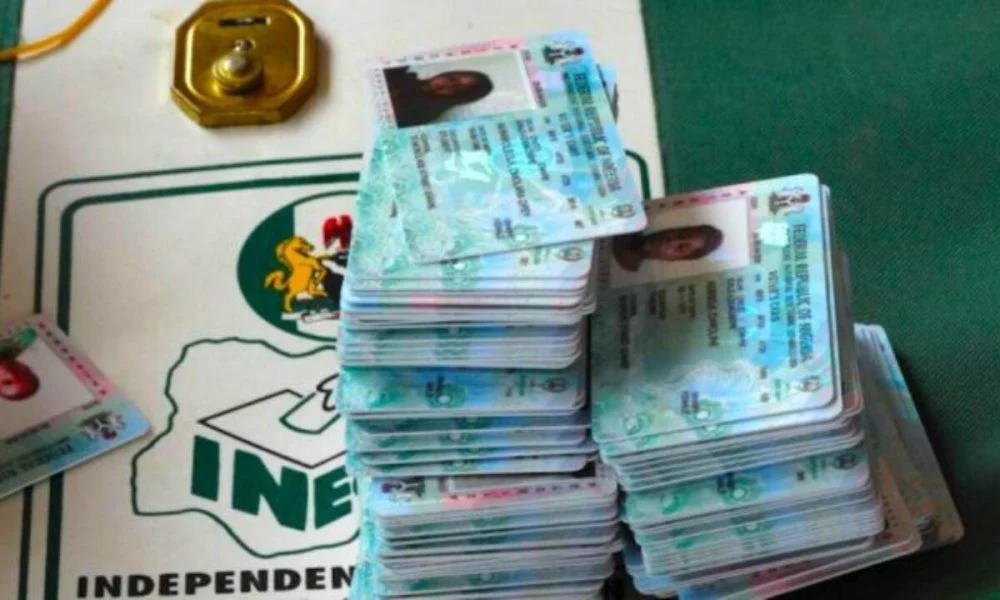
The Independent National Electoral Commission will begin nationwide collection of newly printed Permanent Voter Cards on 9 October 2026, its chairman, Professor Joash Amupitan, announced in Kaduna on Monday, 28 September.
Amupitan gave the date at the commission’s North-West zonal interactive meeting with staff, part of a six-zone tour to assess readiness for the general election. He said the cards were produced after three phases of Continuous Voter Registration, which brought in 10,772,421 new registrants. Those registrations, he added, are still being checked through the Automated Biometric Identification System to weed out double or invalid entries.
The chairman used much of the meeting to press his own field officers rather than voters. He warned that partisan leaning, administrative negligence or compromised ethics would not be tolerated, describing the protection of the commission’s integrity as non-negotiable. Reminding staff of the oath of neutrality required under Section 26 of the Electoral Act 2026, he said the guiding question must never be who benefits from a decision, but what the law requires.
Amupitan argued that good law and modern technology alone cannot guarantee a credible election. “The credibility of an election depends on how faithfully the law is implemented by the officials entrusted with its administration,” he said, telling officers that to a voter in a local ward, INEC is not the chairman in Abuja but the officer on the ground.
He linked conduct directly to public trust. Late opening of polling units, perceived bias or a poor response to technical faults, he said, could deepen voter apathy and open room for disinformation. To reduce that risk, he said the commission was applying what he called a zero-failure approach to logistics, covering early deployment of materials, security coordination and the training of ad-hoc staff.
The chairman also flagged a distribution problem that has dogged past elections. He directed officials to clear bottlenecks in PVC collection at the local government level, warning that delays there could stop eligible citizens, particularly in rural areas, from picking up their cards and effectively disenfranchise them.
According to the Supervising National Commissioner for Kaduna, Kudu Haruna, the zonal meetings were designed to let the commission’s leadership deal directly with the field personnel who run elections. Haruna said Amupitan’s courtesy visit to the Emir of Zazzau, who chairs the Kaduna State Council of Traditional Rulers, was intended to draw traditional institutions into voter mobilisation. The chairman used the visit to inform the emir of the collection schedule and to ask him to encourage residents to collect their cards.
The Director of Planning and Monitoring, Helen Ajayi, said the tour was aimed at gauging each state’s preparedness, spotting operational problems early and keeping staff aligned with the commission’s code of conduct.
The announcement sits within a tight electoral calendar. Following the enactment of the Electoral Act 2026, signed by President Bola Tinubu in February, the commission brought the polls forward, fixing the presidential and National Assembly elections for 16 January 2027 and the governorship and state assembly elections for 6 February 2027. Both were originally scheduled for February and March under the repealed 2022 Act.
The numbers behind the exercise point to a larger electorate than in 2023. The existing register held above 93 million voters, and the commission has said it expects to cross 100 million once the latest registration is finalised. In 2023, the register stood at 93,469,008, of which young people between 18 and 34 made up 37,060,399, or about 39.65 per cent, according to figures released by the commission at the time. If the new total holds, it would reinforce Nigeria’s standing as Africa’s largest electoral democracy.
The stakes attached to card collection are well established. In 2023, millions of registered voters did not collect their PVCs, and low collection in some areas was widely cited afterwards as one reason turnout fell to a historic low. The card remains the sole document a voter must present to be accredited, which is why the gap between registration and collection carries weight for the coming polls.
What remains open is how smoothly the collection itself runs once it begins. The commission has set the date and stated its targets, but the effectiveness of the exercise will depend on how many of the new registrants clear the biometric check, how quickly cards reach collection centres and whether the distribution problems Amupitan flagged are resolved before voting day. Those outcomes will only become clear as collection progresses from October.