
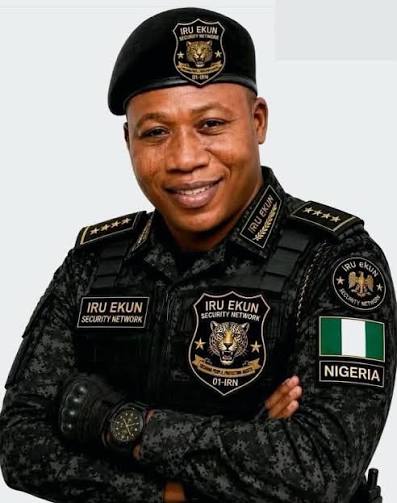
The expansion of the Iru Ekun Security Network into Ogun State has reopened a familiar but increasingly important question in Nigeria’s security debate: how much responsibility should communities assume in protecting themselves when kidnapping and other violent crimes continue to challenge conventional policing?
The initiative, founded by Yoruba Nation activist Sunday Adeyemo, popularly known as Sunday Igboho, was formally launched in Abeokuta on August 26, with reports putting the number of volunteers at more than 15,000. Igboho said the network was intended to complement, rather than replace, established security agencies.
The development is more significant when placed against the wider security picture. Nigeria recorded 7,825 kidnapping victims between July 2025 and June 2026, according to a recent SBM Intelligence report cited by Reuters. The report also recorded 1,142 killings during the period and estimated that more than $5.8 million was paid in ransom.
For the South-West, the concern is no longer theoretical. Large scale abductions have reached Oyo State, while security incidents involving kidnapping have also been recorded in Ogun, Ekiti and Ondo.
The question now is whether the emergence of another community security network can strengthen local intelligence and crime prevention without creating overlapping chains of command, unclear powers or accountability problems.
The South-West already has a formal regional security architecture through the Western Nigeria Security Network, popularly known as Amotekun.
Ogun’s own Amotekun structure was established under the Ogun State Security Agency and Amotekun Corps Law, passed by the state House of Assembly on March 24, 2020. The corps began operations on April 1, 2021 and operates across the state’s 20 local government areas.
Its statutory responsibilities include intelligence gathering, patrols, responding to distress calls, preventing highway crimes and working jointly with the Police and other security agencies.
That makes Iru Ekun’s proposed operation particularly noteworthy in Ogun. It is not entering a security vacuum. It is entering a state where a legally established community based security organisation already exists.
The difference is that Amotekun is a state backed institution created through legislation, while Iru Ekun, based on the publicly available details, is a volunteer initiative whose proposed structure is still being developed.
Igboho said the Federal Government would determine who trains Iru Ekun operatives, while the Ogun State Governor’s Office would determine their deployment. He also said members would receive identification cards at local government level and that operational support and allowances would be arranged through the governor’s office.
Those proposals raise an important administrative question: what formal legal instrument would give a volunteer network authority to operate, and what precisely would its members be permitted to do?
The scale of interest in Iru Ekun is notable, although the figures require careful attribution.
Igboho said in July that more than 80,000 people had registered across the South-West. That figure was reported by several Nigerian newspapers, but it remains a claim by the organisation rather than an independently audited membership database.
The 15,000 volunteers reportedly associated with the Ogun launch therefore represent a substantial proportion of the claimed regional membership, but the two figures measure different things. One refers to registrations across the South-West, while the other concerns participation reported at the Ogun inauguration.
More importantly, membership numbers do not establish whether a security organisation has reduced crime.
Igboho has claimed that kidnapping declined in communities where Iru Ekun operates. No publicly available independent dataset reviewed for this report establishes that the claimed reduction was caused by the network.
That distinction matters because crime trends can be influenced by several factors, including police operations, military deployments, arrests, ransom payments, criminal displacement and changes in reporting.
Available security data nevertheless show why communities remain concerned.
An EU Agency for Asylum assessment based on ACLED data recorded 131 security incidents and 121 fatalities in Ogun between January 2024 and December 2025. The assessment identified kidnapping, armed robbery, cult violence and other criminal activity among the state’s security concerns.
In Ekiti, ACLED recorded 30 security incidents and 16 fatalities between January 2024 and August 2025. Seventeen of those incidents were classified as violence against civilians.
Ondo recorded 89 security incidents and 72 fatalities between January 2024 and August 2025, with 58 incidents classified as violence against civilians. ACLED identified abductions for ransom and killings among the reported violence.
The threat became more visible in 2026 after gunmen abducted students and a teacher in Oyo State in May. ACLED described the attack as significant partly because large scale kidnapping had not traditionally been associated with the South-West to the same extent as the North-West and North-East.
South-West governors have subsequently discussed regional cooperation around security and Amotekun. Ondo Governor Lucky Aiyedatiwa said in June that governors were working together to improve security across the zone.
Nigeria’s security framework makes the proposed arrangement particularly sensitive.
Section 214 of the Constitution provides for the Nigeria Police Force and states that, subject to the constitutional provisions, no other police force shall be established for the Federation or any part of it. The Nigeria Police Force remains responsible for conventional policing functions.
At the same time, the Nigeria Police Act 2020 expressly recognises community policing. Sections 113 to 119 provide for community policing committees, while Section 117 identifies functions including crime prevention, intelligence gathering, community patrols and support for public safety.
The law therefore provides room for structured community participation in security, but that participation is designed around cooperation with the Police.
This is why Igboho’s instruction that Iru Ekun members should report security breaches to Divisional Police Officers and work with the Police, DSS, Army and other agencies is significant.
It also explains why his repeated warnings against indiscipline and personal use of authority matter. A large volunteer organisation operating in communities can generate valuable intelligence, but without clear rules, training, identification, command structures and mechanisms for complaints and discipline, the same structure could create new risks.
Nigeria’s experience with community security initiatives shows that public demand for local protection is real. But legitimacy cannot depend solely on popularity or the number of volunteers recruited.
Iru Ekun’s next stage will therefore be more consequential than its inauguration. Questions remain about its legal status, recruitment standards, training curriculum, weapons policy, command structure, funding, relationship with Amotekun and the Police, rules governing arrest or detention, and mechanisms for investigating complaints against members.
Igboho has said background checks would be conducted on recruits, while publicly available statements emphasise cooperation with established security agencies.
Those safeguards will need to move from statements into documented rules if the initiative is to operate on a sustainable basis.
The broader lesson is that Nigeria’s security challenge cannot be measured simply by how many security organisations exist. The more important questions are whether intelligence reaches the right authorities quickly, whether communities trust those authorities, whether operatives understand their legal limits and whether misconduct can be investigated and sanctioned.
For Ogun and the wider South-West, Iru Ekun’s emergence is therefore less a story about another security outfit than another chapter in Nigeria’s continuing search for a workable balance between community participation and state authority.