
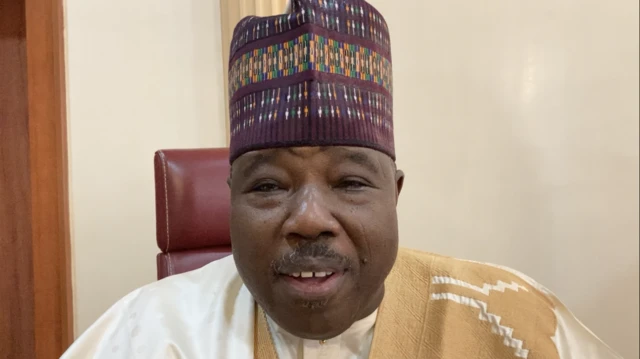
Ali Modu Sheriff has drawn a firm line under the 2027 succession debate, telling former Vice President Atiku Abubakar to abandon any hope of returning to the presidency next cycle and instead hold his ambition until 2031. The former Borno State governor and All Progressives Congress chieftain argued that power must remain in the South for another term, and that no unwritten arrangement binding the country’s political elite would allow the North to break ranks in Atiku’s favour.
Sheriff made the remarks on Monday night during an appearance on Channels Television’s Politics Today, wading into a conversation that has grown louder as opposition figures shuttle between parties and consultations ahead of the next general election. His message, delivered with the bluntness that has long defined his politics, was that timing, not competence, stands between Atiku and Aso Rock.
“After the civil war our leaders have said that there will no longer be this situation in Nigeria, there is a regional agreement. For Atiku, it’s not our time now. He is on his own because it is the turn for the South. Buhari just finished 8 years,” Sheriff said.
He was careful not to question Atiku’s standing as a Northern leader, framing the matter strictly as one of rotation. “If Atiku wants to be president he can wait, he is a leader in Northern Nigeria, he is eminently qualified but it is not our time now, he has to wait till 2031. That is the time for the North, for now, it is time for the South,” he added.
The argument rests on the informal North-South power rotation that has shaped presidential contests since the return to civilian rule in 1999. By Sheriff’s reading, Muhammadu Buhari’s two terms between 2015 and 2023 exhausted the North’s claim for the moment, handing the South a run that, in his view, should extend through a second Tinubu term before any Northern candidate can legitimately stake a claim. It is a convention with no constitutional force, yet one that has repeatedly influenced how the major parties zone their tickets.
Atiku, who has sought the presidency more times than any other living Nigerian politician, is now widely reported to be positioning for a 2027 run on the platform of the African Democratic Congress, having severed his long ties with the Peoples Democratic Party. That shift has itself been complicated by an ongoing legal tangle. The Court of Appeal in Abuja is weighing appeals against a Federal High Court judgment that ordered the Independent National Electoral Commission to deregister the ADC and four other parties for failing to meet the performance thresholds set out in the Constitution and the Electoral Act 2022. The outcome of that case could shape the very vehicles available to opposition contenders.
Sheriff did not confine his fire to Atiku. He dismissed the presidential prospects of Peter Obi, the former Anambra State governor who finished third in the 2023 election with more than six million votes on the Labour Party ticket and is now expected to contest under the newly registered Nigeria Democratic Congress. “I am not worried about Peter Obi at all because I know that Northerners will never vote for Peter Obi,” he said.
Reminded that Obi had performed strongly in Northern-adjacent states such as Nasarawa and Plateau in 2023, Sheriff insisted the ground had shifted beneath the former governor’s feet. “The situation is different now, you know why? Peter Obi when he was a governor chased all the Northerners out of Anambra State,” he alleged, repeating a claim Obi’s camp has consistently rejected.
He went further, suggesting that even a marriage of convenience between Obi and Northern power blocs would struggle to hold. Pointing to supporters of former Kano State governor Rabiu Kwankwaso, Sheriff claimed there was resistance to any alliance that placed Obi at the top of the ticket. “This is what Kano people are telling Kwankwaso now, that we always supported you and we will support you if you run for president but we will not support you to go with Peter Obi,” he said.
Throughout the interview, Sheriff projected confidence in President Bola Tinubu’s re-election, while cautioning his own party against complacency. He defended the administration’s handling of insecurity, arguing that the challenge predated Tinubu and pointing to the push for state police as evidence of a serious response, even as he stressed that the APC would campaign hard rather than assume victory.
The comments land at a moment of intense realignment within the opposition, where questions of zoning, coalition-building and party survival remain unresolved. Whether Sheriff’s version of the rotation principle carries the weight he assigns to it will ultimately be tested at the ballot box, and by whether the fractured opposition can settle on a single candidate before 2027 arrives.