
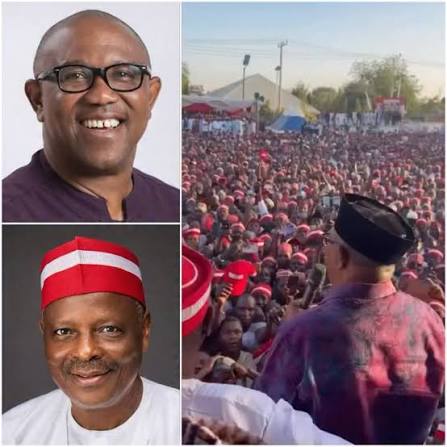
Presidential candidate of the Nigeria Democratic Congress (NDC), Peter Obi, has defended members of the Kwankwasiyya movement over their practice of carrying sticks at political gatherings, saying he has not witnessed supporters using them to attack anyone.
Obi spoke on Tuesday during an interview with Channels Television in Jalingo, Taraba State, following a town hall meeting with his running mate, Rabiu Musa Kwankwaso, at The Crest Hall. His remarks came amid growing concerns over political violence ahead of the 2027 general elections, following attacks on opposition campaign activities in Kano and Delta states.
The former Anambra State governor explained that carrying sticks at political gatherings had long been associated with members of the Kwankwasiyya movement. He maintained that his association with the group had not exposed him to incidents in which supporters used the objects to harm others.
Obi also addressed the controversial campaign slogan against election rigging, arguing that opposition to electoral malpractice should not be interpreted as hostility towards political campaigns. He appealed to security agencies to protect lives and ensure that political competition did not degenerate into violence.
The security concerns intensified following the November 23 attack on a campaign gathering of former Deputy Senate President and NDC candidate for Delta Central Senatorial District, Ovie Omo-Agege, at Uduere community in Ughelli North Local Government Area.
The attack claimed six lives, according to preliminary police figures, against the four deaths initially announced by Omo-Agege’s campaign organisation. The former deputy senate president escaped, while several others sustained injuries.
Delta State Police Command spokesperson, Bright Edafe, subsequently announced that Omo-Agege, Ughelli North Local Government Chairman Jaro Egbo and other persons of interest had been invited for questioning as part of investigations into the incident.
Omo-Agege and Egbo have traded allegations over responsibility for the violence. Egbo denied accusations linking him to the attack, while the police have yet to establish the culpability of those invited for questioning.
Governor Sheriff Oborevwori condemned the killings and directed security agencies to apprehend those responsible. The state government also imposed a daily 12 hour curfew in Ughelli North as part of measures to restore order.
The Delta incident occurred eight days after an attack on Kwankwaso’s campaign convoy in Bichi Local Government Area of Kano State. Members of the campaign team sustained injuries, while vehicles were damaged, according to Ibrahim Shu’aibu, spokesperson for the campaign organisation of NDC governorship candidate Aminu Gwarzo.
Obi’s defence of the Kwankwasiyya movement comes against a wider legal framework governing political campaigns. Section 97 of the Electoral Act 2026 prohibits the use or threat of violence to compel individuals to support or oppose political parties and candidates.
The law prescribes a maximum fine of N5 million or 12 months imprisonment for individuals convicted of the offence. Political parties face a fine of N10 million for a first offence and N2 million for subsequent violations.
While Obi maintains that carrying sticks is an established practice among Kwankwasiyya supporters, his personal account does not independently establish that no incidents of violence have involved members of the movement. Questions concerning intimidation and public safety remain subject to electoral law and the findings of security agencies.
The Kwankwasiyya movement derives its political identity from Kwankwaso, who governed Kano State between 1999 and 2003 and again between 2011 and 2015. Its supporters are widely identified by their distinctive red caps and grassroots political mobilisation.
Obi and Kwankwaso were separate presidential candidates during the 2023 general election, contesting on the platforms of the Labour Party and the New Nigeria Peoples Party respectively. Their current alliance has brought together two established opposition political networks.
Both politicians have been holding town hall meetings across the country ahead of the 2027 elections. However, the recent incidents in Kano and Delta have brought campaign security, political tolerance and the protection of citizens participating in electoral activities into sharper focus.