
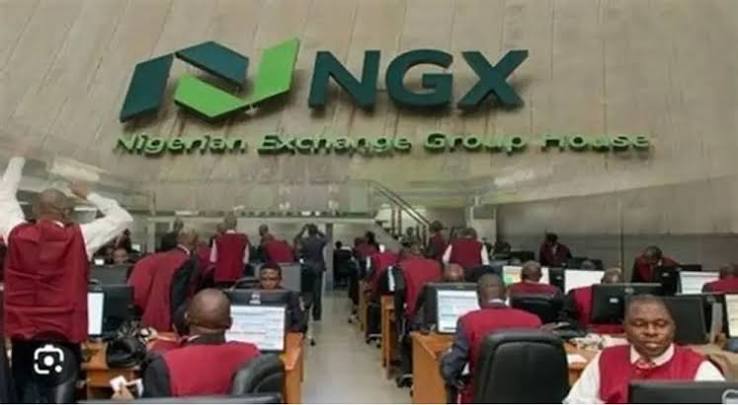
Nigeria’s equities market lost N514.91 billion in market value on Tuesday, November 24, as losses in several major banking and consumer goods stocks outweighed gains recorded across the insurance sector.
The Nigerian Exchange Limited (NGX) recorded a decline in market capitalisation from N160.04 trillion on Monday to N159.52 trillion on Tuesday, representing a decrease of approximately 0.32 per cent. The All Share Index also fell by 793.03 points, closing at 245,685.87 against 246,478.90 in the previous trading session.
Market data compiled by GTI Research showed that 29 stocks declined, 22 appreciated, while 95 remained unchanged. Despite the latest downturn, the benchmark index retained a return of 57.88 per cent since the beginning of 2026, reflecting substantial gains recorded earlier in the year.
Trading activity increased considerably despite the decline in share prices. Transaction value rose by 82.07 per cent from N15.49 billion on Monday to N28.21 billion on Tuesday.
Equities trading accounted for 489.43 million shares across 31,609 deals, compared with approximately 441.07 million shares in the preceding session. This represented an increase of about 11 per cent in trading volume, even as the number of transactions declined.
Banking stocks contributed to the negative performance, with the NGX Banking Index falling by 0.47 per cent to 2,256.23 points from 2,266.95 points. Zenith Bank declined by 3.23 per cent to N105, United Bank for Africa lost 2.56 per cent to close at N38, while Guaranty Trust Holding Company shed 0.89 per cent to settle at N111.
Sterling Financial Holdings Company also depreciated by 3.07 per cent to N74.90. However, FCMB Group gained 7.23 per cent to close at N12.60, while Access Holdings appreciated by 5.06 per cent to N27.
First HoldCo and Fidelity Bank recorded modest gains of 0.53 per cent and 0.45 per cent, closing at N103.55 and N22.20 respectively.
Insurance stocks bucked the broader market trend, with the sector’s benchmark index rising by 5.01 per cent from 1,129.35 points to 1,185.90 points. Insurance companies also occupied the first five positions on the gainers’ chart, making the sector the most prominent source of price appreciation during the session.
NEM Insurance, Cornerstone Insurance and SUNU Assurances each appreciated by 10 per cent, closing at N30.80, N6.05 and N2.86 respectively. AIICO Insurance gained 9.91 per cent to N4.77, while Mutual Benefits Assurance advanced by 7.77 per cent to N3.05.
AIICO was among the most actively traded equities, accounting for 72.09 million shares, equivalent to approximately 14.7 per cent of total equities trading volume. Not all insurers benefited from the rally, however, as Guinea Insurance, Fortis Global Insurance and International Energy Insurance recorded losses.
Consumer goods and technology companies also came under pressure. Unilever Nigeria led the losers’ chart with a decline of 9.98 per cent to N101, followed by Legend Internet, which dropped 9.72 per cent to N3.25, and Omatek Ventures, which fell 9.66 per cent to N1.31.
The NGX Industrial Goods Index declined by approximately 0.63 per cent to 11,599.88 points, while the Pension Index eased by 0.37 per cent to 12,116.73 points. The Oil and Gas Index recorded a marginal gain of 0.03 per cent.
Beyond equities, trading in exchange traded products accounted for 152,022 units across 567 transactions. Meristem Value Exchange Traded Fund appreciated by 6.60 per cent, while the Vetiva S&P Nigeria Sovereign Bond ETF gained 5.05 per cent.
Tuesday’s performance extended the market’s recent decline. Between November 18 and November 24, the benchmark index fell from 248,329.65 points to 245,685.87 points, representing a cumulative decline of approximately 1.06 per cent and a reduction of about N1.72 trillion in market capitalisation.
The contrast between rising transaction value and falling market capitalisation shows that increased trading activity did not translate into broader price recovery. While insurance companies attracted considerable demand, weakness across banking, consumer and industrial stocks remained sufficient to keep the overall market in negative territory.