
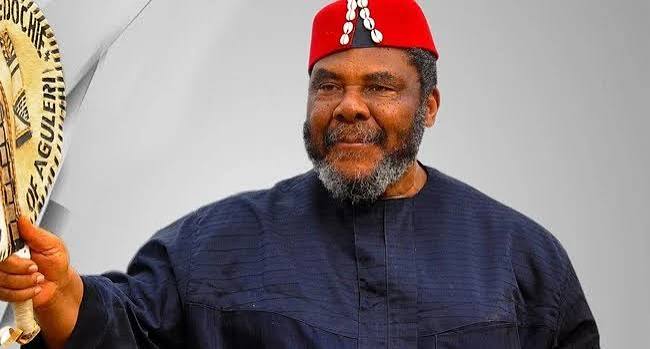
Veteran Nigerian actor and broadcaster, Chief Pete Edochie, whose portrayal of Okonkwo in the television adaptation of Chinua Achebe’s Things Fall Apart established him as one of Nigeria’s most celebrated performers, has died at the age of 79.
His son, Leo Pete Edochie, announced the death in a statement on behalf of the family, saying the actor died at 12:30 am on Wednesday, November 25, 2026, in Enugu, following a prolonged battle with prostate cancer.
Edochie’s death marks the end of a career spanning nearly six decades, during which he distinguished himself in broadcasting, television drama and filmmaking. His distinctive voice, command of Igbo proverbs and portrayal of traditional rulers and family patriarchs made him one of the most recognisable figures in African cinema.
Born on March 7, 1947, and raised in northern Nigeria, Edochie hailed from Akamnato, Ifite Nteje, in Anambra State. He attended St Patrick’s and St James Primary Schools in Zaria and St John’s College, Kaduna, before pursuing further studies in journalism and television in England.
His professional journey began in 1967 when he joined the Eastern Nigerian Broadcasting Corporation as a junior programmes assistant. He rose through the ranks to become Director of Programmes at the Anambra Broadcasting Service, where he also served as Deputy Managing Director and occasionally as Acting Managing Director.
Edochie developed an interest in drama long before his emergence as a professional actor. Recalling his early years in a 2022 interview, he spoke about performing in William Shakespeare’s The Merchant of Venice during his secondary school days in Kaduna and participating in television drama productions during his broadcasting career.
His breakthrough came in the 1980s when he played Okonkwo in the Nigerian Television Authority’s adaptation of Things Fall Apart. The production, based on Achebe’s 1958 novel, explored the disruption of traditional Igbo society following the arrival of colonial administration and Christian missionaries.
His performance attracted international attention, prompting the British Broadcasting Corporation to interview him. By the time Living in Bondage was released in 1992, ushering in a new era of commercial home video production in Nigeria, Edochie had already established himself as a prominent television actor.
He subsequently featured in several notable films, including Rituals, Igodo and Billionaire’s Club. His ability to incorporate traditional expressions, cultural references and proverbial wisdom into his performances distinguished him throughout the expansion of Nollywood in the 1990s and 2000s.
More than three decades after his breakthrough on television, Edochie appeared as Chief Ernest Obiagu in Genevieve Nnaji’s 2018 film, Lionheart. The production reached international audiences through Netflix, reflecting the extent to which Nigerian cinema had evolved from television drama and home video distribution.
His contributions earned him the national honour of Member of the Order of the Niger (MON) in 2003 under former President Olusegun Obasanjo. He also received the Africa Magic Industry Merit Award, a Lifetime Achievement Award from the Africa Film Academy and the African Film Legend Award in 2020.
Until his death, Edochie remained active in public conversations about marriage, family, African culture and the entertainment industry.
An interview he granted Ugo Nwokolo TV was scheduled for release on Wednesday, the same day his family announced his death. Excerpts circulated on November 22 showed the actor addressing the controversy surrounding his son, Yul Edochie’s marriage to actress Judy Austin and the public criticism that followed.
Wednesday’s announcement came nine months after his family dismissed rumours of his death in February 2026.
Edochie is survived by his wife, Josephine Edochie, six children, including actors Linc and Yul Edochie, siblings and other relatives.
Across 59 years in broadcasting and entertainment, Edochie witnessed the transformation of Nigerian storytelling from government television stations to an industry whose productions now reach audiences across the world. His portrayal of Okonkwo and subsequent contributions to Nollywood remain a significant part of Nigeria’s cultural and cinematic history.
The family said funeral arrangements would be announced in due course.