
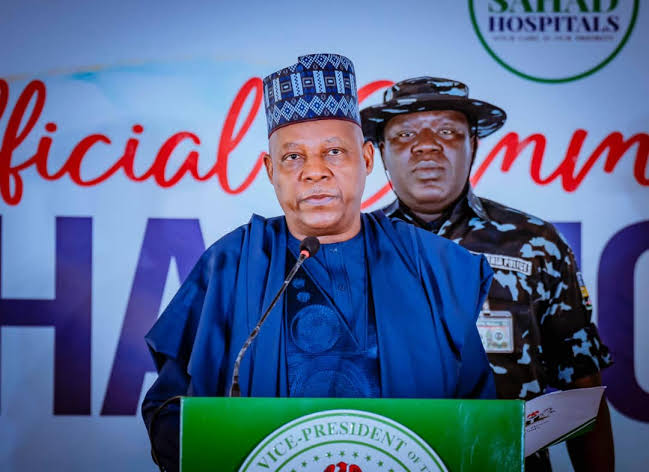
Vice President Kashim Shettima has called for drug abuse and illicit drug trafficking to be treated as a national emergency, warning that their consequences extend beyond criminal activities to public health, national security, workforce productivity and the future of millions of young Nigerians.
Shettima made the call on Monday, November 23, during the launch of the National Drug Control Master Plan for 2026 to 2030. Represented by the Special Adviser to the President on Special Duties, Modibbo Umar, the Vice President said Nigeria could no longer rely on arrests, drug seizures and prosecution alone to address a problem affecting families, schools, workplaces and communities.
The call comes as the National Drug Law Enforcement Agency (NDLEA) disclosed that the implementation of the previous master plan, which covered 2021 to 2025, resulted in 77,736 arrests, the seizure of more than 14.8 million kilogrammes of illicit drugs and over 14,200 convictions.
NDLEA Chairman, Brigadier General Mohamed Buba Marwa (retd.), said more than 32,400 people also benefited from treatment, counselling and rehabilitation services during the period. However, an evaluation of the previous framework identified weaknesses in funding, institutional coordination, service delivery, data management and implementation at state and local government levels.
The scale of Nigeria’s drug problem was established by the 2018 National Drug Use Survey, conducted by the National Bureau of Statistics with support from the United Nations Office on Drugs and Crime (UNODC). The survey estimated that 14.3 million Nigerians aged between 15 and 64 had used drugs for nonmedical purposes within the preceding 12 months, representing 14.4 per cent of that population. This was more than twice the then global prevalence of 5.6 per cent. UNODC +1
The nationwide study covered 38,850 household respondents and 9,344 people classified as high risk drug users. It found that approximately one in five people who had used drugs experienced drug use disorders, while nearly 40 per cent of high risk users indicated a need for treatment. Stigma, treatment costs and inadequate facilities were identified as major obstacles to accessing care. EEAS +1
Although the survey provides an important national baseline, its figures should not be mistaken for current prevalence estimates. Similarly, the thousands of arrests and substantial drug seizures recorded between 2021 and 2025 demonstrate the scale of enforcement activities but do not, on their own, establish whether drug consumption has declined nationwide.
Shettima said the new framework would address six priority areas, including reducing illicit drug supply and demand, improving access to controlled medicines for legitimate medical purposes, providing alternative livelihoods, disrupting criminal financial networks and strengthening institutional coordination.
The Vice President also directed government institutions to reflect the priorities of the master plan in their annual budgets and operational programmes. He maintained that inadequate financing and fragmented institutional responses could undermine the objectives of the policy. TVC News +1
Marwa identified emerging synthetic drugs and increasingly sophisticated international trafficking networks as additional challenges confronting Nigeria. He said the agency would strengthen intelligence gathering, financial investigations and international cooperation to dismantle criminal organisations and recover proceeds linked to illicit drug activities.
The NDLEA chairman also disclosed that the proposed NDLEA Bill 2026 had passed second reading at the National Assembly. He advocated dedicated funding for drug control committees across states and local government areas, alongside provisions for implementing the master plan in the Federal Government’s annual budgets and Medium Term Expenditure Framework. National Drug Law Enforcement Agency +1
Attorney General of the Federation and Minister of Justice, Lateef Fagbemi (SAN), said his ministry would work with the judiciary to accelerate the determination of drug related cases under the Administration of Criminal Justice Act. He also pledged stronger international legal cooperation, extradition arrangements and recovery of criminal assets.
Fagbemi, however, stressed the importance of distinguishing between individuals involved in trafficking and people experiencing drug dependence, maintaining that the latter require appropriate healthcare, counselling and reintegration into society rather than punishment alone.
Part of the government’s prevention strategy involves supporting alternative livelihoods in communities associated with illicit drug cultivation. Shettima identified three communities in Ondo State where the NDLEA’s pilot alternative development programme was already being implemented.
The Economic Community of West African States (ECOWAS), through its Commissioner for Human Development and Social Affairs, Professor Nassirou Bako-Arifari, welcomed the framework but emphasised that its success would depend on sustained political commitment, adequate funding and cooperation across national borders. TheCable +1
For Nigeria, the next five years will provide an opportunity to assess whether drug control policies can deliver results beyond arrests and seizures. Updated prevalence surveys, wider access to affordable treatment, transparent expenditure records, effective prevention programmes and measurable reductions in drug related harm will be important indicators of whether the new framework is achieving its intended objectives.