
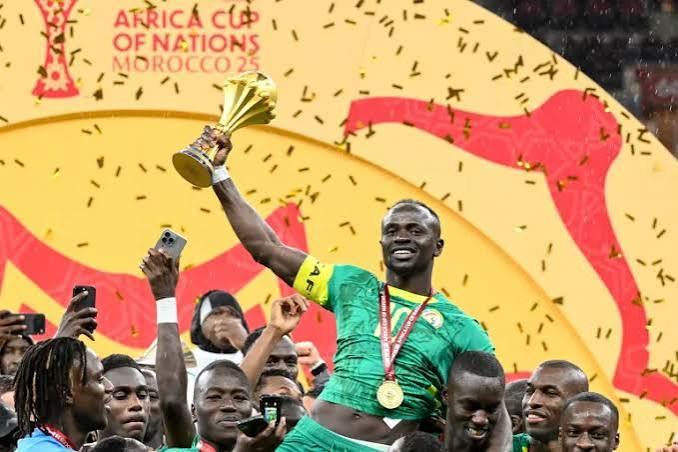
The Court of Arbitration for Sport (CAS) is scheduled to deliver its ruling on Senegal’s appeal against the decision to strip the country of the 2025 Africa Cup of Nations (AFCON) title on Tuesday, November 24, bringing months of legal proceedings over the disputed final against Morocco closer to a conclusion.
The ruling will determine whether Senegal’s victory on the pitch should be restored or the Confederation of African Football’s (CAF) decision to award Morocco a 3–0 victory should stand.
CAS notified the Senegalese Football Federation (FSF), the Royal Moroccan Football Federation (FRMF) and CAF that the decision would be communicated on Tuesday afternoon, without specifying an exact time. The court also stressed that announcements concerning the ruling would carry official authority only when issued through its recognised channels.
The dispute dates back to January 18, 2026, when Senegal defeated hosts Morocco by a lone goal after extra time at the Prince Moulay Abdellah Stadium in Rabat. Pape Gueye scored the decisive goal after Morocco’s Brahim Diaz failed to convert a penalty awarded towards the end of regulation time.
The penalty decision, however, triggered protests from Senegalese players, several of whom left the pitch. The incident interrupted proceedings for approximately 14 minutes before the players returned and Congolese referee Jean Jacques Ndala allowed the match to continue.
Although Senegal celebrated what would have been their second continental title, the Moroccan football federation challenged the outcome, arguing that the departure of the Senegalese players constituted a breach of the competition regulations. The dispute subsequently moved from CAF’s disciplinary proceedings to its Appeal Board.
On March 17, CAF’s Appeal Board overturned the earlier disciplinary decision, finding that Senegal’s conduct fell within the provisions of Articles 82 and 84 of the AFCON regulations. It declared that Senegal had forfeited the final and officially recorded Morocco as winners by three goals to nil. Confédération Africaine de Football +2
Article 82 addresses situations in which a team refuses to play or leaves the pitch before the end of a match without the referee’s authorisation. Article 84 prescribes forfeiture and a corresponding three goal defeat under the applicable circumstances.
Senegal rejected the decision and lodged an appeal with CAS on March 25, eight days after CAF’s ruling. The Senegalese federation requested that the decision be set aside and its national team recognised as champions of the tournament.
Senegal’s argument centres on the authority of the referee, who permitted the match to resume and reach its conclusion. Morocco, on the other hand, maintains that completing the match did not invalidate the earlier breach of the competition regulations.
Arguments from the three parties were heard behind closed doors on October 8 at the headquarters of CAS in Lausanne, Switzerland. The arbitration panel comprises French sports law expert Gérald Simon, Italian law professor Luigi Fumagalli and sports law specialist Ulrich Haas.
The court initially indicated that a decision could be reached within days of the hearing but subsequently opted to publish a comprehensive award containing the legal grounds for its ruling. The October 19 procedural update placed the expected delivery of the decision towards the end of November. TAS-CAS +2
Tuesday’s ruling comes 310 days after the final and 244 days after Senegal formally registered its appeal, bringing an unusually prolonged dispute over the ownership of Africa’s most prestigious football trophy to a critical stage.
The historical significance is considerable for both countries. Morocco secured its first AFCON title in 1976, while Senegal won its maiden championship at the 2021 edition, played in February 2022, defeating Egypt on penalties.
A ruling restoring Senegal’s victory would secure the country’s second continental championship. Conversely, upholding CAF’s decision would preserve Morocco’s second title, ending a 50 year interval between its championships.
For Nigeria and other African football nations, the legal reasoning accompanying the verdict will be particularly important. It could provide greater clarity on the relationship between refereeing authority, disciplinary jurisdiction and the enforcement of competition regulations when players abandon a match but subsequently return to complete it.
CAS awards are legally binding, although challenges may be brought before the Swiss Federal Supreme Court on limited legal grounds.
Until the arbitration panel publishes its decision, Morocco remains the officially recognised champion under CAF’s March 17 ruling, while Senegal’s claim to the title remains the subject of the pending appeal.