
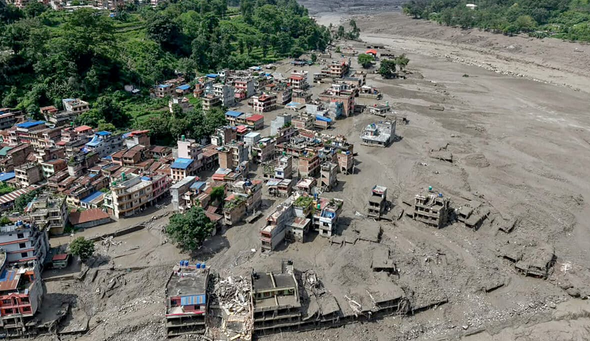
A catastrophic glacier collapse high in the Himalayas triggered flash floods along the Nepal-Tibet border on Wednesday, 26 August 2026. Surging walls of water and rock killed more than 160 people and left nearly 1,500 missing across mountain districts in both countries. The torrent tore through Nepal’s Rasuwa district and ripped into Tibet’s Gyirong County within minutes. The sudden deluge wiped out border posts, paved highways, and several key hydroelectric dams. Floodwaters carried mud and heavy debris over one hundred kilometres downstream into low-lying farming valleys. Thousands of Hindu pilgrims and Western trekkers found themselves trapped along narrow mountain corridors. Nature offered no advance warning to those standing below. High mountain settlements paid a terrible price for living beneath fragile ice.
Early reports from Kathmandu suggested a tectonic earthquake had shaken the lower edge of a hanging glacier. United States Geological Survey analysts quickly corrected that initial reading. Long-period seismic sensors proved that the falling mass of ice and rock itself generated the magnitude 5.2 shockwave. Millions of tonnes of glacial ice sheared off the heights near Langtang Lirung and plunged into the Lhende Khola gorge. The falling ice melted upon impact and pushed an eight-metre wall of mud down the river channel. Trapped debris formed temporary dams that burst in rapid succession, multiplying the downstream force. Fast-moving water behaves like liquid concrete when packed with mountain stone. The narrow Himalayan canyons channelled that destructive energy straight toward vulnerable frontier towns.
The timing of the surge coincided with the peak pilgrimage season for Mount Kailash and Lake Mansarovar. More than six hundred foreign travellers remain unaccounted for across the rugged border zone. Indian devotees formed the largest foreign contingent, with over 170 nationals missing in Nepal alone. A large group of pilgrims stood inside the Rasuwagadhi immigration building when the muddy torrent struck. The flood swept the entire border complex away before anyone could reach high ground. Embassies in Kathmandu now scramble to trace missing citizens from Britain, America, Australia, and Canada. Sacred journeys ended in sudden chaos along the rocky frontier. Consular desks face frantic calls from families across three continents.
The flood pulverised critical transport and energy infrastructure along the Trishuli River basin. The Nepal Electricity Authority reported severe damage across six power stations, knocking 430 megawatts off the national grid. Raging water wrecked the Chilime and Trishuli hydroelectric plants and smashed key high-voltage substations. Road engineers estimate that the torrent destroyed nineteen bridges and washed out forty kilometres of paved highway. The destruction of the Rasuwagadhi customs terminal completely severed northern trade with China. Similar flooding last year destroyed the historic Friendship Bridge and halted commercial transport for months. Mountain roads require years of repair after one violent morning. Nepal lost its main overland commercial gateway in a single stroke.
Mudslides and broken bridges severely handicap military rescue teams trying to reach isolated gorges. Mud up to two metres deep covers the approach roads around the Gyirong land port in Tibet. The Nepali Army deployed helicopters to winch survivors from roofs and tree canopies in Nuwakot. Thick cloud cover and relentless monsoon showers repeatedly forced rescue pilots back to Kathmandu tarmac. Local volunteers and health workers searched riverbanks on foot using crude ropes and bamboo poles. The Nepal Red Cross Society moved emergency tents and clean water kits toward displaced villagers in Syabrubesi. Bad weather makes mountain rescues brutally slow and dangerous. Ground teams dig through wet clay while racing against freezing night temperatures.
The danger did not stop at the mountain foothills. Water levels spiked rapidly along the Gandak River system as runoff poured south toward the Indian plains. Authorities in Bihar and Uttar Pradesh issued urgent flood alerts to farming settlements along the riverbanks. Chinese hydrological monitors warned that unstable debris dams upstream in Tibet still threaten sudden secondary releases. Emergency managers ordered low-lying villages in Chitwan district to move families to elevated school buildings. Downstream communities watch river gauges with justified anxiety. Silt-heavy floodwaters ruin freshwater wells and spoil standing rice paddies within hours. Shared river basins turn local mountain disasters into cross-border economic shocks.
Scientists point to accelerating Himalayan warming as the underlying driver of frequent glacial collapses. The International Centre for Integrated Mountain Development warned that regional glaciers are losing volume at record speed. Warmer summer temperatures destabilise high-altitude permafrost and weaken the rock foundations holding hanging ice sheets. Traditional mountain communities build concrete homes and power plants along riverbeds that glaciers once occupied. Regional governments still treat these mountain surges as freak accidents rather than predictable climate realities. Expanding hydropower capacity without early warning satellite networks represents a reckless gamble with public money. Planners cannot tame mountain rivers with wishful engineering alone. The Himalayan heights will continue to cast down ice and water until policy matches the climate reality.