
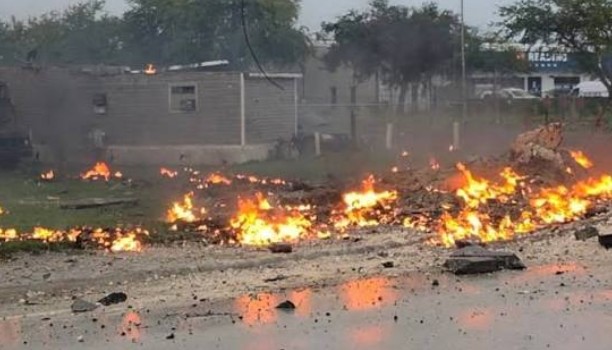
A private business jet slammed into a Florida neighbourhood near Donald Trump’s Mar-a-Lago estate on Sunday, killing all nine people on board. The Bombardier-built Learjet 60 plummeted into a street in Cresthaven, leaving a burning crater and knocking out local electrical power. The aircraft had taken off from Austin-Bergstrom International Airport in Texas and was flying toward North Eleuthera Airport in the Bahamas. Death met them in transit.
Heavy rainstorms pounded Palm Beach County as the aircraft approached the coastal corridor. Air traffic controllers recorded distress calls from the pilot shortly before the twin-engine jet lost altitude. Radar tracking data showed the aircraft banking sharply to the right from 8,000 feet before plunging nose-first into the ground. Ground witnesses described the final dive as looking and sounding like an incoming missile.
US Transportation Secretary Sean Duffy confirmed the total casualty count and offered public condolences to the families. Emergency responders rushed to the impact site near a busy roadside, but found zero survivors among the wreckage. Donald Trump had departed the area on Air Force One roughly one hour before the disaster occurred. Federal investigators quickly secured the crash zone to preserve flight evidence.
The National Transportation Safety Board and the Federal Aviation Administration launched a joint investigation into the fatal crash. Investigators will analyse radar trajectories, flight recording devices, and local weather conditions to determine why the jet lost control. Aviation records show a Delaware corporate entity owned the multi-million-dollar private aircraft. Federal authorities have not yet released the passenger manifest or victim identities.
Private aviation safety faces renewed public scrutiny following high-profile accidents during severe weather events. Light business jets operate near structural performance limits when navigating intense tropical storm cells. Mechanical failure, severe wind shear, and sudden pilot disorientation remain primary focus areas for air safety inspectors. Small jet charter firms must enforce rigid weather avoidance protocols to keep passengers safe.
The disaster highlights the inherent risks of light private aircraft operating in turbulent weather zones. Federal air safety teams must provide fast, transparent answers to explain the sudden loss of structural control. Regulators must enforce strict maintenance standards across all charter fleets to prevent catastrophic mid-air failures. Safety regulations require constant enforcement to protect human lives in the skies.