

In a landmark step for African integration, the African Continental Free Trade Area (AfCFTA) Secretariat signed a $3.1 billion, 20-year concession agreement with Bergmans Security Consultants and Supplies Limited to overhaul customs administration across member states. The project aims to deploy digital infrastructure, real-time tracking, and automated risk systems across fifty participating nations, creating a unified architecture for a $3.4 trillion continental market. Yet, on the very same day this deal was sealed in Abuja, officers at the Tin Can Island Port Command in Lagos were physically unsealing container TEMU 184536/9. Inside, hidden among legitimate imports, lay 140 reassembled double-barrel pump-action rifles alongside packages of cannabis-infused goods worth over N373 million. The interception relied on intelligence flags, but the final discovery required human officers to physically break seals, offload crates, and inspect cargo piece by piece.
This simultaneous occurrence lays bare the core dilemma confronting Nigerian trade policy. Broad digital agreements signed at diplomatic summits mean little if maritime gateways remain anchored to physical, manual cargo examinations. For the AfCFTA to double intra-African trade, processing speed at major maritime corridors must accelerate dramatically. However, Nigeria’s ongoing struggle against transnational arms smuggling, illicit narcotics, and false manifest declarations creates deep institutional resistance to paperless, non-intrusive clearance. The central challenge for national trade policy is not merely purchasing software or signing cross-border protocols; it is replacing manual port inspections with automated, non-intrusive scanning systems that stop illegal contraband without paralyzing commercial trade velocities.
Interoperability and Legacy Architecture: Connecting the Continental Grid to Local Corridors
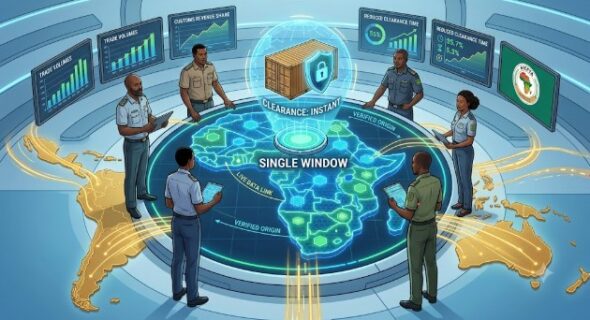
The $3.1 billion AfCFTA digital customs project promises a single digital backbone across Africa. Under this framework, cargo movements between nations, such as a container originating in Douala, moving through Calabar, or arriving via ocean vessel at Apapa, can be tracked in real time. Customs declarations registered in one country will automatically populate the data terminals of transit and destination authorities. On paper, this system promises to eliminate duplicated documentation, reduce border delays, and establish clear fiscal visibility across trade corridors.
For Nigeria’s primary maritime hubs at Apapa and Tin Can Island, however, integrating with this continental framework requires overcoming severe internal technological fragmentation. Nigeria currently operates the Nigeria Integrated Customs Information System (NICIS II), alongside various port community platforms, terminal operator systems, and single-window pilot programmes managed by different state authorities. These existing platforms often fail to communicate effectively with one another. A shipping line submits manifest data electronically, yet clearing agents must still print physical copies to obtain stamps from multiple government agencies stationed within the port terminals.
Integrating the new AfCFTA digital architecture with local port clearing protocols demands a single, unified national single-window platform. Without an integrated local interface, the data generated by the AfCFTA digital network will simply pool in administrative silos at national headquarters while field officers at the quay side demand paper printouts. To drastically reduce dwell times, which currently average fourteen to twenty-one days at Lagos ports compared to the international benchmark of two days—the digital interface must automate duty assessments, streamline release approvals, and enforce electronic signatures across all regulatory agencies.
The financial and operational structure of the AfCFTA agreement offers a private-sector-led infrastructure model that does not place direct debt burdens on member states. However, local implementation depends on terminal readiness. Apapa and Tin Can Island handle the vast majority of Nigeria’s non-oil trade, but their physical infrastructure remains congested. Digital integration must extend beyond electronic data interchange to include physical gate automation, optical character recognition for container codes, and automated weighbridges linked directly to customs processing servers. If digital declarations clear in minutes while physical trucks queue for days due to manual gate checks, the continental digital investment yields zero net gain for port efficiency.
The Manual Examination Trap: Why Physical Inspection Persists in Nigerian Ports
The persistence of manual cargo examination in Nigerian seaports remains one of the most stubborn obstacles to trade facilitation in West Africa. For nearly two decades, successive administrations have announced port modernization drives, paperless initiatives, and scanner procurement contracts. Despite these efforts, physical inspection, where containers are opened on the quay side under sun or rain, emptied onto concrete bays, and manually searched by hand, remains the default operational procedure for over seventy percent of imports arriving in Lagos.
The factors driving this reliance on manual inspection are structural, institutional, and behavioral. At the technical level, non-intrusive inspection equipment, such as drive-through X-ray container scanners, has suffered from chronic operational downtime, poor maintenance contracts, and inadequate power supply at terminal yards. High-capacity scanners acquired in previous reform cycles frequently broke down due to lack of spare parts or specialized technical personnel, forcing customs commands to fall back on physical examinations to keep cargo moving, albeit at a snail’s pace.
Institutionally, low compliance culture among importers and clearing agents feeds a deep atmosphere of regulatory distrust. Misclassification of tariff heads, under-invoicing, concealment of commercial goods, and false origin declarations remain widespread tactics used to evade statutory import duties. When importers systematically under-declare cargo values, customs authorities view physical inspection as their primary line of defence to recover lost revenue and enforce import prohibition lists. The recent interception of pump-action rifle components hidden inside a container arriving aboard the vessel MV Velika reinforces the security apparatus’s belief that automated processes alone cannot catch sophisticated smuggling tactics.
There is also a political economy dimension within port operations. Physical cargo examination sustains an extensive informal economy within port terminals. Manual inspections involve multiple physical checkpoints, creating opportunities for discretionary interventions, physical negotiations, and rent-seeking by various security agencies operating in the ports. Transitioning to a fully automated, non-intrusive environment removes personal discretion from cargo release decisions, eliminating informal revenue streams. Consequently, institutional resistance to automated scanning often manifests as procedural delays, technical delays in scanner deployment, or persistent demands for joint physical examinations by secondary agencies.
Predictive Risk Management: Balancing National Security and Trade Velocity
Resolving the conflict between trade security and trade speed requires abandoning the notion that every container must be physically verified. No major maritime port in the world maintains high trade velocity by physically opening most of its incoming cargo. Instead, modern trade hubs rely on automated, machine-learning risk-management systems that filter shipments long before vessels dock at the terminal berth.
An automated risk-management system evaluates incoming cargo data against historical patterns, behavioral indicators, and multi-agency intelligence feeds. Under a functional risk-engine model, shipments are automatically assigned to specific processing channels:
Immediate Automated Release
- Green Channel: Low-risk shipments from compliant, accredited operators receive immediate electronic release without physical intervention.
- Yellow Channel: Medium-risk shipments undergo documentary verification and automated cross-matching of valuation data.
- Red Channel: High-risk shipments, or those flagged by intelligence alerts, are routed directly to non-intrusive high-speed scanners or targeted physical examination.
The primary hurdle to executing this model in Nigeria is the quality and integrity of data feeds. Automated risk algorithms require accurate, pre-arrival information to function effectively. When shipping lines submit incomplete or late cargo manifests, or when importers use disposable corporate shells to process declarations, the risk engine automatically flags those shipments as high risk, routing them to physical inspection and rebuilding port congestion.
To make automated risk management effective without creating bottlenecks, the Nigeria Customs Service must expand its Authorized Economic Operator (AEO) scheme and Time Release Studies. Compliant manufacturers, major multinationals, and vetted logistics providers must receive fast-track processing based on established audit histories, removing their high-volume shipments from terminal inspection bays.
Simultaneously, the physical infrastructure at Apapa and Tin Can Island must integrate high-throughput, non-intrusive drive-through scanners directly into the container discharge workflow. Modern scanning systems equipped with automated target recognition software can analyze a container’s contents in seconds, flagging density anomalies and weapon profiles for targeted opening while allowing legitimate cargo to pass unimpeded. By combining predictive data analytics with non-intrusive hardware, customs authorities can isolate illicit arms shipments like those intercepted at Tin Can Island without forcing legitimate commercial trade to stand still.
The Path to Operational Trade Modernization
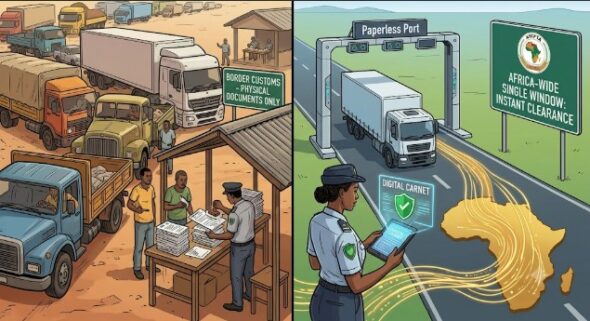
The $3.1 billion AfCFTA customs digitization agreement provides a valuable continental framework, but its success within Nigeria depends entirely on domestic operational reforms. Digitization is not merely the installation of digital portals or the signing of international agreements; it is the systematic elimination of manual intervention from routine border processing.
First, the Federal Ministry of Marine and Blue Economy, alongside the Ministry of Finance, must enforce a single-window technology architecture that mandates all port security agencies to share a single data stream. The current practice of multiple independent inspections by different government units must be replaced by a single, integrated electronic release workflow led by customs risk assessments.
Second, Nigeria Customs Service must pair its digital upgrades with strict operational service-level agreements for non-intrusive scanner uptime. Maintenance and operation of high-speed scanning infrastructure should be structured through performance-based concession contracts, ensuring that equipment failures do not serve as an excuse to default back to manual cargo searches.
Third, revenue collection mechanisms must be decoupled from physical border checks through post-clearance audit systems. In mature trade environments, customs authorities focus on rapid release at the port gate while conducting post-clearance audits at importers’ premises based on financial books and corporate records. Shifting the primary focus of tariff enforcement from physical port barriers to corporate accounting audits reduces quay-side dwell times while preserving state revenue collection targets.
The interception of illicit weapons at Tin Can Island demonstrates that trade security cannot be compromised. However, treating every commercial container as a potential security breach ensures that Nigerian ports remain expensive, slow, and uncompetitive within the AfCFTA framework. By replacing physical inspections with predictive risk algorithms, high-capacity scanning hardware, and integrated digital networks, Nigeria can secure its maritime borders while operating as a premier trade hub for the African continent.