
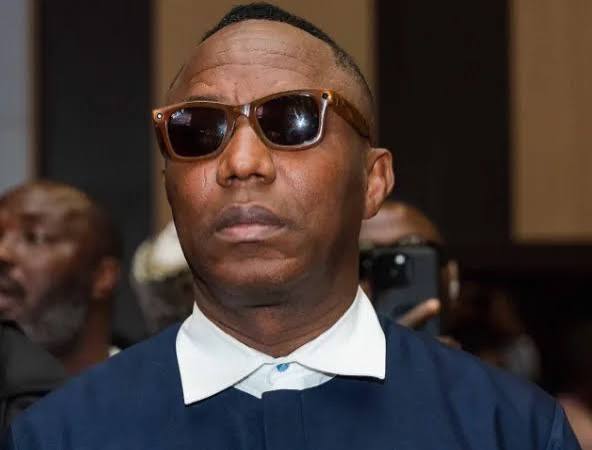
Opposition presidential candidate Omoyele Sowore has called on President Bola Tinubu to step down if he cannot guarantee a steady water supply at the Presidential Villa, turning the President’s own account of a failed tap into a fresh attack on the administration’s record on basic infrastructure.
The African Action Congress flag bearer for the 2027 election made the demand in a post on his X account on Sunday night, hours after Tinubu disclosed that water had been cut off at the Villa while he was shaving. Sowore described the lapse at the seat of power as proof that the government could not manage even the most basic public service. He wrote that aides who applaud the President rather than confront him with hard truths “must really hate Nigeria,” and said Tinubu should have been advised to resign over the failure.
The row grew out of remarks the President made on Sunday at a special prayer session organised by his family at the Yoruba Tennis Club in Onikan, Lagos. Tinubu recounted that the water went off while he was shaving the previous Wednesday, and admitted that the Villa was not spared the discomforts ordinary Nigerians live with. “No light, no water, no electricity, no development,” he said, before expressing confidence that his government would close the country’s infrastructure gaps. He added that the work had only just begun and would be seen through for Nigeria.
The exchange lands awkwardly for the Presidency because of how much public money the Villa commands. The State House runs on a 2026 budget of about N43.19bn, within which roughly N15.92m is set aside for water rates and N12.01m for sewerage charges. The complex has also been at the centre of a long argument over energy spending, with N10bn allocated in 2025 and a further N7bn in 2026 for a solar mini grid, bringing the total to about N17bn. Officials justified that outlay by describing the Villa’s roughly N47bn yearly electricity bill as unsustainable, and the complex was scheduled to leave the national grid and run fully on solar from early 2026.
Those figures sit against a far harsher national picture. The 2021 WASH NORM survey, carried out under the Federal Ministry of Water Resources, found that only about one in ten Nigerians has access to complete basic water, sanitation and hygiene services. World Bank data put access to electricity at around 61 per cent of the population in 2023, meaning close to four in ten Nigerians still live without power, while access to safely managed drinking water remains below 30 per cent by the same global measures.
The timing sharpens the contrast. Parts of the Federal Capital Territory have battled water shortages this year, with the FCT Minister, Nyesom Wike, blaming one disruption on a pipe damaged by a private developer. The government has pointed to projects such as the $470m Greater Abuja Water Supply Scheme, commissioned in 2025, as evidence of progress, yet residents of several satellite towns say reliable supply has still not reached their homes.
Sowore’s intervention fits a pattern of escalating criticism he has aimed at the President in recent weeks, from security concerns to pointed questions over Tinubu’s fitness for office. For the Presidency, the episode is a reminder that even a candid admission of discomfort can be turned into a symbol of wider failures in power and water delivery, the very services the government has promised to transform before 2027.
Whether the moment leaves a lasting mark will depend on delivery rather than words. The solar switch at the Villa, the pace of the Abuja water schemes and the national access figures will offer a clearer verdict than any single dry tap. For now, a brief interruption during a morning shave has handed the opposition an easy metaphor, and left the government defending both its spending at the seat of power and its promises to the millions who have neither steady water nor light.