
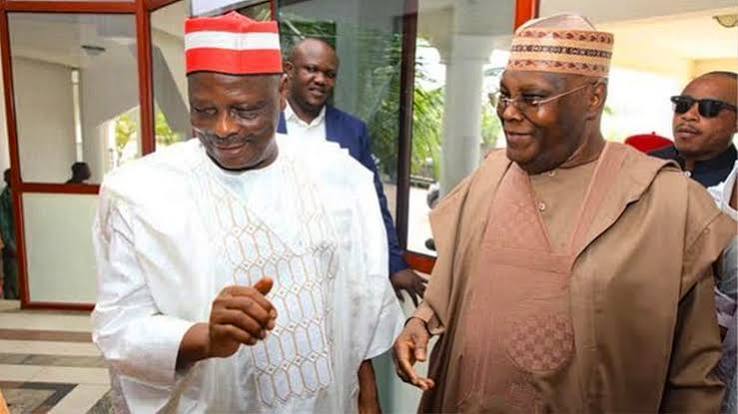
Rabiu Kwankwaso, vice presidential candidate of the Nigeria Democratic Congress (NDC), says former Vice President Atiku Abubakar should abandon his 2027 presidential bid and step down for the NDC candidate, Peter Obi. Asked directly on Thursday whether that was his position, the former Kano State governor replied, “Well, yes.” With the presidential election three months away, the appeal sharpens one of the biggest questions hanging over the opposition: whether it can avoid splitting its vote again.
Kwankwaso made the case on Channels Television’s Politics Today programme. He said he had recently used a courtesy visit to his house by a group of Fulani people from across the country to ask them to speak with Atiku before returning to their towns and villages. He insisted the call was not born of hostility. “We are not against him,” he said, adding that “everything has time.”
The former Defence Minister leaned heavily on history to make his point. He traced his ties with Atiku to 1993, when both belonged to the political movement led by the late General Shehu Musa Yar’Adua, which backed Atiku for the Social Democratic Party (SDP) presidential ticket. Atiku came third at the party’s Jos convention that year and stepped down for Moshood Abiola, but the running mate slot went to Babagana Kingibe.
Kwankwaso said the relationship continued into 1999, when he was Kano governor elect and the PDP picked Olusegun Obasanjo as its candidate in the same city of Jos, with Atiku as running mate. He also recalled that the two men were aspirants for the All Progressives Congress (APC) ticket ahead of 2015. Records of that primary bear out his account: Muhammadu Buhari won with 3,430 votes, Kwankwaso came second with 974 and Atiku third with 954.
One claim is harder to square with the official record. Kwankwaso said almost 90 per cent of Kano’s votes went to Atiku in the 2007 presidential election, when Atiku ran on the Action Congress platform. The Independent National Electoral Commission declared Umaru Yar’Adua winner of that disputed poll with about 24.6 million votes nationwide, while Atiku finished third with roughly 2.6 million votes, about seven per cent of the total. A figure of that size in Kano could not be independently verified.
Their alliance has also been tested at the ballot box more recently. In 2019, Kwankwaso backed Atiku’s PDP candidacy, yet Buhari carried Kano with 1,464,768 votes against Atiku’s 391,593. Four years later, Kwankwaso ran on his own platform, the New Nigeria Peoples Party, and won Kano with about 997,000 votes, far ahead of Bola Tinubu’s 517,341.
The 2023 results explain why opposition consolidation keeps returning to the table. Tinubu won with 8,794,726 votes, or 36.61 per cent. Atiku polled 6,984,520, Obi 6,101,533 and Kwankwaso 1,496,687. Taken together, the three men drew about 14.58 million votes, nearly six million more than the winner, though there is no guarantee that votes transfer neatly from one candidate to another.
The field for 2027 has since been redrawn. Obi and Kwankwaso moved to the NDC, where Obi was ratified as presidential candidate on May 29, 2026, with Kwankwaso as his running mate. Atiku is the candidate of the African Democratic Congress (ADC). The Independent National Electoral Commission has fixed January 16, 2027 for the presidential and National Assembly elections, and has cleared 18 presidential candidates.
The contest between the two opposition camps has played out alongside a shared assault on the Tinubu administration over petrol prices. Atiku has campaigned on a production based subsidy for local refining, while Kwankwaso, on the same programme, outlined the NDC’s own position on fuel prices and subsidy. The ruling APC has dismissed both camps as no match for Tinubu.
Atiku’s camp had not publicly responded to Kwankwaso’s latest remarks as of Friday. The former Vice President has contested for the presidency several times, including in 1993, 2007, 2011, 2015, 2019 and 2023, and has given no public sign of withdrawing. Whether Kwankwaso’s appeal, delivered through intermediaries and on national television, produces any formal talks between the ADC and NDC before the January poll remains to be seen.