
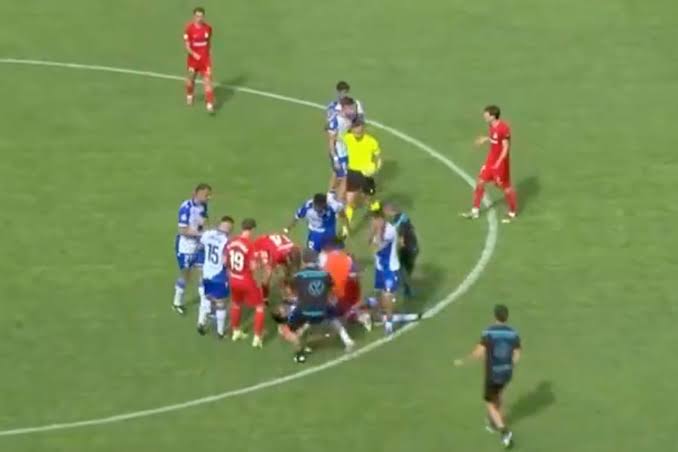
Spanish football is in mourning after CD Tenerife confirmed the death of their striker Jesús de Miguel, who died on Tuesday morning, a day after a heavy collision during a league match against FC Andorra. He was 30.
The club said De Miguel passed away at 8am at the University Hospital of Nuestra Señora de Candelaria in Santa Cruz de Tenerife, where he had been admitted after collapsing on the pitch the previous evening. In an emotional statement, Tenerife said they were “broken with pain” and unable to believe the loss was real, offering condolences to his family, teammates and supporters.
The collision happened in the closing stages of the game at the Heliodoro Rodríguez López Stadium. De Miguel chased a loose ball as Andorra goalkeeper Jesús Owono, who had rushed off his line and out of his area, moved to clear it. The two met heavily, leaving the striker unconscious on the turf. Medical staff treated him for several minutes before he was carried off on a stretcher.
With the score level at 2-2, the referee abandoned the match in the 108th minute so medics could continue their work. Owono was shown a red card for the challenge. De Miguel is understood to have suffered a cardiac arrest after the impact and was resuscitated in the ambulance. His condition appeared stable at first but deteriorated in the early hours of Tuesday.
Born in Madrid in September 1996, De Miguel came through the Leganés youth ranks and spent most of his career in Spain’s lower tiers, turning out for clubs including Unionistas de Salamanca, Castellón and Fuenlabrada before joining Tenerife in July 2025 on a three-year deal. He wore the number nine shirt and had become a familiar face for the islanders.
His death revives painful memories of other players lost in the game, though most of those tragedies were caused by sudden cardiac failure rather than a collision. Cameroon midfielder Marc-Vivien Foé collapsed and died during a Confederations Cup semi-final in 2003. Sevilla’s Antonio Puerta died three days after collapsing in a La Liga match in 2007, aged 22. Italian midfielder Piermario Morosini died during a Serie B game in 2012.
Not every case has ended in tragedy, and the difference has often come down to the speed of the response. Bolton’s Fabrice Muamba survived a cardiac arrest during an FA Cup tie in 2012 after lengthy resuscitation on the pitch, and Denmark’s Christian Eriksen was revived with a defibrillator after collapsing at the European Championship in 2021. Ghana forward Raphael Dwamena, by contrast, died after collapsing during a match in Albania in November 2023, aged 28.
Those incidents pushed football’s authorities to tighten their safeguards, from compulsory cardiac screening for professionals to mandatory defibrillators and trained medical teams at grounds. Studies of sudden cardiac death in athletes have consistently shown that survival depends on treatment within the first few minutes, which is why pitchside equipment and rehearsed emergency drills are now standard at the elite level. De Miguel’s case is a sobering reminder that collisions, though a far rarer cause of death, can be just as devastating.
Messages of sympathy came through Tuesday from across Spanish football and beyond, with major clubs and supporters’ groups among those paying tribute. De Miguel’s family thanked everyone who had reached out and asked for privacy as they grieve.