
President Bola Tinubu has told the United Nations that the world of 2026 can no longer be governed by the balance of power fixed in 1945, and has demanded that Africa be given permanent seats on the Security Council.
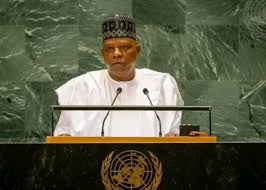
He made the call on Thursday in Nigeria’s national statement at the general debate of the 81st session of the UN General Assembly in New York. The address was delivered on his behalf by Vice President Kashim Shettima, who is leading the Nigerian delegation.
Tinubu said reform of the world body must begin with the Security Council, arguing that the continent cannot keep shaping the Council’s agenda while shut out of its permanent membership. According to him, Africa should have at least two permanent seats with full rights and responsibilities, including veto power for as long as the veto exists, and five non-permanent seats in total.
He anchored the demand in the Ezulwini Consensus and the Sirte Declaration, the African Union positions that have long framed the continent’s case for Council reform. “The authority to speak for humanity carries an obligation to represent it,” he said in the address.
The demand is not new. Nigeria made much the same case at the 80th session in 2025, also through Shettima, and Tinubu repeated it at the Tokyo International Conference on African Development in Yokohama in August 2025. The Security Council has kept its five permanent members, the United States, China, Russia, Britain and France, since the UN was founded, and no African country holds a permanent seat.
Beyond the Council, Tinubu used the address to press for an end to conflicts around the world and a return to what he called the founding principles of the UN Charter. He warned leaders against assuming that distant or domestic wars carry no cost for other nations, and pushed back against rising nationalism and unilateral action.
He also placed the argument in economic terms. Tinubu said inadequate financing remained one of the biggest obstacles to development, with debt servicing swallowing resources that could go to education, healthcare and infrastructure. On that basis he called for reform of the international financial architecture, wider access to concessional financing and debt sustainability frameworks that reflect the needs of developing countries.
The debt point lands close to home. Nigeria has spent heavily on servicing its obligations in recent years, and the cost of borrowing has been a recurring strain on the federal budget, which makes the President’s appeal for fairer financing terms as much a domestic concern as a continental one.
On climate, Tinubu rejected what he described as a false choice between development and climate action, saying developing countries must be allowed to industrialise and expand energy access along lower carbon paths. He noted that Africa accounts for less than four per cent of global greenhouse gas emissions yet carries a disproportionate share of the consequences.
He reaffirmed Nigeria’s commitment to the Paris Agreement and, under the country’s Energy Transition Plan, a target of net-zero emissions by 2060, combining renewable energy, cleaner cooking, gas as a transition fuel and climate-smart agriculture. He argued that climate finance should rest on equity and shared responsibility rather than charity.
Tinubu framed Nigeria’s peacekeeping record as evidence that the country is ready to carry greater responsibility, citing its past deployments in Liberia, Sierra Leone, Darfur, Mali and The Gambia. He said Nigeria continues to advance mediation, democratic governance, counter-terrorism and maritime security through ECOWAS, the African Union and Gulf of Guinea partnerships.
He tied the foreign policy agenda back to his administration’s economic reforms, saying national development, continental progress and global peace were bound together, and that government earns trust only when its decisions improve lives.
What the President did not address is the gap between the demand and its prospects. Security Council reform requires amending the UN Charter, which needs the support of two thirds of member states and the agreement of all five permanent members, a threshold that has blocked every serious reform attempt for decades. On that measure, the call is a statement of position rather than a change that is close at hand.
For now, the address restates a case Nigeria has made consistently under Tinubu and links it to the reforms his government has pursued at home. Whether it moves the wider push for a permanent African seat any closer will depend on the appetite of the existing permanent members, none of whom has signalled readiness to share the veto.