
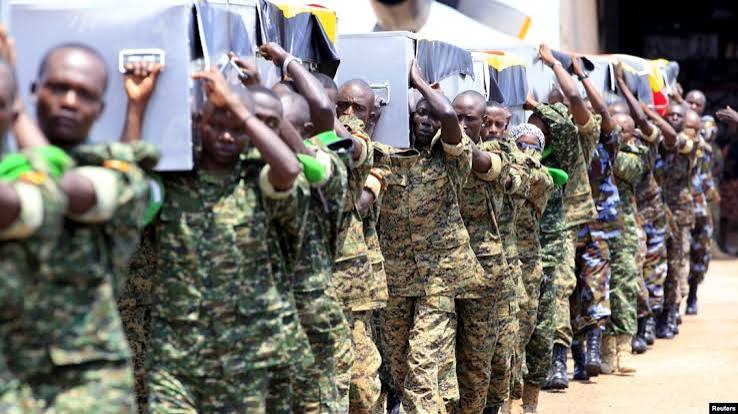
Uganda has started bringing its soldiers home from Somalia, with the first group already back on Ugandan soil and the rest of the contingent deployed under a bilateral arrangement expected to follow within days.
The Uganda People’s Defence Forces announced the drawdown on Monday in a statement signed by its Acting Director of Defence Public Information, Colonel Chris Magezi. The force said the pull-out of troops serving under its direct agreement with Mogadishu took effect immediately, and that it would be completed shortly.
Beyond that contingent, the military said it intends to withdraw every Ugandan soldier in Somalia, including those under the African Union Support and Stabilisation Mission in Somalia, by the end of 2027. It cast the exit as the close of a 20-year chapter that should allow Somalia’s own forces to take full charge of the country’s security.
The move puts into effect a decision Kampala has been signalling for most of the year. In January, the Chief of Defence Forces, General Muhoozi Kainerugaba, said on X that Uganda planned to pull out completely in the near future. By late October he confirmed the process had begun, describing it as handing over security “to our Somali brothers.”
Uganda holds a particular place in the mission. It was the first country to send troops, in March 2007, under the African Union Mission in Somalia, known as AMISOM, and it grew into the largest contributor, with more than 6,000 soldiers at the height of its deployment. Ugandan units secured Mogadishu’s airport and seaport, led major operations against al-Shabaab and helped train the Somali national army.
The mission has changed names and shape several times. AMISOM gave way to the African Union Transition Mission in Somalia in 2022, which was itself replaced by the current AUSSOM in January 2025. Through each phase the task stayed the same: hold the line against al-Shabaab, which still controls large parts of southern and central Somalia and has intensified its attacks in recent months, including mortar strikes on the capital.
Money has become the mission’s biggest headache. A United States decision to pull its funding and logistical support left AUSSOM, a force of roughly 12,000, facing a gap estimated at about $180m. Washington first set a cut-off at the end of 2026 before agreeing to a twelve-month extension through the UN Security Council, and troop-contributing nations meeting in Kampala in July backed a transition plan of 18 to 24 months to shift responsibility onto Somali forces.
The pull-out carries real risk. Security analysts and Somali officials have warned that a hurried drawdown could open gaps for al-Shabaab to exploit, especially as political infighting in Mogadishu slows the build-up of a capable national army. President Yoweri Museveni has repeatedly blamed those divisions for stalling progress against the group.
For Nigeria, the shift is not entirely distant. Nigeria contributes a formed police unit to AUSSOM, part of the international presence whose future now turns on how quickly Somalia can stand on its own.
Whether Somali forces are ready to fill the space Uganda leaves behind remains the open question, and the coming months of handovers will offer the first real test.