
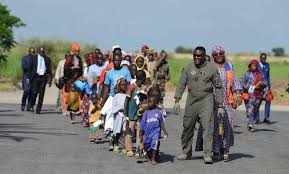
The number of Nigerian refugees who voluntarily returned home more than doubled within the first quarter of 2026, offering a cautious but measurable sign of progress in one of Africa’s most protracted displacement crises, even as internally displaced persons within Nigeria’s own borders continued to surge.
Fresh data drawn from three successive Forcibly Displaced Populations dashboards published by the United Nations High Commissioner for Refugees for February, March, and April 2026 shows that the returnee count rose from 1,705 in February to 3,083 in March, then climbed further to 3,510 by April, a total first-quarter increase of 1,805 persons, representing a 106 per cent rise.
The dashboards are produced jointly by UNHCR, the International Organisation for Migration’s Displacement Tracking Matrix, the Nigeria Immigration Service, and the National Commission for Refugees, Migrants and Internally Displaced Persons, drawing on biometric registration, field assessments, and population profiling across Nigeria’s displacement-affected states.
All returnees documented are Nigerian refugees coming back from Cameroon, Chad, and Niger Republic under tripartite voluntary repatriation agreements, and all are returning to their areas of origin in Borno State, the epicentre of Boko Haram and ISWAP insurgency that has driven displacement across the Lake Chad Basin for over a decade.
The legal scaffolding for these returns has been years in the making. Nigeria and Cameroon signed their tripartite repatriation agreement on 2 March 2017, establishing a legal framework for the voluntary return of refugees in safety and dignity, overseen by a commission composed of officials from all three parties. In February 2025, UNHCR, Chad, and Nigeria signed a separate tripartite agreement to facilitate voluntary, safe, and dignified returns from Chad, with talks also advancing toward a similar arrangement with Niger.
Despite the returnee progress, the broader displacement picture remains alarming. Even as refugees returned home, internally displaced persons across Nigeria surged by 166,795 in the same period. Zamfara State alone recorded 279,224 IDPs, the single largest IDP population outside Borno, while Katsina hosts 206,071 and Sokoto 181,526.
Nigerian refugees still registered in Cameroon, Chad, and Niger stood at 406,672 in February, declining only marginally to 405,062 by April. Cameroon alone hosts 124,382 Nigerian refugees, Niger 258,777, and Chad 21,999.
Reintegration upon return remains as critical a challenge as the return journey itself. Returnees are entitled to transportation, temporary shelter, and access to essential services, while communities receiving them face pressure on infrastructure, healthcare, education, and livelihoods.
The contrasting figures, rising returnees against swelling IDP numbers, underscore that stabilisation remains incomplete, and that addressing the root causes of Nigeria’s displacement crisis demands sustained, coordinated intervention well beyond the logistics of getting refugees home.