
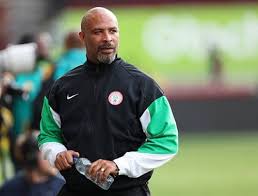
Super Eagles head coach Eric Chelle has formally apologised to Nigerian football supporters following the national team’s failure to meet expectations in recent Africa Cup of Nations and FIFA World Cup qualifying campaigns, acknowledging that the country’s most beloved sporting institution has fallen short during one of the most demanding rebuilding phases in its modern history.
The Franco Malian tactician, who took charge of the three time African champions in January 2025 following the departure of Finidi George, conceded that recent results have not reflected the standard Nigerians traditionally associate with the Super Eagles, a team ranked among the top five in Africa and currently positioned 41st in the FIFA World Rankings.
Chelle’s apology arrives at a delicate moment. Nigeria, a six time AFCON finalist and three time champion (1980, 1994, 2013), finished as runners up at the 2023 AFCON in Côte d’Ivoire, losing 2 to 1 to the host nation. The team’s subsequent decline has been steep. In the CAF qualifiers for the 2026 FIFA World Cup, the Super Eagles, drawn in Group C alongside South Africa, Rwanda, Benin, Lesotho and Zimbabwe, struggled for momentum after opening the campaign with damaging draws and an unexpected home defeat that placed automatic qualification beyond reach. Nigeria eventually advanced through the CAF playoff route but exited the African playoff at the semi final stage, ending hopes of a return to the World Cup, which the country last featured in at Russia 2018.
The numbers underscore the concern. Since the start of the 2026 World Cup qualifying cycle, the Super Eagles have recorded fewer wins per game than at any comparable point since the early 2000s. The team’s goal scoring output has remained respectable, anchored by Galatasaray striker Victor Osimhen, the 2023 CAF Player of the Year, but defensive lapses and inconsistent midfield control have repeatedly cost Nigeria critical points.
Chelle’s tenure has also been disrupted by injuries to key personnel, including periods without Osimhen, Ademola Lookman, the 2024 CAF Player of the Year, and captain William Troost Ekong. Limited preparation windows under FIFA’s international calendar have further constrained tactical integration.
“Accountability is an important part of leadership,” Chelle stated, accepting responsibility for the outcomes while reaffirming his long term vision for the squad.
Since his appointment, the former Mali national team coach has prioritised tactical discipline, defensive structure and a more methodical build up approach, while integrating emerging talents alongside established stars. Several younger players have been introduced into recent squads as part of a generational refresh.
Upcoming international friendlies against Poland and Portugal are expected to provide a measurable test of progress, offering the technical crew an opportunity to assess tactical execution against top tier European opposition.
For a footballing nation that has produced talents across Europe’s elite leagues, the gap between individual brilliance and collective output remains the central question facing Chelle’s project. The coming months will determine whether his apology marks the beginning of recovery or another chapter in Nigeria’s prolonged search for stability.