
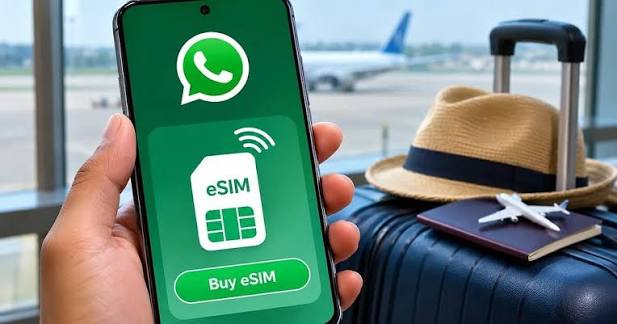
WhatsApp is moving into the mobile data business, announcing a new feature that will let travellers buy and install an eSIM for internet access abroad without ever leaving the app. The company, owned by Meta, said the service is meant to spare users the familiar scramble for a local SIM card, an airport kiosk or a café with Wi-Fi the moment they touch down in a new country.
According to WhatsApp, users will be able to purchase and set up a data eSIM in a few taps and carry on using the platform with their usual phone number after they arrive. The company said it is working with eSIM providers and telecoms partners, among them Jio, Smart Axiata, Smart Communications and Verizon, and that the feature will begin rolling out in selected countries soon. It did not name the countries or give a firm date.
An eSIM is a digital SIM built into a compatible phone that lets a user activate a network plan without slotting in a physical card. For travellers, it has become a fast way to get online abroad while sidestepping roaming charges, long one of the sharpest hidden costs of crossing a border.
The timing is not accidental. Travel has become the single biggest driver of eSIM adoption. Industry research values the wider eSIM market at about 6.05 billion dollars in 2025, rising to roughly 7.4 billion dollars this year and heading towards nearly 28.7 billion dollars by 2036. The travel segment alone is expanding at close to 18 per cent a year, and in North America travel eSIMs are already used on about four in every ten trips abroad.
For WhatsApp, the step pushes it past messaging into a space crowded with specialists such as Airalo and Holafly, alongside traditional carriers now selling their own travel bundles. Rather than build a network, the company is making itself the shopfront, using the fact that people open the app many times a day to sell connectivity at the exact moment they need it.
The Nigerian angle matters, even though the country’s place in the rollout is unclear. Industry estimates put WhatsApp’s user base here at more than 50 million, making Nigeria its largest market in Africa and one of its biggest anywhere. Meta’s apps are also woven deep into local trade, with about 14 million Nigerian small businesses using Facebook, Instagram, WhatsApp and related services in 2025, and the company’s yearly contribution to the economy estimated at around 820 million dollars.
Whether Nigerian travellers gain soon rests on two things the company has not settled. The first is which markets go live at launch. The second is hardware, since an eSIM needs a compatible handset, and many of the budget phones that dominate sales across Nigeria and much of Africa still ship without eSIM support.
WhatsApp described the eSIM as part of a wider push to make the app more useful, saying it would keep adding features based on user feedback. The announcement lands as eSIM technology drifts from a niche convenience to a standard feature on new phones, and as the lines between messaging apps, telecoms and travel services keep blurring.