
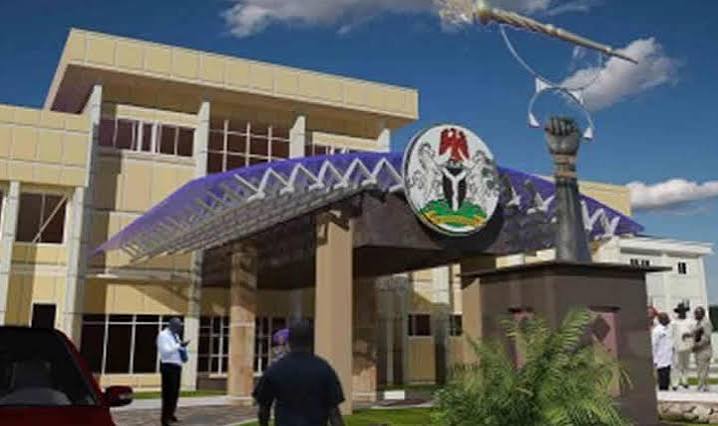
Presidential and governorship candidates who want their faces on billboards in Abakaliki will now pay N150 million for the privilege, after the Ebonyi State House of Assembly approved new levies on political billboards and posters in the state capital. The House fixed the fee at N20 million for National Assembly candidates and N5 million for State House of Assembly candidates. It also ordered the immediate termination of all existing contracts for political billboards and posters within the capital city.
The resolution followed a motion of urgent public importance moved by the Deputy Chief Whip and Chairman of the House Committee on Capital City Development, Arinze Lucas Chukwu, who represents Ishielu South Constituency. Chukwu complained about posters and billboards on public buildings, electric poles, streetlights, bridges and fences, describing the practice as environmental pollution that also robbed the state of internally generated revenue. He said competing claims by different agencies over the levies had caused confusion, revenue leakages and double taxation.
Under the new arrangement, the Commissioner for Capital City Development takes over enforcement and collection. Any party, aspirant, group or individual must pay the levy into a designated government account and obtain an official receipt before putting up a billboard or poster. The commissioner is to designate approved locations and set up a task force to remove unpaid installations, while defaulters will pay a 50 per cent penalty on top of the levy.
The House directed the Chairman of the Ebonyi State Internal Revenue Service to end all contracts with private consultants and agents handling political billboards in the capital and hand over the relevant files to the commissioner. Onyebuchi Ogbadu, who represents Ivo Constituency, seconded the motion, saying it would restore order and boost revenue. Speaker Moses Ije Odunwa put it to a vote and it was adopted unanimously, with three committees given 30 days to monitor compliance.
The levy arrives deep into the campaign season. Under INEC’s revised timetable, campaigns for the presidential and National Assembly elections began on August 19, while governorship and State Assembly campaigns opened on September 9. The presidential poll holds on January 16, 2027, about 80 days away, and the governorship election follows on February 6.
Set against the campaign spending limits in the Electoral Act 2026, the figures are significant. The law caps spending at N10 billion for presidential candidates, N3 billion for governorship, N500 million for Senate, N250 million for House of Representatives and N100 million for State House of Assembly candidates. The Abakaliki billboard fee alone therefore equals 1.5 per cent of a presidential candidate’s legal ceiling, five per cent of a governorship candidate’s and eight per cent of a House of Representatives candidate’s. A State Assembly candidate would spend one twentieth of the entire lawful campaign budget on visibility in a single city.
Revenue pressure forms part of the backdrop. National Bureau of Statistics data on 2025 internally generated revenue placed Ebonyi second from the bottom with N17.18 billion, ahead of only Yobe at N16.01 billion. All 36 states and the FCT generated N5.15 trillion over the same period, with neighbouring Enugu recording N406.77 billion.
Ebonyi is not the first South East state to put a high price on campaign visibility. In February, the Enugu State Structures for Signage and Advertisement Agency announced a N150 million campaign permit covering billboards, banners, branded vehicles, rallies and street campaigns. Opposition parties in Enugu condemned the fee, and Accord Party chieftain John Nwobodo argued that regulating campaign activities was the responsibility of INEC, not a state agency.
Some questions remain open. The details released do not state whether the Ebonyi fee is charged per candidate or per party, how many billboards it covers, or how candidates who had already paid agents under the terminated contracts will be treated. The levy was also adopted through a resolution rather than a bill passed into law.
At the same sitting, the Assembly approved Governor Francis Nwifuru’s request to borrow N9.673 billion from Keystone Bank Limited. According to the governor’s letter, read by House Leader Kingsley Ikoro, the facility will enable the state government and local councils to meet counterpart funding requirements of the Universal Basic Education Commission. The loan carries an annual interest rate of 17 per cent and a management and commitment fee of 0.5 per cent.
Igu Chikezie Nwankwo of Ohaozara East described the request as critical to expanding access to education, while Ifeanyi Nwakpu of Ikwo North also backed it before it was approved unanimously by voice vote. The facility is equivalent to about 56 per cent of the state’s 2025 internally generated revenue. If fully drawn, interest alone would come to roughly N1.64 billion a year, in addition to about N48 million in fees.