
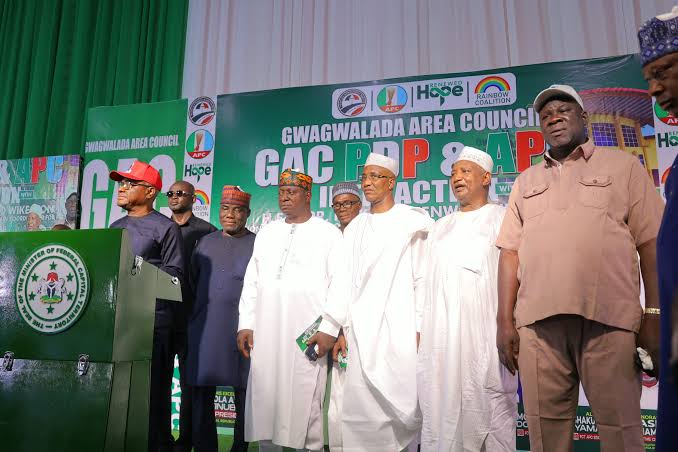
Minister of the Federal Capital Territory, Nyesom Wike, has dismissed critics who question the existence of his Rainbow Coalition, saying politicians who deny the alliance lack the capacity to unite even their own families and communities. He spoke on Monday in Gwagwalada while commissioning the area council’s civic centre and hosting an interactive session with All Progressives Congress and Peoples Democratic Party stakeholders.
Wike described the coalition as a platform built for unity, cooperation and development in the territory, and challenged its doubters to explain why leaders who once stood on opposite sides could not work together for a common purpose. He said those who waved the arrangement away had shown they could not hold their own political space, let alone a wider movement.
The Rainbow Coalition is the cross-party platform Wike has assembled to back President Bola Tinubu’s re-election in 2027. It draws in members of the PDP, to which he still belongs, the APC and smaller parties, while leaving each party free to field its own candidates for governorship, National Assembly and state assembly seats. Tinubu has publicly endorsed it.
The arrangement has split opinion. The APC Governors’ Forum has insisted there is no room for the coalition and that the ruling party will support only its own candidates at every level in 2027, a position Wike has repeatedly dismissed as lacking any political basis. He maintains the platform is not an APC structure and was never designed to weaken the ruling party, but to pool votes for Tinubu across party lines. Beyond the FCT, he has pushed the same model in Rivers State and counts figures such as Osun Governor Ademola Adeleke among a broader national coalition for the President.
For Wike, the FCT sits at the centre of that calculation. In the 2023 presidential election, Labour Party’s Peter Obi carried Abuja, and Ireti Kingibe of the same party took the territory’s lone Senate seat, unseating Philip Aduda, a former Senate Minority Leader. On Monday the minister canvassed support for Aduda and other coalition-endorsed candidates, and urged residents not to repeat what he called the mistake of 2023.
He told the gathering that polling day was a moment for collective action rather than routine business, saying it would not be a day for market or fishing, and pressed residents to mobilise their communities for Tinubu. Elected representatives, he added, must remain accessible and familiar with the people they serve.
The civic centre itself illustrated the theme of continuity he pressed. A former chairman of the council, Zakari Angulu Dobi, said the project was about 80 per cent complete when he left office but was vandalised during roughly 16 years of abandonment, leaving it at around 40 per cent before work resumed.
The FCT APC chairman, Ishaku Tanko Yamawo, called the event historic, saying it had brought together leaders who once operated on opposing sides. The FCT PDP chairman, Ismaila Mohammed Dogara, credited Wike with reviving a project stalled for 16 years, while the Aguma of Gwagwalada, Muhammadu Magaji, and the council chairman, Kassim Mohammed, commended the administration’s infrastructure drive and appealed for more road projects.
The Gwagwalada event captured the wider gamble behind the Rainbow Coalition: whether a bloc that keeps rival parties intact at lower levels can still deliver one presidential verdict in 2027. Supporters present it as pragmatic cooperation, while opponents see an arrangement that blurs party lines for short-term gain. How it performs in the FCT, where Tinubu struggled in 2023, will be an early test of its reach.