
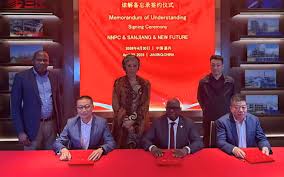
The Nigerian National Petroleum Company Limited has taken a formal step towards reviving its long-troubled refining infrastructure, signing a Memorandum of Understanding with two Chinese companies for a potential Technical Equity Partnership aimed at completing and operating the Port Harcourt and Warri refineries.
The agreement was signed on April 30, 2026, in Jiaxing City, China, by NNPCL’s Group Chief Executive Officer, Bayo Ojulari; Chairman of Sanjiang Chemical Company, Guan Jianzhong; and Chairman of Xinganchen (Fuzhou) Industrial Park Operation and Management Co., Ltd, Bill Bi.
According to a statement issued on Monday by NNPCL’s Chief Corporate Communications Officer, Andy Odeh, the potential framework would cover the completion of outstanding work at both refineries, as well as their operation and maintenance to achieve what was described as “best-in-class, sustainable performance.”
The company said planned expansion and upgrades would elevate both facilities to cleaner and more profitable product standards, while the collaboration also contemplates expanding petrochemical capacities and harnessing gas and downstream opportunities through co-located, gas-based industrial hubs.
Speaking after the signing, Ojulari described the MoU as a significant milestone, coming after more than six months of engagement between the technical and management teams of NNPCL and its two Chinese partners.
“All parties recognise mutually beneficial opportunities for the development and long-term sustainable profitability of NNPC’s refining assets in Nigeria, and the collective weight required for success,” Ojulari stated.
He further described the agreement as an important step towards identifying potential technical equity partners to restart and expand NNPCL’s refineries, and to explore opportunities in co-located petrochemicals and gas-based industries.
NNPCL was careful to frame the MoU within measured expectations, noting that it reflects the parties’ shared intent to progress discussions in good faith, with any definitive arrangements subject to customary approvals and to follow in due course.
Nigeria’s four government-owned refineries in Port Harcourt, Warri, and Kaduna have operated far below capacity for decades, costing the country billions in crude-for-refined-product swaps and fuel subsidy expenditure. Both the Port Harcourt and Warri facilities have undergone multiple rehabilitation attempts with limited results, making the latest Chinese partnership a closely watched development in the country’s energy sector.