

Mali’s Eid Crisis Deepens Under Jihadist Blockade
For millions of Muslims across West Africa, Eid al-Adha, known in Mali as Tabaski, is the most sacred family gathering of the year. But for residents of Bamako, Mali’s capital, the 2025 celebration has been reduced to a painful exercise in isolation, as an Al-Qaeda linked jihadist blockade severs the roads connecting families separated by months of work and distance.
Alpha Amadou, 40, originally from the central city of Mopti, has lived in Bamako for three decades. Every year without fail, he made the journey home for Tabaski. This year, that tradition collapsed.
“For the first time in 30 years living in Bamako, I’ll be celebrating Eid here this year,” he told AFP.
His story is not unusual. Across the capital, thousands of residents face the same heartbreak, cut off from their villages and families by a campaign of violence that has made Mali’s highways among the most dangerous in the Sahel.
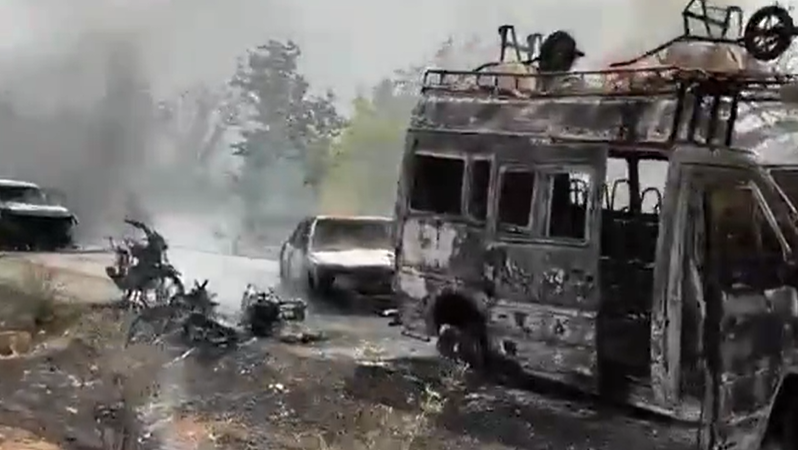
Since late April 2025, fighters from Jama’at Nusrat al-Islam wal-Muslimin (JNIM), Al-Qaeda’s Sahel branch, have imposed a sustained road blockade on the principal arteries leading into and out of Bamako. Dozens of buses and freight trucks have been torched along these routes, and the imagery of charred, gutted vehicles circulating on social media has been enough to bring passenger transport to a near standstill, even where the blockade remains only partial.
Mali has endured years of jihadist insurgency since armed groups seized the country’s north in 2012. Despite two military coups, in 2020 and 2021, and the deployment of Russian Wagner Group fighters after the expulsion of French forces in 2022, the security situation has continued to deteriorate across the country’s vast central and northern territories.
The timing of this particular escalation, just ahead of Tabaski, has amplified its social devastation. In Mali, Tabaski is far more than a religious observance. It is one of the rare occasions each year when families scattered across regions and countries reunite, sharing a sacrificial meal and reaffirming bonds stretched thin by economic migration.
This year, Bamako’s bus stations, normally teeming with holiday travellers in the days before Tabaski, fell silent.
“Not only do we lack diesel to keep running, but we’ve also lost buses in recent incidents. It’s a huge economic blow,” said the owner of a local travel agency, speaking to AFP under anonymity.
Another transport company manager put the scale of the disruption in plain numbers: “Normally, we could transport more than 50,000 people from Bamako to other regions in a week for Tabaski. This year, we’re not planning any trips.”
Even private vehicles have not been spared. Wara Bagayoko, who for three decades drove his family car to Segou every Tabaski, remained in the capital this year.
“It will be the first time in 30 years I won’t celebrate in my village. The road is too dangerous,” he told AFP.
Oumar Diarra echoed the same resignation: “Before, about 20 of us would travel together on motorbikes to Sikasso to celebrate. This year, we’ll stay in Bamako.”
A small number of minibuses continue to enter the city, using remote backroads or travelling under military escort, but these remain the exception.
The blockade’s economic consequences extend well beyond the transport sector. The livestock trade, which is central to Tabaski’s sacrificial tradition, has been severely disrupted as herders and traders struggle to move animals into Bamako, the country’s largest consumer market.
Transport costs for a single animal, previously between 2,500 and 2,750 CFA francs (approximately $4 to $5), have risen sharply, according to transporter Alassane Maiga, as reported by AFP. The squeeze has created artificial scarcity in a market already under pressure.
“Many trucks of sheep have been burned by jihadists. Normally, I’d have more than 1,000 animals, but today, not a single one,” vendor Hama Ba told AFP.
The price inflation has been staggering. A buyer identified only as Iyi described searching for an animal he could afford: “Sheep we used to buy for 75,000 francs are now going for 300,000. Before, there was plenty to choose from, but now they’ve almost vanished from Bamako.”
This price surge is particularly punishing in a country where the national monthly minimum wage stands at just 40,000 CFA francs, making the 300,000-franc cost of a single sheep equivalent to nearly eight months of minimum earnings.
Beyond the roads and the livestock market, the crisis has crept into everyday urban life. Bamako is simultaneously grappling with prolonged electricity outages and critical shortages of drinking water, adding a further layer of hardship to pre-Eid preparations.
Tailors’ workshops across the city are struggling to finish festive outfits known locally as “Selifini,” the traditional holiday garments that families commission weeks in advance.
“We tried using a small solar panel,” dressmaker Alou Diallo told AFP. “But it can’t replace electricity.”
Food storage has emerged as another urgent concern. With no reliable power, preserving the meat from the traditional Tabaski sacrifice becomes nearly impossible.
“How are we supposed to keep meat without electricity? Buying an expensive sheep only to lose it within 24 hours due to power cuts is a real fear,” one mother on the outskirts of Sirakoro told AFP.
In recent days, Malian authorities announced the arrival of hundreds of fuel tankers in Bamako, raising cautious hopes that power and transport could partially stabilise. But for the thousands who have already resigned themselves to spending Eid far from their families, the announcement has come too late.
Mali’s transitional government, led by Colonel Assimi Goïta since the 2021 coup, continues to face mounting criticism over its handling of the jihadist insurgency, even as it projects a posture of military confidence bolstered by its partnership with Russian security contractors. The Tabaski crisis has stripped away that confidence, exposing how deeply the conflict has now penetrated the routines of ordinary urban life.
For many in Bamako this year, the road home for Eid did not just become dangerous. It simply ceased to exist.
AFP