
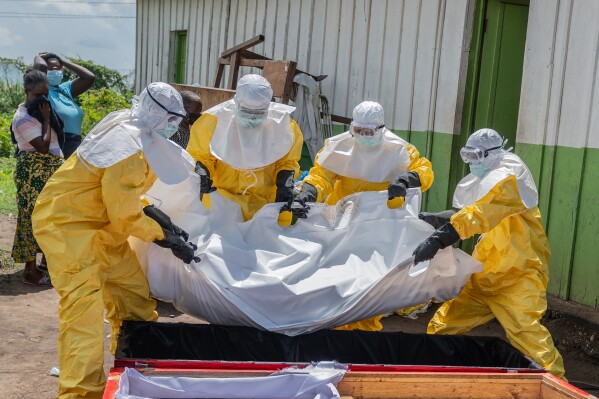
More than 1,100 people are suspected of having contracted the Ebola virus across the Democratic Republic of Congo and neighbouring Uganda, the African Union’s continental health agency has confirmed, raising fears that the outbreak could escalate rapidly across central and east Africa.
In a commentary published in the Financial Times on Sunday, the Director General of the Africa Centres for Disease Control and Prevention, Jean Kaseya, disclosed that 263 confirmed cases and 43 confirmed deaths had been recorded across both countries as of Saturday. He noted that over 1,100 suspected cases remained under investigation, a sharp escalation from the 246 suspected deaths the agency reported only days earlier on Thursday.
“We must move at the speed of the epidemic,” Kaseya wrote, while criticising the continent’s heavy dependence on external financial assistance to respond to public health emergencies.
The health ministers of the Democratic Republic of Congo, Uganda, and South Sudan recently adopted a $319 million joint response plan aimed at containing the spread of the virus across the affected region.
“That momentum must now expand across the continent,” Kaseya said, describing the current outbreak as a “serious test” for both the Africa CDC and the African Union. He added pointedly, “This outbreak will not be the last.”
The outbreak was officially declared on May 15 in Ituri Province, located in the northeast of the Democratic Republic of Congo, a country of more than 100 million people and among the poorest nations in the world. The virus has since been detected in three Congolese provinces and has crossed into Uganda, prompting heightened surveillance across porous border regions.
Ebola, which causes a severe and often fatal haemorrhagic fever, remains one of the most feared viral pathogens in modern epidemiology. The current outbreak involves the Bundibugyo strain, for which there is no approved vaccine or licensed treatment. Containment efforts therefore rely almost entirely on preventative measures, including isolation, contact tracing, safe burial practices, and community sensitisation.
The World Health Organisation has triggered an international health alert in response to the outbreak, though the agency has cautioned that the true scale of transmission is not yet fully understood. International health authorities believe current figures are likely an underestimation, given the remoteness of affected communities and limitations in testing capacity.
WHO Director General Tedros Adhanom Ghebreyesus continued a visit to Ituri Province on Sunday, pledging continued support to communities battling the virus.
“You are not alone in this. We are here, we are with you, and we will see this through together,” Tedros said after arriving in the affected region on Saturday.
Historically, Ebola has devastated central and west Africa, with the 2014 to 2016 West African outbreak killing more than 11,000 people across Guinea, Liberia, and Sierra Leone. The Democratic Republic of Congo, where the virus was first identified in 1976 near the Ebola River, has now endured more than a dozen recorded outbreaks, making it the country with the longest and most complex Ebola response history globally.
Public health analysts have repeatedly warned that fragile health systems, conflict, displacement, and underfunded surveillance infrastructure across the Great Lakes region continue to create conditions favourable for rapid viral spread. The Africa CDC’s renewed call for continental self reliance comes amid declining donor support and competing global health priorities.
For now, attention remains fixed on Ituri and its surrounding provinces, where frontline health workers race to identify, isolate, and treat suspected cases before the virus tightens its grip on yet another corner of the continent.